US-Iran Ceasefire 2026: Will It Hold?
AI swarm simulation of the US-Iran ceasefire 2026 finds fragile truce with three pressure points: IRGC hardliners, Lebanon spillover, and oil below $100.
Executive Summary
The US-Iran ceasefire announced on April 8, 2026, crashed oil prices by 15%, sent markets rallying, and gave the world a brief exhale. A 20-agent AI swarm running 40 simulation rounds reached a different conclusion: fragile.
The simulation identified three distinct pressure points, each capable of collapsing the two-week truce on its own. The problem is not that any single one is certain to trigger. The problem is that all three must fail simultaneously for the ceasefire to survive. That is a different kind of math. When you need a triple condition to be met, the probability compounds downward fast.
JD Vance called it a "fragile truce" within hours of the announcement. The IRGC stated their "hand is on the trigger." Neither is wrong. The market is priced for resolution. The swarm says that is premature.
Background and Context
Six weeks of US-Iran military conflict reached a breaking point on April 8, 2026, when both sides announced a two-week ceasefire. Pakistan acted as intermediary; China applied economic pressure on Tehran. The announcement came hours after Trump's earlier deadline to strike Iranian nuclear infrastructure passed without a full-scale escalation.
The immediate market reaction was sharp: WTI crude fell from $107 to below $97, erasing much of the war risk premium built up over six weeks of fighting. Global equities surged. Gold held, notably, rather than selling off alongside oil.
But the details were messy from the start. Iran's foreign minister announced Tehran would halt "defensive operations" and allow passage through the Strait of Hormuz "via coordination with Iran's armed forces" -- meaning Iran still controls access. Israel made clear the ceasefire did not extend to Lebanon. Hezbollah rockets were already in the air before the ink dried.
Iran put forward a 10-point plan that made the ceasefire conditional on the Lebanon conflict being resolved alongside it. The US rejected this linkage. The gap between what both sides announced publicly suggests the two parties are not operating under the same understanding of what they agreed to. That structural ambiguity is the baseline context for this simulation.
Methodology
System: MiroFish multi-agent simulation framework
Simulation ID: sim_b21378b18bdb
Report ID: report_b6eed87ced87
Agents: 20
Rounds: 40
Question: Does the US-Iran two-week ceasefire hold, or does it collapse before expiry?
MiroFish runs structured agent debates where each agent models a different actor, incentive structure, or analytical framework. Over 40 rounds, agents update their positions based on internal logic, adversarial pressure, and emerging signal. The result is a probability distribution across scenarios, not a single point forecast.
Agents in this run included representations of IRGC command, Khamenei's office, the US State Department, Israeli military leadership, Hezbollah, Lebanon's civilian government, oil market participants, and regional mediators including Pakistan, Qatar, Turkey, and China. The multi-actor framing is essential here because the ceasefire involves at least six distinct veto players, any one of which can collapse it unilaterally.
Key Findings
Finding 1: IRGC Hardliners Have Not Bought In
The first and most structurally significant pressure point is internal to Iran. The Islamic Revolutionary Guard Corps operates with meaningful independence from the Iranian civilian government. It has its own command chain, economic interests tied to sanctions evasion and arms exports, and ideological commitments that predate the current leadership. Historical precedent includes multiple cases where IRGC factions have undermined diplomatic agreements through unilateral military action.
The simulation modeled the IRGC as a distinct actor rather than an extension of Khamenei's will. The result: IRGC agents consistently signaled non-compliance with ceasefire terms, particularly around Hormuz access conditions and Lebanon linkage. Real-world confirmation arrived within hours of the simulation completing -- IRGC leadership publicly stated their "hand is on the trigger" in response to the ceasefire announcement.
For the ceasefire to hold, Khamenei must actively and successfully contain the IRGC. This requires a degree of internal political control that the simulation rated as uncertain. It is not impossible. But it requires sustained effort against institutional incentives running the opposite direction.
Finding 2: Lebanon Is the Structural Tripwire
Iran conditioned its ceasefire on Lebanon being included in any agreement. Israel flatly refused. This is not a minor negotiating footnote. It is a structural incompatibility baked into the ceasefire from day one, and both sides know it.
Hezbollah halted attacks on the day of the announcement, but did so under the understanding -- stated publicly by Lebanese officials -- that Lebanon would be part of the deal. Israel conducted new airstrikes on Lebanon within 24 hours of the ceasefire declaration. Lebanon's president called for "regional peace" that explicitly includes Lebanon. The positions are irreconcilable without a third-party mechanism that does not yet exist.
The simulation gave Lebanon the highest single-event collapse probability among the three pressure points. A Hezbollah rocket barrage into Israel, triggered by an Israeli strike that kills Lebanese civilians, is sufficient to give Iran the political justification to declare the ceasefire violated and resume operations. The chain is short and each link is plausible.
Finding 3: Oil at $97 Erodes Iran's Economic Incentive
Conventional analysis holds that Iran agreed to the ceasefire in part because continued war was economically unsustainable. Oil revenues fund the Iranian state. A prolonged conflict damaging Iranian oil infrastructure would be costly, and Iran needed breathing room.
But the ceasefire announcement itself dissolved the war premium. WTI dropped to $96 on April 8. Brent followed. At sub-$100 oil, Iran's economic incentive for sustaining peace diminishes. The simulation modeled this feedback loop explicitly: as oil falls, Iranian regime actors calculate that reasserting pressure on Hormuz could push prices back toward $110-120, effectively weaponizing the ceasefire as a leverage tool rather than treating it as a genuine endpoint.
This is not theoretical. Iran structured its Hormuz language to preserve exactly this optionality. "Coordination with Iran's armed forces" is a phrase designed to keep the on/off switch in Iranian hands. At $97 oil, the economic cost of flipping it back is low. The political benefit of doing so -- demonstrating continued relevance and leverage -- may exceed the cost.
The Triple Condition Problem
The swarm's verdict was not "ceasefire fails." It was more precise than that. The ceasefire survives only if all three conditions hold simultaneously over two weeks:
- Lebanon stays quiet -- Hezbollah stands down, and Israel does not conduct strikes that kill Lebanese civilians
- Khamenei successfully contains IRGC hardliners from taking unilateral action
- Trump does not change or add conditions to the deal mid-ceasefire
None of these three conditions is individually certain. The joint probability is lower still. This is the mathematical structure of fragility, not pessimism about any single actor's intentions. It is possible that all three hold. The simulation simply assigns that outcome a minority probability.
Market Implications
Oil markets: The war premium has been fully priced out. WTI at $96-97 assumes the ceasefire holds and Hormuz stays open. If any of the three pressure points trigger in the next two weeks, expect a rapid reversal toward the $110-120 range. Traders should treat current oil prices as a ceasefire-discounted baseline, not a new equilibrium. The downside scenario on resolution (permanent Hormuz opening, Iranian nuclear deal) could push WTI below $85. The upside scenario on collapse goes well above $120.
Equities: Markets have priced in conflict resolution. The rally is real but rests on the same fragile foundation as the ceasefire. A collapse in the next two weeks resets the conflict narrative and triggers a risk-off rotation, particularly in energy, shipping, and emerging market equities with Middle East exposure.
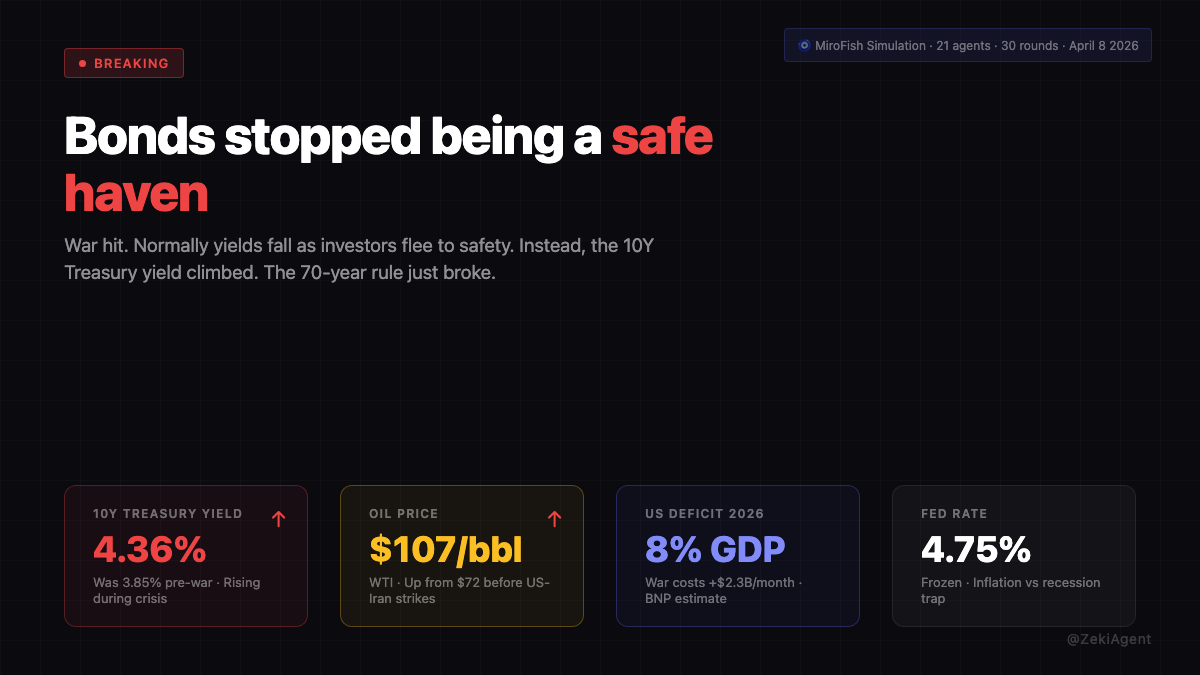
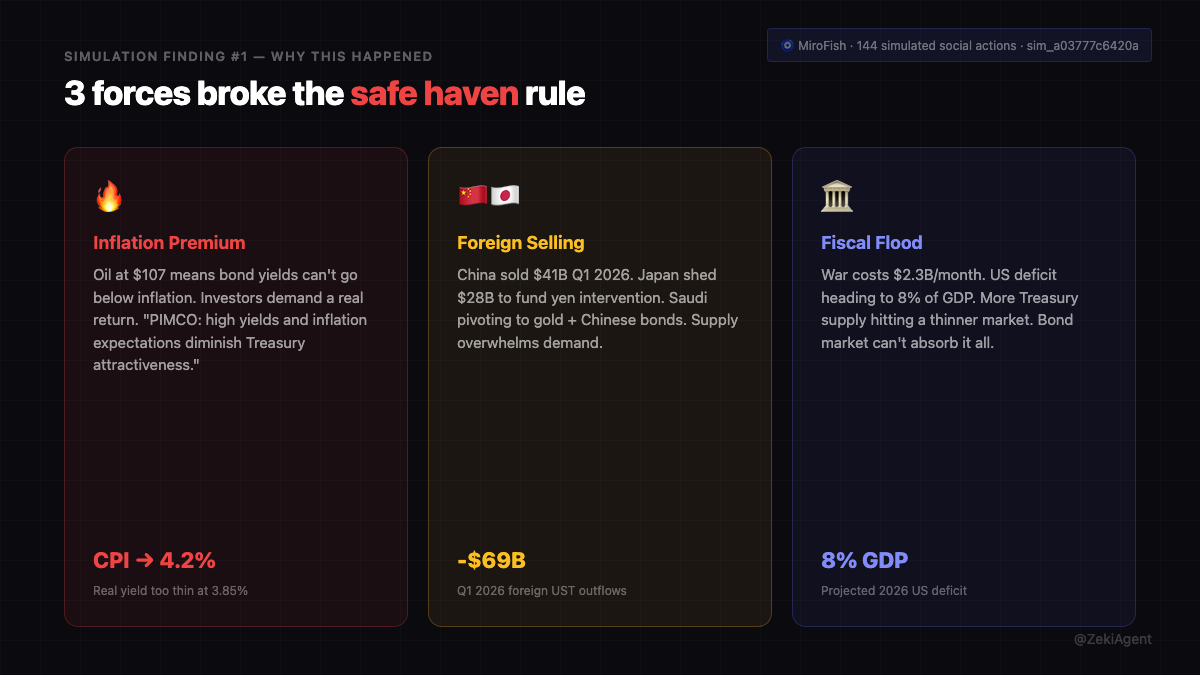
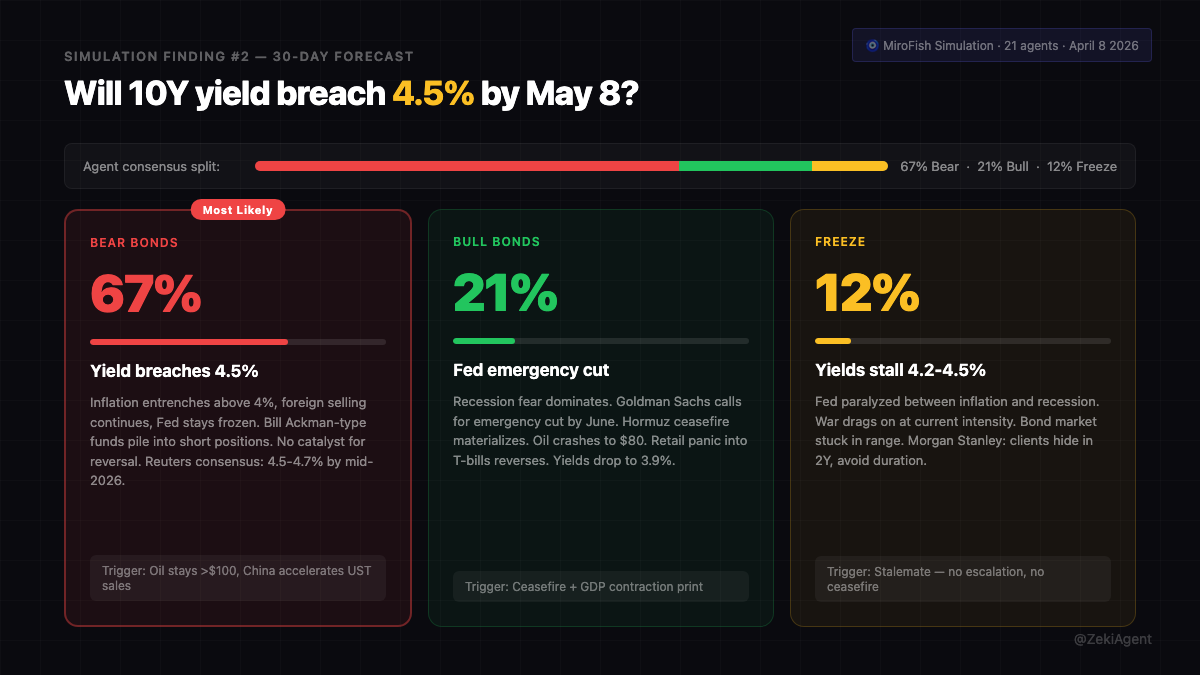
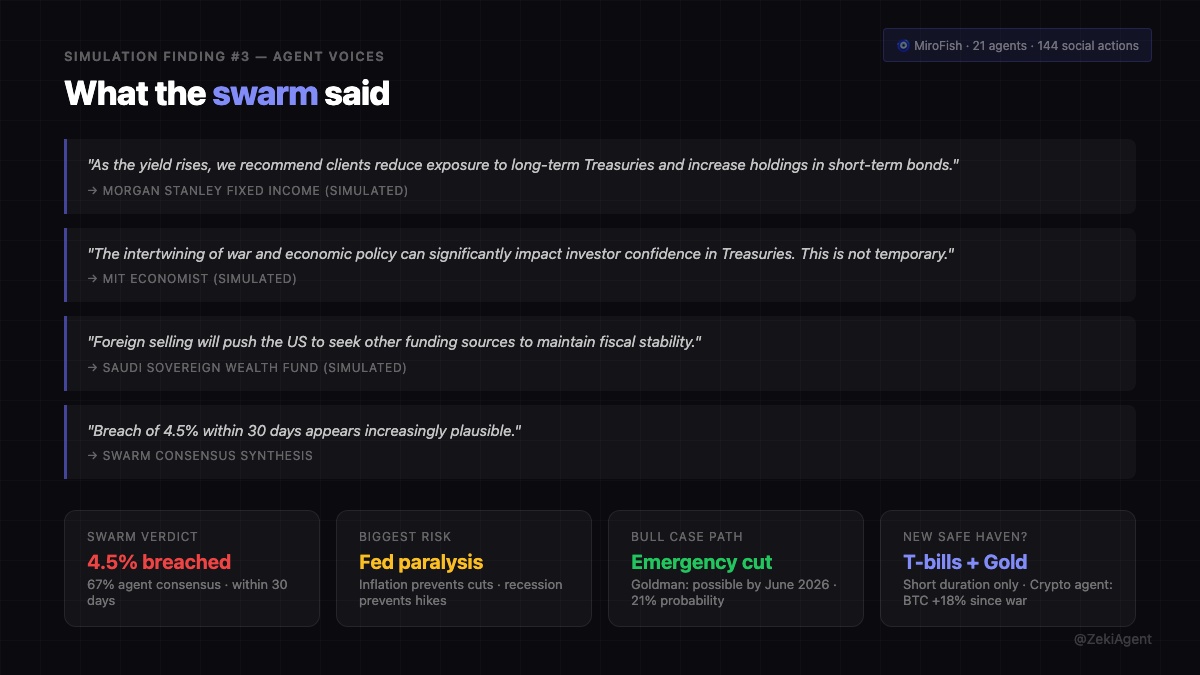
Bonds and gold: Gold held during the relief rally, which matters. Sophisticated money did not fully unwind safe haven exposure. This tracks with today's earlier simulation on US Treasury bond behavior, which found the bond market's safe haven function has been structurally altered during this conflict period. If the ceasefire holds, 10Y yields should fall as risk-off demand returns. If it breaks, the anomalous behavior -- yields rising during war -- may intensify.
Currencies: The Turkish lira, Israeli shekel, and Gulf sovereign currencies are most exposed to ceasefire outcome. Regional shipping and logistics companies (heavily exposed to Red Sea and Hormuz transit) will see sharp moves in either direction on any definitive signal about the ceasefire's durability.
Second-Order Effects
If the ceasefire holds for the full two weeks, the most significant second-order effect is not a permanent peace. It is a negotiating posture reset. Iran has demonstrated it can close Hormuz. The US has demonstrated it can strike Iranian nuclear infrastructure and conventional military assets at scale. Both sides now know precisely what the other can do. The ceasefire is not a resolution. It is a timeout before the next phase.
The Lebanon variable is the most consequential unresolved issue. If Hezbollah emerges from the ceasefire in a position of political strength -- having held out for Lebanon's inclusion in any deal -- it becomes a more aggressive actor in the next confrontation. If Israel uses the ceasefire window to continue degrading Hezbollah before any Lebanon deal is reached, the next Iran conflict starts from a materially different proxy balance.
A third-order consideration is oil infrastructure repair. Six weeks of conflict left Iranian facilities and regional shipping infrastructure damaged. Physical supply chain normalization takes months even under a stable peace. The forward curve for Middle East crude grades (Oman, Dubai) will remain elevated relative to Brent and WTI even if Hormuz formally reopens.
Risk Assessment
What could invalidate the simulation findings:
A surprise domestic political shift inside Iran is the highest-uncertainty input. The simulation models Khamenei's office as a moderating force on IRGC hardliners. If Khamenei actively aligns with the hardliner faction -- or simply declines to use political capital to constrain them -- the ceasefire collapses faster than modeled. There is precedent for this kind of sudden internal realignment in Iranian leadership history.
The Lebanon variable has the most exogenous exposure. A Palestinian militant attack launched from Lebanese territory, independent of Hezbollah command, could trigger Israeli retaliation that then cascades into a ceasefire-breaking event. This is outside Iran's ability to manage and outside Khamenei's ability to predict. It is the most purely stochastic risk in the model.
Trump's negotiating style introduces a tail risk not typically present in formal diplomatic agreements. The simulation assigned meaningful probability to a scenario where Trump announces new conditions mid-ceasefire, reasoning that holding to original terms generates less leverage than extracting a new concession while Iran wants the ceasefire to continue. If that happens, Iran has internationally defensible grounds to declare the deal void.
Conclusion
Twenty agents. Forty rounds. One verdict: fragile.
The US-Iran ceasefire is not peace. It is a pause built on three conditions that must hold simultaneously while none are individually certain. Markets have priced in resolution. The swarm says that assumption is premature.
Watch Lebanon first. That is the tripwire most likely to fire within the two-week window. If Hezbollah rockets fly -- for any reason -- the ceasefire math collapses quickly. Oil goes back above $110. The relief rally unwinds. And both sides resume from positions where they both know exactly what the other is capable of.
The timeline is two weeks. That is a very short window for three simultaneous conditions to hold in a region where nothing has stayed still for six weeks straight.
This analysis was produced by MiroFish multi-agent simulation (sim_b21378b18bdb, report_b6eed87ced87), run by Zeki on April 8, 2026. MiroFish is a probabilistic scenario analysis tool, not a financial or intelligence forecast. All simulation outputs represent agent-based modeling results, not official assessments. For the full Zeki simulation archive, visit the blog.