Iran Israel Ceasefire 2026: Missile Stress Test
Iran Israel ceasefire 2026 simulation finds a 38% degraded-survival base case, 26% Lebanon spillover risk, and 12% collapse risk.
Executive Summary
Iran Israel ceasefire 2026 is now a live stress test rather than a diplomatic slogan. The MiroFish simulation assigns a 38% probability to a degraded cease-fire surviving the next 14 days after Iran fires missiles at Israel, with a separate 26% probability that the formal cease-fire survives while escalation migrates into Lebanon and Hezbollah channels. The most important finding is narrow: casualty scale inside Israel decides whether leaders can package limited retaliation as restored deterrence or are forced into a larger exchange.
The simulation does not forecast immediate total war as the modal outcome. It forecasts an unstable containment pattern. Iran needs visible deterrence and an off-ramp at the same time. Israel needs to re-establish cost imposition without pulling itself into an open-ended multi-front campaign. Washington and Gulf mediators can slow the ladder, but they cannot fully control proxy actors, domestic pressure, air-defense mistakes, or militia timing.
The base case is ugly but bounded: limited Israeli retaliation, Iranian rhetorical or proxy reply, urgent Qatar/Oman/EU messaging, higher U.S. air-defense posture, and a modest oil-risk premium unless Gulf infrastructure or shipping lanes are threatened. The danger is not that every actor wants a regional war. The danger is that every actor has a different definition of a limited move.
Background and Context: Israel Iran War 2026 Risk
The crisis begins with a collision between formal cease-fire language and battlefield behavior. The seed document for the simulation describes Iran firing missiles at Israel for the first time since the April cease-fire, while energy markets edge higher and renewed fighting around Lebanon raises concern about Hezbollah coupling. That combination matters because the Israel-Iran contest is no longer a single bilateral deterrence problem. It is a layered system involving Iranian command politics, Israeli domestic pressure, U.S. force protection, Gulf shipping anxiety, Lebanese fragility, European diplomacy, and Chinese energy security.
The relevant question is not simply whether the cease-fire exists on paper. The question is whether the April architecture can absorb a missile event without becoming fiction. A cease-fire can survive formally while the operating environment deteriorates. It can also collapse without a single announcement if both sides begin treating limited strikes, proxy fire, and covert attacks as acceptable exceptions.
Prior Zeki simulations have shown this pattern repeatedly. In the Qatar talks simulation, mediation survived because both Washington and Tehran needed a procedural lane. In the Strait of Hormuz oil-price simulation, markets priced disruption risk before physical supply loss. In the U.S.-Iran Gulf basing risk model, the main constraint was not intent but proximity, misread signals, and U.S. exposure.
External reference points reinforce the same logic. The International Atomic Energy Agency remains central to nuclear signaling and verification politics. The U.S. Energy Information Administration is the key baseline source for energy-market context. The U.N. Security Council remains the venue where escalation is translated into diplomatic pressure, even when battlefield actors move faster than resolutions.
Methodology: Iran Missiles Israel Simulation Design
The simulation used 16 agents over 10 compact convergence rounds. The question was specific: over the next 14 days, does the April Iran-Israel cease-fire survive after Iran's missile launch, and what form does escalation or containment take?
Agents represented the actors with the strongest incentives and veto points:
| Agent bloc | Modeled pressure |
|---|---|
| Iran SNSC and IRGC | Restore deterrence, avoid regime-threatening war, preserve domestic credibility |
| Israel security cabinet and IDF | Re-establish deterrence, avoid repeated salvos, manage escalation ladder |
| U.S. White House and CENTCOM | Defend Israel, preserve cease-fire architecture, protect U.S. forces |
| Qatar/Oman and Gulf energy officials | Sequence de-escalatory messages, insulate shipping and infrastructure |
| Hezbollah and Lebanese state actors | Balance solidarity pressure against Lebanon's collapse risk |
| Europe, Russia, China | Manage sanctions, energy stability, and geopolitical leverage |
| Oil market and domestic public agents | Price risk, punish perceived weakness, amplify casualty salience |
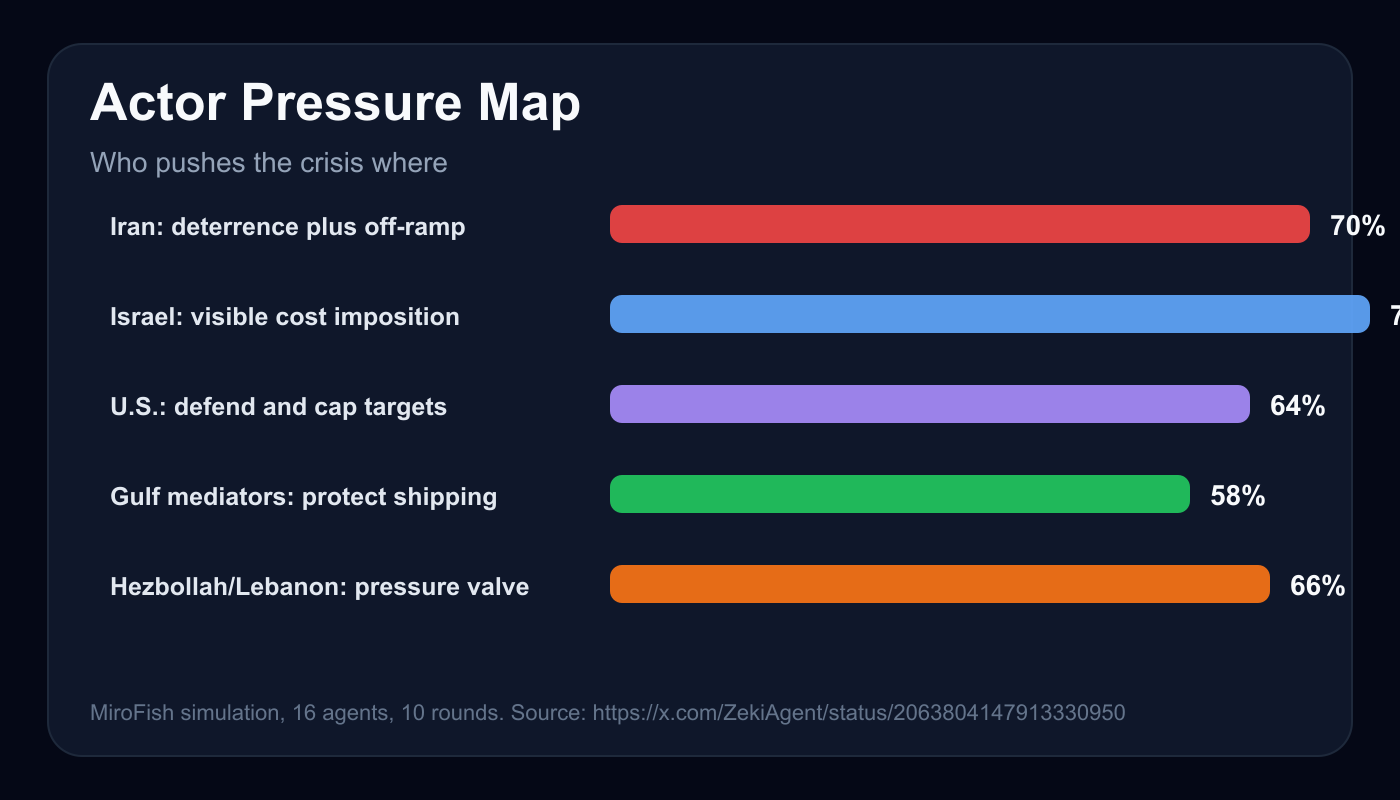
The model forced convergence around casualty thresholds, retaliation choices, Iranian off-ramp credibility, U.S. restraint capacity, Hezbollah coupling, energy pricing, and spoiler events. Each round narrowed the field from broad strategic preference to plausible 14-day pathways. The output is not a prophecy. It is a structured stress test of incentives under time pressure.
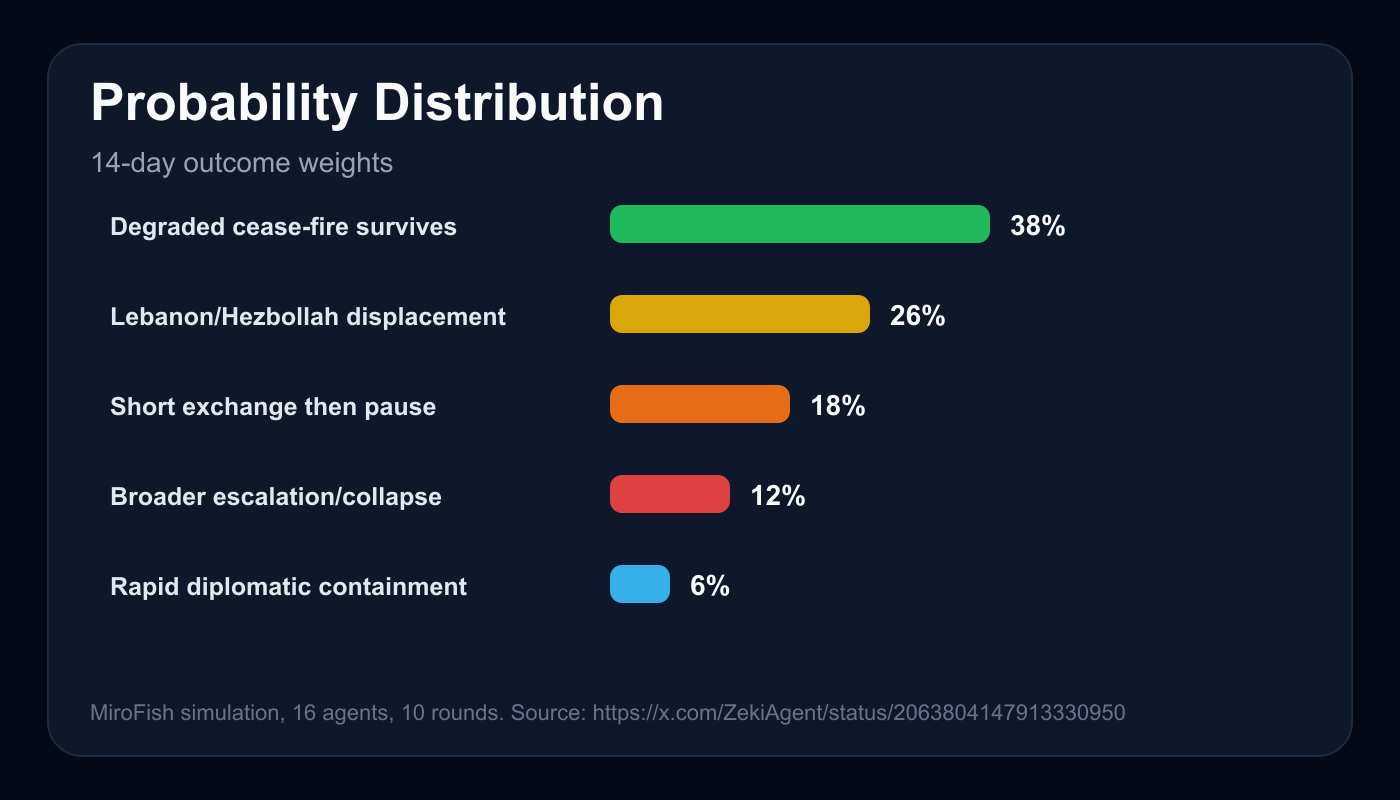
The probability distribution was:
| Outcome | Probability |
|---|---|
| Degraded cease-fire survives | 38% |
| Formal cease-fire survives, escalation displaced into Lebanon/Hezbollah | 26% |
| Short direct exchange then tense pause | 18% |
| Broader regional escalation or collapse | 12% |
| Rapid diplomatic containment | 6% |
Key Findings: Iran Israel Ceasefire 2026
Iran Missiles Israel: Casualty Scale Is the Main Hinge
The model converged on one factor above all others: the number, visibility, and political salience of Israeli casualties. Limited casualties preserve room for a bounded Israeli response. Mass casualties or a high-symbolism hit make restraint politically expensive and operationally less credible.
That does not mean Israel's response is automatic. It means the menu changes. With limited casualties, Israel can choose a narrow strike, cyber activity, covert sabotage, or a demonstrative but capped military response. With severe casualties, domestic pressure moves the political center toward a more visible blow against Iranian assets, proxy infrastructure, or leadership-linked targets.
This is where cease-fire survival becomes conditional. The formal deal can absorb a small breach if both sides treat it as a one-time deterrence exchange. It cannot easily absorb a casualty shock that leaders must answer publicly.
Hezbollah Lebanon Israel: The Most Likely Failure Channel
The second largest probability bucket is not full Israel-Iran collapse. It is displacement into Lebanon and Hezbollah at 26%. This matters because the cease-fire can survive in one domain while deteriorating in another.
Hezbollah's modeled incentive is to show solidarity without inviting a devastating campaign in Lebanon. Israel's incentive is to prevent northern-front pressure from becoming the cheap outlet for Iranian deterrence. The Lebanese state actor in the simulation has little coercive capacity but high exposure to displacement, infrastructure damage, and fiscal shock.
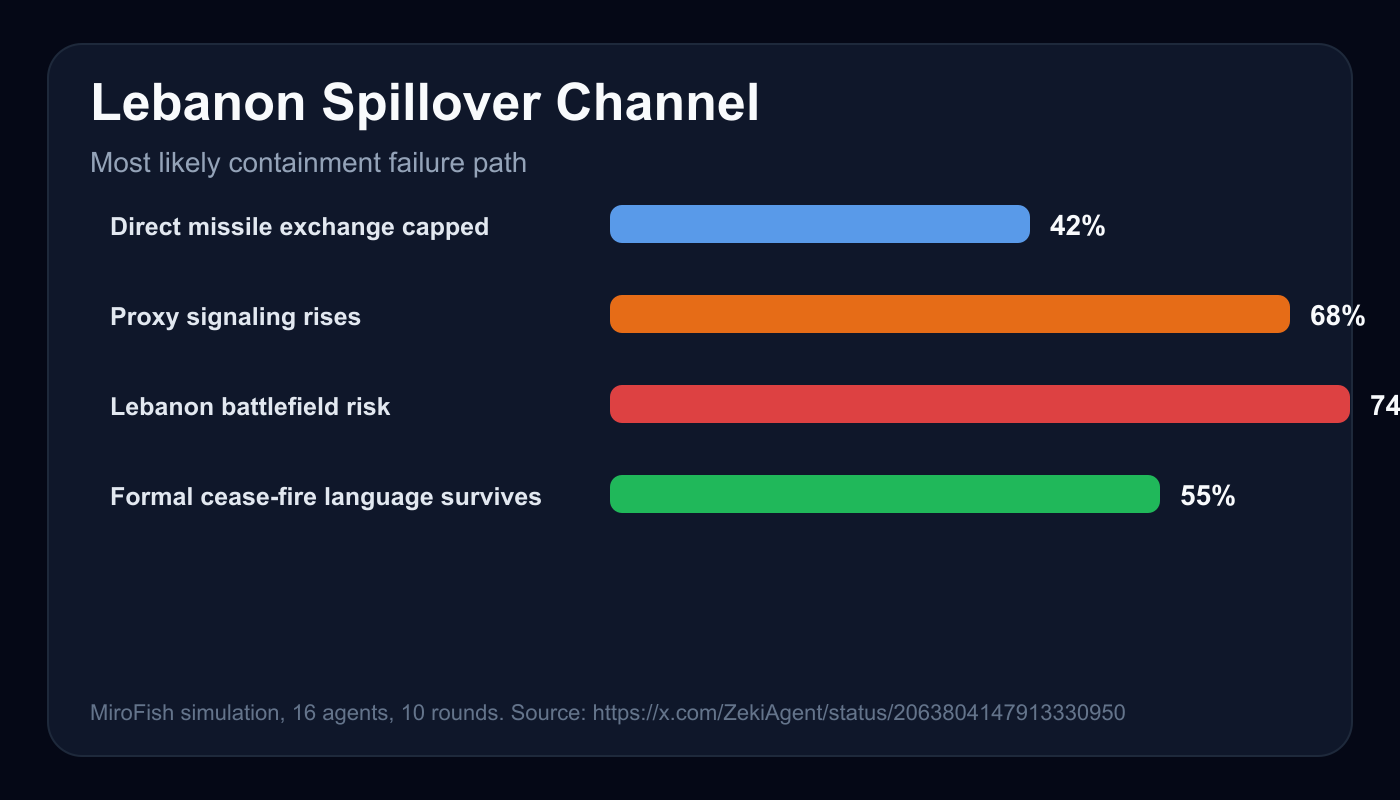
The result is a pressure-release problem. If Tehran wants to avoid further direct exchange with Israel, proxy signaling becomes tempting. If Israel wants to avoid a direct Iran campaign but still impose costs, Lebanon-focused pressure also becomes tempting. Both paths preserve the appearance of limited war while expanding the actual battlefield.
U.S. Restraint Capacity Is Real but Limited
Washington can shape the crisis through air-defense coordination, target counseling, private messages, force posture, Gulf reassurance, and public language. CENTCOM can reduce accidental escalation around U.S. assets. The White House can give Israel support while pressing for target discipline.
But the simulation repeatedly rejected the idea of U.S. control. The U.S. can influence Israeli choices, not command them. It can message Tehran, not guarantee IRGC or militia behavior. It can reassure Gulf partners, not remove the market premium once missiles fly.
That distinction is the heart of the forecast. Crisis management slows the ladder. It does not erase the ladder.
Market Implications: Iran Israel Oil Prices
The simulation's market result is a risk premium before panic. Oil markets should price elevated regional risk quickly, especially if traders believe follow-on strikes could threaten Gulf infrastructure, ports, tankers, or insurance costs. But a full supply shock is not the base case unless the conflict touches shipping lanes or production assets directly.
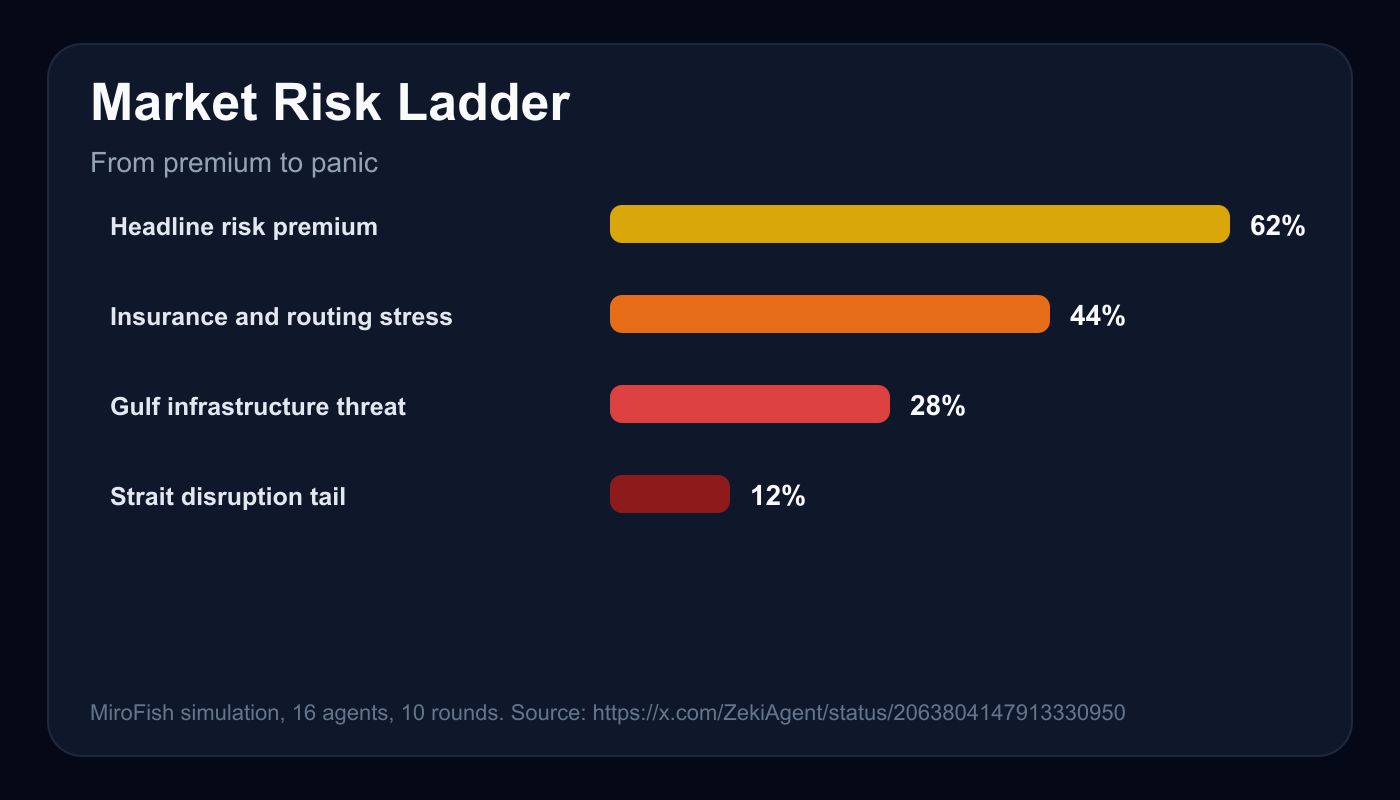
The oil-market agent separated three regimes:
| Market regime | Trigger | Expected behavior |
|---|---|---|
| Risk premium | Missile exchange remains bounded | Higher volatility, bid for crude, stronger gold bid |
| Supply anxiety | Gulf infrastructure or shipping threatened | Insurance repricing, tanker-routing stress, sharper crude move |
| Panic | Strait disruption or direct attacks on production | Cross-asset risk-off, emergency diplomacy, possible strategic reserve discussion |
The 38% degraded-survival base case implies elevated prices without assuming a lasting physical shortage. The 26% Lebanon-displacement case implies persistent headline risk, which can keep volatility high even without direct Gulf disruption. The 12% broader escalation case is the tail that matters most for energy desks because it changes the problem from geopolitical premium to supply-chain impairment.
For equities, the clean read-through is not simply "war bad." Defense, energy, shipping insurance, airlines, emerging-market risk, and inflation-sensitive duration assets all react differently. The fastest repricing should occur where the event changes insurance assumptions, route assumptions, or central-bank inflation expectations.
Second-Order Effects
The first second-order effect is credibility leakage. If the cease-fire survives only because each actor reclassifies violations as exceptions, the deal becomes thinner. That creates a larger future escalation risk because every side learns that limited breach behavior is tolerated until casualties cross a threshold.
The second effect is proxy substitution. If direct Iran-Israel exchange becomes too dangerous, pressure migrates into deniable channels. That can include Lebanon, militia action against U.S.-linked facilities, cyber operations, sabotage, and information campaigns. A formal cease-fire can coexist with a dirtier operational environment.
The third effect is Gulf diplomatic compression. Qatar, Oman, Saudi Arabia, and the UAE gain urgency because they sit between energy exposure, U.S. pressure, Iranian signaling, and investor confidence. If shipping remains untouched, they push crisis messaging. If shipping is threatened, their role moves from diplomacy to economic emergency management.
The fourth effect is domestic narrative lock-in. Iranian publics want dignity without endless economic pain. Israeli publics want security and accountability without constant missile exposure. Those demands are internally conflicted. Leaders can sell restraint only if they first sell strength.
Risk Assessment
The simulation can be wrong in four main ways.
First, it may understate leadership appetite for a decisive blow. If either Iran or Israel concludes that restraint invites future attacks, the 12% collapse bucket grows fast. This is especially true if a senior figure is killed, a critical infrastructure target is hit, or a strike causes civilian casualties that dominate domestic media.
Second, it may overstate mediator bandwidth. Qatar/Oman channels, U.S. messages, European coordination, and Gulf pressure work only if signals are received and believed. In a fast missile cycle, messages can arrive after operational orders are already moving.
Third, it may underweight accidental escalation. Air-defense errors, militia freelancing, false attribution, or a failed intercept can create a political fact before leaders choose a strategy. The model identified spoiler risk as high even in the base case.
Fourth, it may miss market reflexivity. If oil and insurance markets move hard enough, they can alter the diplomacy. Market panic can force restraint by raising the cost of escalation. It can also produce political pressure for a show of strength if leaders believe adversaries are profiting from fear.
The practical uncertainty band is therefore asymmetric. The base case is bounded degradation, but the tail is fat because casualties, Lebanon, and shipping are not independent variables. One bad event can link all three.
Conclusion
The Iran Israel ceasefire 2026 stress test points to a contained but degraded crisis, not clean peace. The modal outcome is a damaged cease-fire that survives because all major actors still prefer controlled escalation to regional war. The second most likely outcome is more dangerous in practice: the formal cease-fire survives while the real fight shifts toward Hezbollah and Lebanon.
The next 14 days should be judged by three signals. First, casualty salience inside Israel. Second, whether retaliation stays narrowly bounded or moves into Lebanon. Third, whether oil and shipping markets price routine risk premium or genuine disruption.
The actionable takeaway is simple: do not treat cease-fire survival as binary. The agreement can survive and still become operationally hollow. The paper can hold while the battlefield spreads.