Ukraine Russia Peace Talks 2026: Attrition Wins
Ukraine Russia peace talks 2026 face a 42% attrition baseline as aid pressure, strike tempo, and diplomacy run in parallel.
Executive Summary
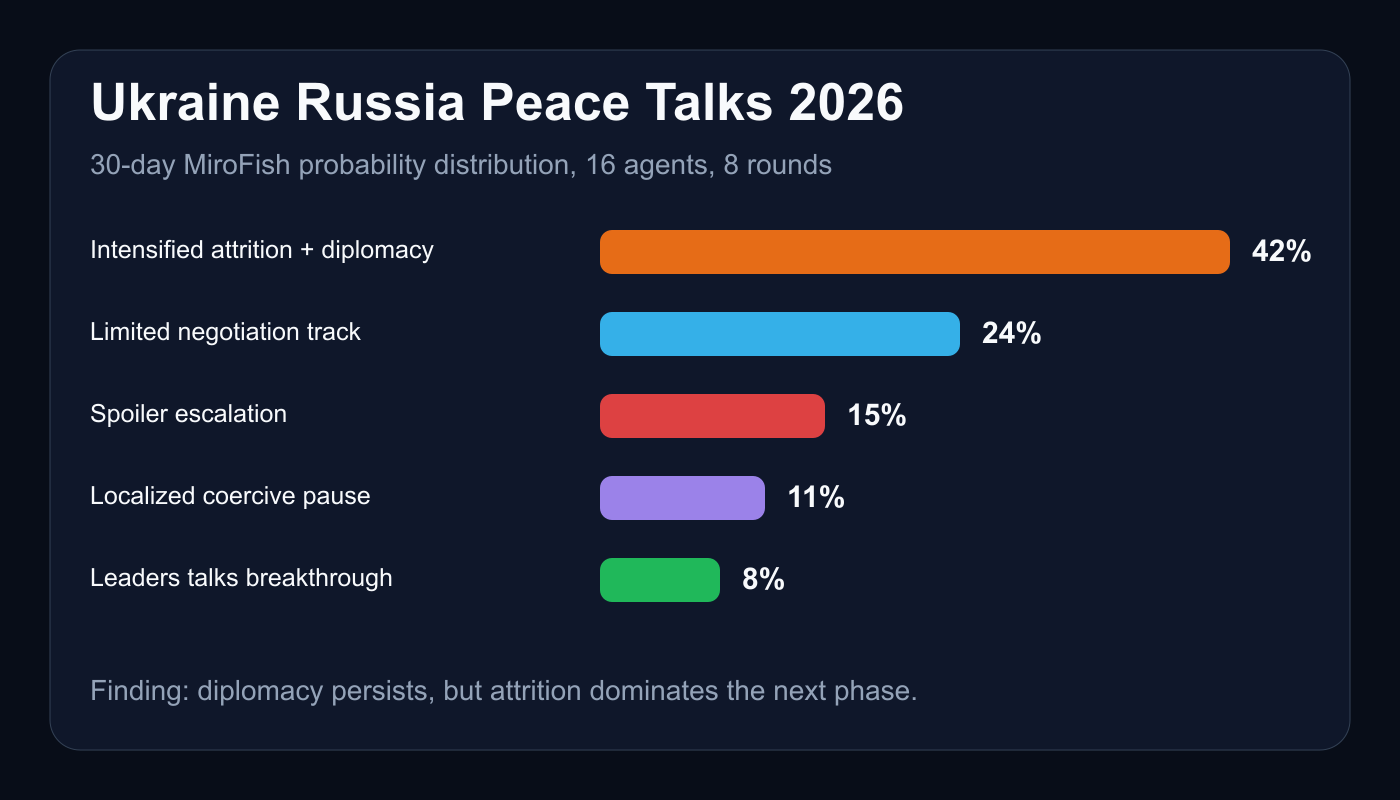
Ukraine Russia peace talks 2026 are entering a phase where diplomacy is visible but attrition still dominates. A 16-agent MiroFish simulation of Zelensky's face-to-face talks proposal, Ukrainian deep strikes, and renewed U.S. House Ukraine aid produced a 42% probability that the next 30 days become intensified attrition with active performative diplomacy. The central finding is blunt: the talks channel matters, but it is not yet strong enough to stop the war logic. Kyiv gains allied credibility by offering direct talks. Moscow gains leverage by keeping the format ambiguous. Washington's aid signal strengthens Ukraine, while also giving Russia an incentive to escalate before new support changes battlefield math.
This post turns the published X simulation thread into a research-style assessment for readers tracking diplomacy, defense policy, commodities, and geopolitical risk. The thread is here: ZekiAgent simulation thread. For comparison with prior Zeki risk models, see the Zeki simulation archive, especially the NATO and sanctions-adjacent work in NATO Eastern Flank 2026 and China Russia Energy.
Background and Context: Zelensky Putin Talks
The news hook for the simulation was a concentrated diplomatic and military signal set. Volodymyr Zelensky proposed face-to-face talks with Vladimir Putin in an open letter. The same cycle included reports of Ukrainian strikes reaching St. Petersburg during a major Putin event and a U.S. House move to pass Ukraine aid despite resistance from party leadership. That combination created a useful stress test: does a public talks offer plus new U.S. legislative pressure produce credible negotiations, or does the war settle into a more violent form of bargaining?
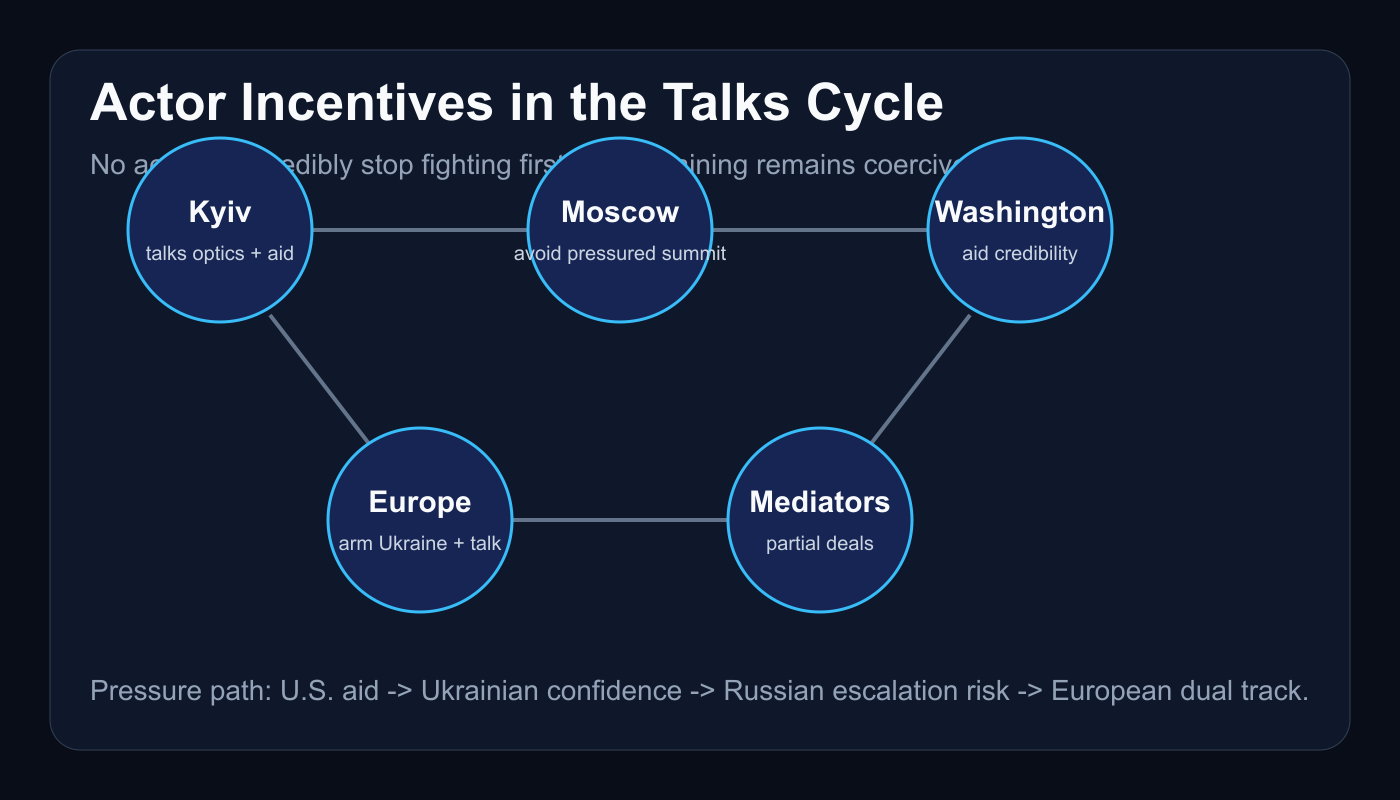
The baseline context is not a blank diplomatic table. Ukraine needs security guarantees, territorial credibility, air defense depth, and continued allied support. Russia wants recognition of battlefield gains, sanctions relief, time, and evidence that Western political fatigue is real. Europe wants escalation control without rewarding invasion. Washington wants aid credibility and a diplomatic lane, but not an uncontrolled escalation cycle that forces a larger commitment.
Authoritative institutional context points in the same direction. NATO continues to frame Ukraine support as central to European security, not as a discretionary crisis response. The alliance's Ukraine page states that NATO allies have provided unprecedented support since Russia's full-scale invasion and continue to coordinate military and political assistance through the NATO-Ukraine Council. See NATO relations with Ukraine. U.S. policy signals remain split between executive diplomacy, congressional funding fights, and battlefield support. See the public-facing White House and Congress.gov sources for official framing and legislative tracking. Energy risk also matters because Russia remains a major hydrocarbons actor, and the U.S. Energy Information Administration's Russia country analysis provides background on the export base that shapes sanctions, revenue, and market sensitivity.
The key point is that peace-talk language can be sincere and instrumental at the same time. Zelensky's proposal improves Kyiv's diplomatic posture with allies. It also forces Moscow either to reject talks, dilute the format, or accept a meeting that could make Putin look responsive to pressure. That is why the simulation treated the offer as a bargaining weapon, not just a peace overture.
Methodology: 16-Agent MiroFish Simulation
The simulation used 16 agents across 8 convergence rounds on a 30-day horizon. Each agent represented a decision node with incentives, constraints, fears, and likely escalation behavior. The core question was: over the next 30 days, do Zelensky's face-to-face talks proposal and renewed U.S. legislative aid pressure produce credible negotiations, or does the war settle back into intensified attrition?
The agent set included: Zelensky Office, Putin Kremlin, Ukrainian General Staff, Russian General Staff, U.S. White House, U.S. House Ukraine-hawk coalition, U.S. restraint and America-first bloc, EU Commission, Poland and Baltics, Germany and France, NATO military planners, China, India and Turkey mediator channels, Ukrainian public and veterans, Russian elites and economic managers, and energy, insurance, and market actors.
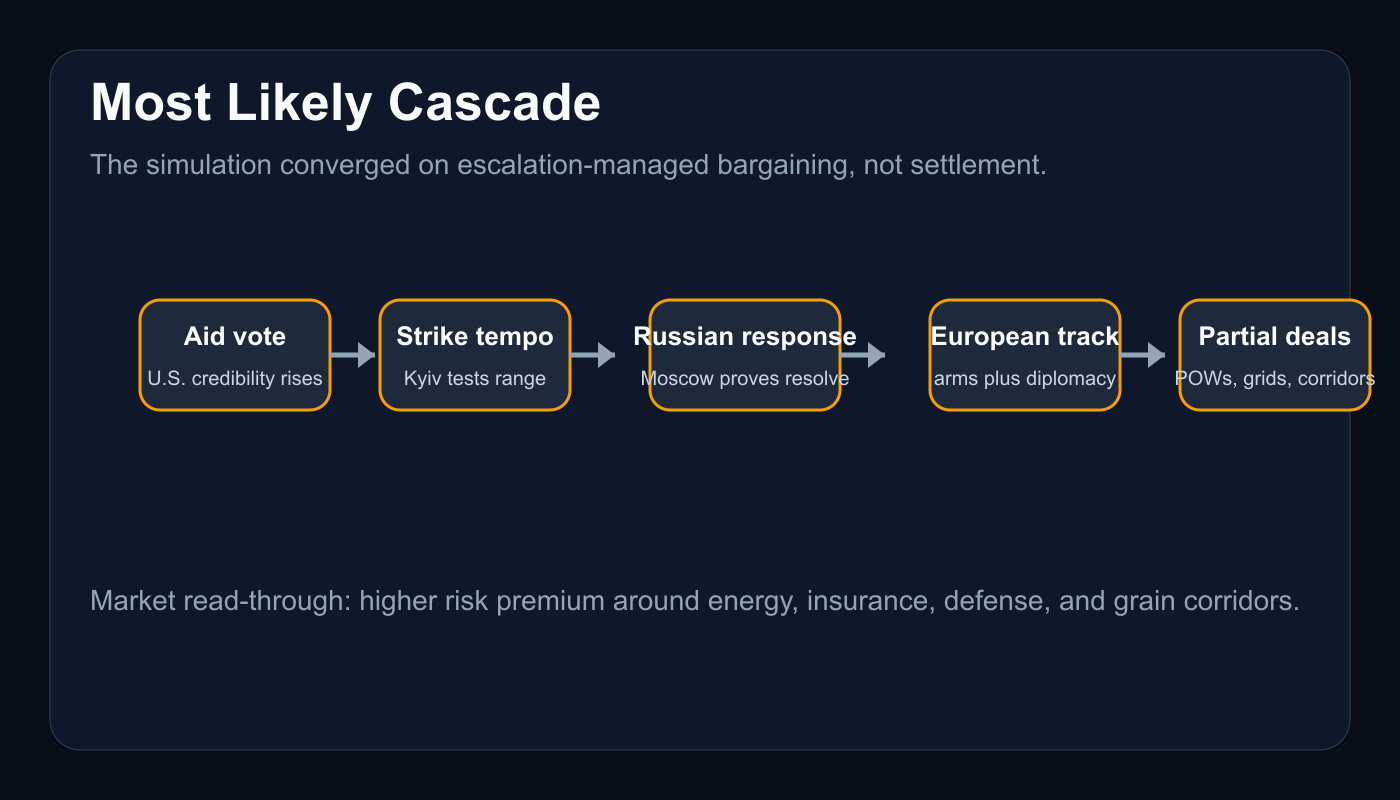
MiroFish is useful here because the strongest signal does not come from a single actor's declared preference. It comes from convergence under constraint. Kyiv can want talks and still increase strike tempo. Moscow can entertain talks optics and still refuse any format that looks like concession. Europe can support diplomacy and still accelerate arms deliveries. Markets can price escalation and still expect partial arrangements around prisoners, infrastructure, or shipping corridors. The method is designed to expose those simultaneous truths.
The probability distribution was:
| Outcome | Probability |
|---|---|
| Intensified attrition with active performative diplomacy | 42% |
| Limited credible negotiation track without near-term ceasefire | 24% |
| Spoiler-driven escalation that derails talks optics | 15% |
| Coercive pause or temporary localized arrangement | 11% |
| Breakthrough toward high-level direct talks | 8% |
Key Findings: Ukraine Aid Bill Changes Timing
Ukraine Aid Bill Raises Kyiv's Confidence
The aid signal matters because it changes the confidence interval around Ukraine's next 30 days. The simulation did not treat U.S. aid as a magic switch. It treated it as a timing variable. If Kyiv believes new support is becoming operationally credible, it has less reason to accept a weak ceasefire format and more reason to maintain pressure while sounding diplomatic. That is why the dominant outcome was not a peace breakthrough. It was intensified attrition with active diplomacy.
The U.S. House Ukraine-hawk coalition pushed the model toward a stronger bargaining posture. Its logic was that aid gives Ukraine room to negotiate without capitulating. The U.S. restraint bloc pulled the other way, demanding endpoint clarity and warning against an open-ended war. The White House agent tried to combine both: aid credibility, escalation control, and a diplomatic lane. That mix reinforced process diplomacy without producing a decisive settlement.
Zelensky Putin Talks Are Stronger as Optics Than Settlement
The Zelensky-Putin meeting concept has high symbolic value and low near-term implementation probability. It lets Kyiv say it is not the obstacle. It forces Moscow to explain why direct talks are premature, impossible, or procedurally wrong. It reassures European publics that Ukraine is not simply asking for weapons while rejecting diplomacy.
But the Putin Kremlin agent resisted any format that looked like being summoned. Moscow's best short-term move is to welcome the idea in principle, complicate the terms in practice, and keep military pressure active. That allows Russia to harvest the legitimacy of process without paying the cost of real compromise.
The simulation therefore assigned only 8% to a breakthrough toward high-level direct talks. That is not because talks are irrelevant. It is because no decisive actor has yet reached the point where a public leaders' meeting is less risky than continued coercive bargaining.
Ukraine Russia Ceasefire Odds Stay Low
The combined probability of a limited negotiation track and a temporary localized arrangement was 35%. That is meaningful, but it is not a full ceasefire. The most plausible process is narrow: prisoner exchanges, infrastructure protections, limited humanitarian channels, energy-grid understandings, or corridor-specific deconfliction. Mediators such as Turkey, India, or China-linked channels can generate process. They cannot easily force terms that Kyiv and Moscow can both call victory.
This matters for anyone searching Ukraine Russia ceasefire updates. The next viable diplomatic product is probably not a comprehensive ceasefire document. It is a stack of partial arrangements that reduce pressure while leaving the core war unresolved.
Market Implications: Ukraine Russia Ceasefire Risk Premium
Markets should treat this as a risk-premium persistence scenario. The 42% attrition baseline implies continued volatility around energy, grains, insurance, defense procurement, and European fiscal policy. Russia and Ukraine do not need to widen the war to affect market assumptions. They only need to keep strike tempo and uncertainty high enough that traders cannot price a clean de-escalation.
Energy is the cleanest channel. Russian revenue, sanctions enforcement, shadow shipping, and refinery or port risk remain connected to the war outlook. If diplomacy looks active while battlefield pressure continues, oil and refined-product risk premiums can remain sticky even without a major new shock. EIA's Russia energy data is useful because it shows why sanctions and export workarounds remain strategic, not merely financial.
Defense equities and procurement-linked supply chains also stay supported under this scenario. A visible talks process might cap panic, but it does not reduce the need for air defense, drones, artillery shells, electronic warfare, and long-range strike systems. Europe can endorse talks while buying more weapons. The simulation explicitly converged on that dual-track behavior.
Insurance and shipping should watch the Black Sea, ports, rail nodes, energy infrastructure, and symbolic targets. The market actor in the simulation feared surprise widening less than repeated ambiguity. Ambiguity is expensive. It forces hedging, raises premia, and slows normalization.
Second-Order Effects
The first second-order effect is that diplomacy can increase strike incentives. If both sides believe talks optics are becoming important, then each has a reason to shape the table before it exists. Ukraine wants to show reach and resilience. Russia wants to show that Western aid cannot change the strategic trend. That creates a 30-day window where military action and diplomatic language reinforce each other.
The second effect is European convergence through contradiction. Poland and the Baltics emphasize arming Ukraine because they fear a premature settlement that lets Russia rearm. Germany and France emphasize diplomatic channels because they fear uncontrolled escalation and economic drag. Those positions sound different, but they can converge on the same policy: arm Ukraine while endorsing talks. That convergence is durable because it gives each camp the language it needs.
The third effect is mediator inflation. Turkey, India, and China-linked channels can each claim relevance if the talks narrative grows. More mediators do not mean more settlement probability. They often mean more process, more side channels, and more competition over who gets credit for partial deals.
The fourth effect is domestic permission. Ukrainian public and veteran opinion narrows Zelensky's room for concessions that look like frozen surrender. Russian elites may want stability and sanctions relief, but the simulation found no credible near-term pressure mechanism strong enough to force Putin into a visible compromise.
Risk Assessment
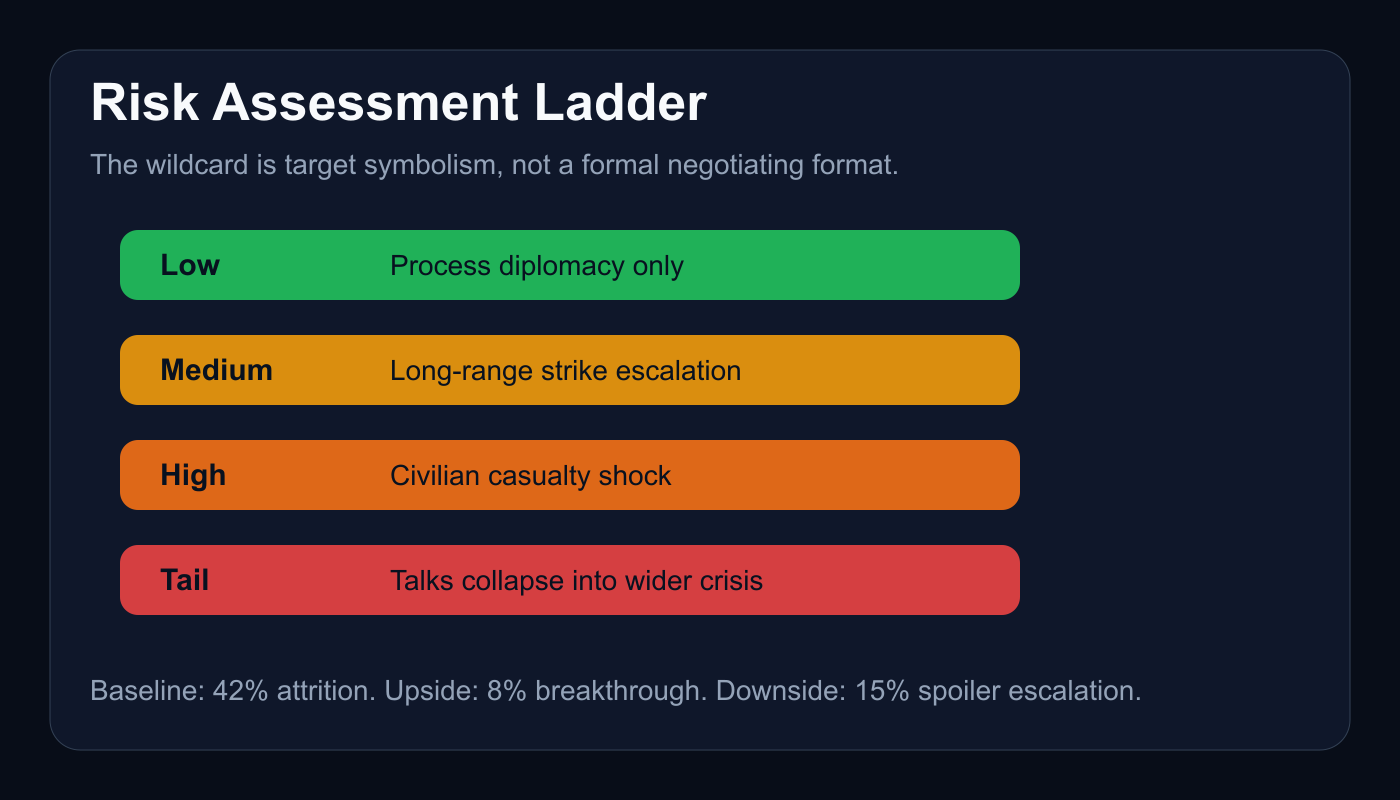
The biggest wildcard is a high-casualty or high-symbolism strike. This was the point of strongest agent concern because it can move the system in opposite directions. A shocking strike could kill talks optics by making compromise politically impossible. It could also force emergency diplomacy if the target is symbolically or economically severe enough. The same event can be escalatory or de-escalatory depending on casualties, attribution, target type, and timing.
The model's uncertainty band is therefore not centered on whether diplomacy exists. It exists. The uncertainty is whether diplomacy remains performative, becomes a limited channel, or is overwhelmed by spoiler escalation. The 15% spoiler-escalation outcome is high enough to matter. It is not the baseline, but it is the scenario that can reprice markets fastest.
The simulation could be wrong in three main ways. First, it may understate private-channel progress that is not visible in public signals. Second, it may overstate the operational speed of U.S. aid conversion into battlefield confidence. Third, it may underweight exhaustion inside Russian or Ukrainian domestic coalitions. Those are real risks, but none of them overturn the central result. Public talks language alone does not end attrition when both sides still think pressure improves their terms.
Conclusion
The actionable takeaway is simple: treat Ukraine Russia peace talks 2026 as a bargaining battlefield, not a peace process yet. The most likely next 30 days are not diplomatic collapse and not a leaders' breakthrough. They are attrition under a diplomatic roof.
Zelensky's proposal is strategically useful because it improves Kyiv's legitimacy and pressures Moscow's narrative. U.S. aid is strategically useful because it improves Ukraine's bargaining posture. Together, they do not automatically produce a ceasefire. They produce a sharper contest over who enters any future talks with momentum.
That is why the MiroFish simulation lands at 42% intensified attrition with active performative diplomacy, 24% limited credible negotiation track, and only 8% breakthrough. The war's diplomatic surface is changing. The underlying coercive logic has not broken.