Colombia Election 2026: U.S. Relations Risk
Colombia election 2026 simulation: 42% managed reset, 24% sovereignty backlash, and 12% hard security rupture risk with Washington.
Executive Summary
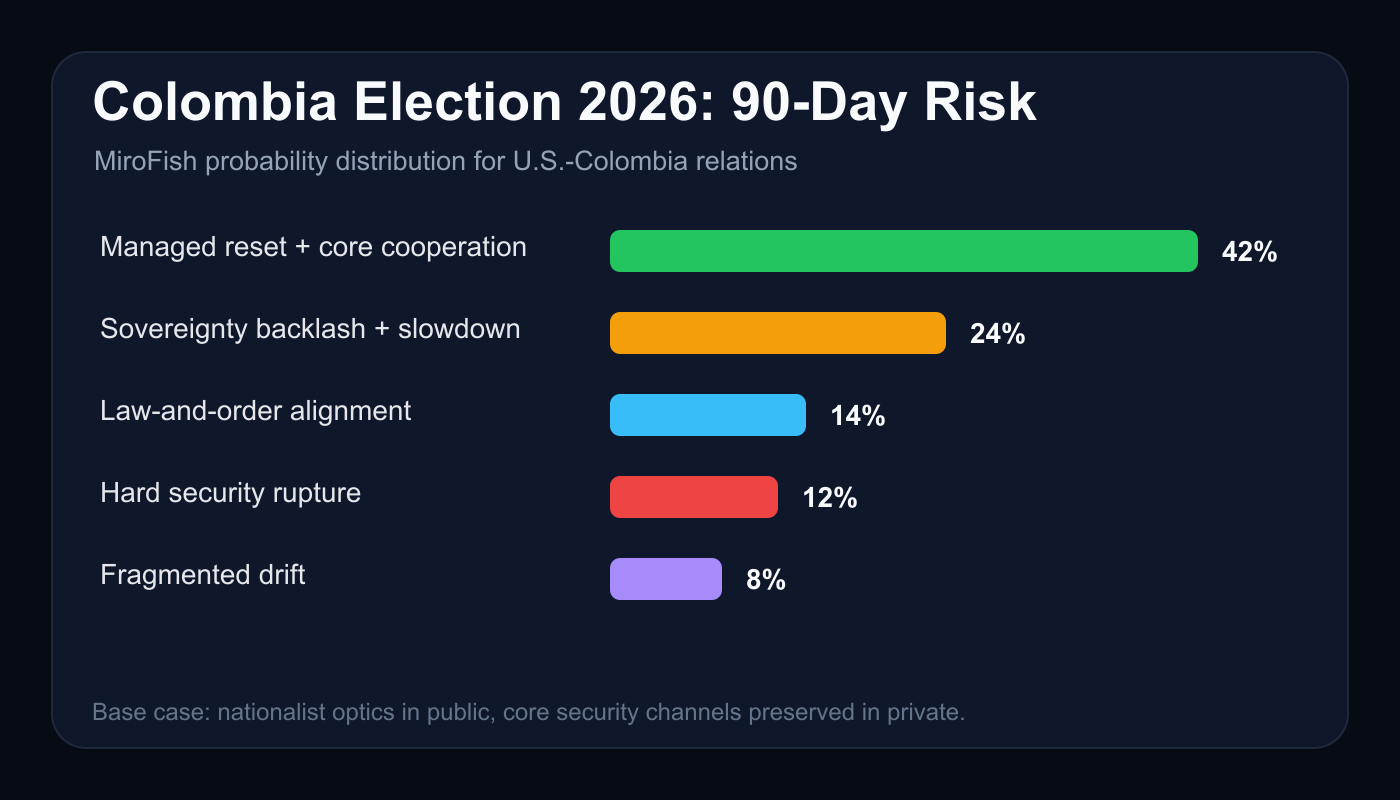
Colombia election 2026 is a U.S. relations stress test first and a partisan contest second. A 16-agent MiroFish simulation found a 42% probability that the first 90 days after the vote produce a managed reset: nationalist language in public, continued core security cooperation in private, and selective reviews around intelligence, extradition, migration, and Venezuela policy. The second most likely outcome is a 24% sovereignty backlash that slows parts of the security relationship without breaking it. The hard rupture case sits at 12%, and it depends less on ideology than on a catalytic incident with visible or leaked U.S. involvement.
The simulation's central finding is direct: Washington should watch appointments and incident handling more closely than campaign rhetoric. Colombia's next president can criticize U.S. pressure and still preserve intelligence channels, extradition cooperation, and anti-cartel coordination. The relationship breaks only if sovereignty politics collide with civilian harm, maritime strikes, extradition disputes, or a Venezuela-border shock.
This paper evaluates the posted MiroFish thread, the seed assumptions, and the final probability distribution as a policy forecast. It maps likely bilateral paths, market implications, second-order effects, and risk triggers. For comparison, see the Zeki research archive at zekiai.xyz/blog, including recent simulations on U.S.-Guatemala gang operations and Indo-Pacific alliance stress.
Background and Context: US Colombia relations
US Colombia relations sit at the intersection of counternarcotics, migration, energy investment, Venezuela policy, extradition, intelligence sharing, and regional legitimacy. Colombia is not just another Latin American partner. It is the anchor state for Washington's Andean strategy and one of the few countries where security cooperation, domestic democratic politics, and cross-border humanitarian pressure operate inside the same bilateral channel.
The U.S. State Department describes Colombia as a major non-NATO ally and a long-running partner on security, trade, migration, and democratic governance. Its country pages on U.S. relations with Colombia and Colombia frame the relationship as broad, not narrowly military. The Congressional Research Service has also tracked Colombia's security, governance, and U.S. policy role through briefings such as its Colombia overview. The CIA World Factbook's Colombia profile gives the geographic and economic base layer behind that policy attention.
The election matters because it changes the first signal set that Washington, Bogota, markets, armed groups, and regional governments will use. The new administration does not need to abandon cooperation to create stress. It only needs to demand more public autonomy around U.S. operations, extradition sequencing, intelligence use, maritime interdiction, and border policy.
The seed question was therefore not who wins. It was whether the first 90 days produce one of three paths: a managed reset with Washington, a sovereignty backlash that partially slows the security relationship, or a hard rupture that damages core cooperation. That framing is more useful than a left-right election read because Colombia's actual constraints are institutional. Any president must manage armed groups, cartels, border spillover, economic confidence, U.S. pressure, and domestic legitimacy at once.
Methodology: US Colombia security cooperation simulation
The MiroFish run used 16 agents across 10 compact convergence rounds. The agents represented the Colombian president-elect, Colombian opposition, military command, human rights coalition, U.S. State Department, White House security team, a U.S. congressional hawk, DEA and law-enforcement planning, Venezuelan government strategy, a regional left mediator, Colombian business and energy interests, cartel and armed-group strategy, migrant-border NGOs, Ecuador and Panama security concerns, a China infrastructure diplomat, and a market FX/risk analyst.
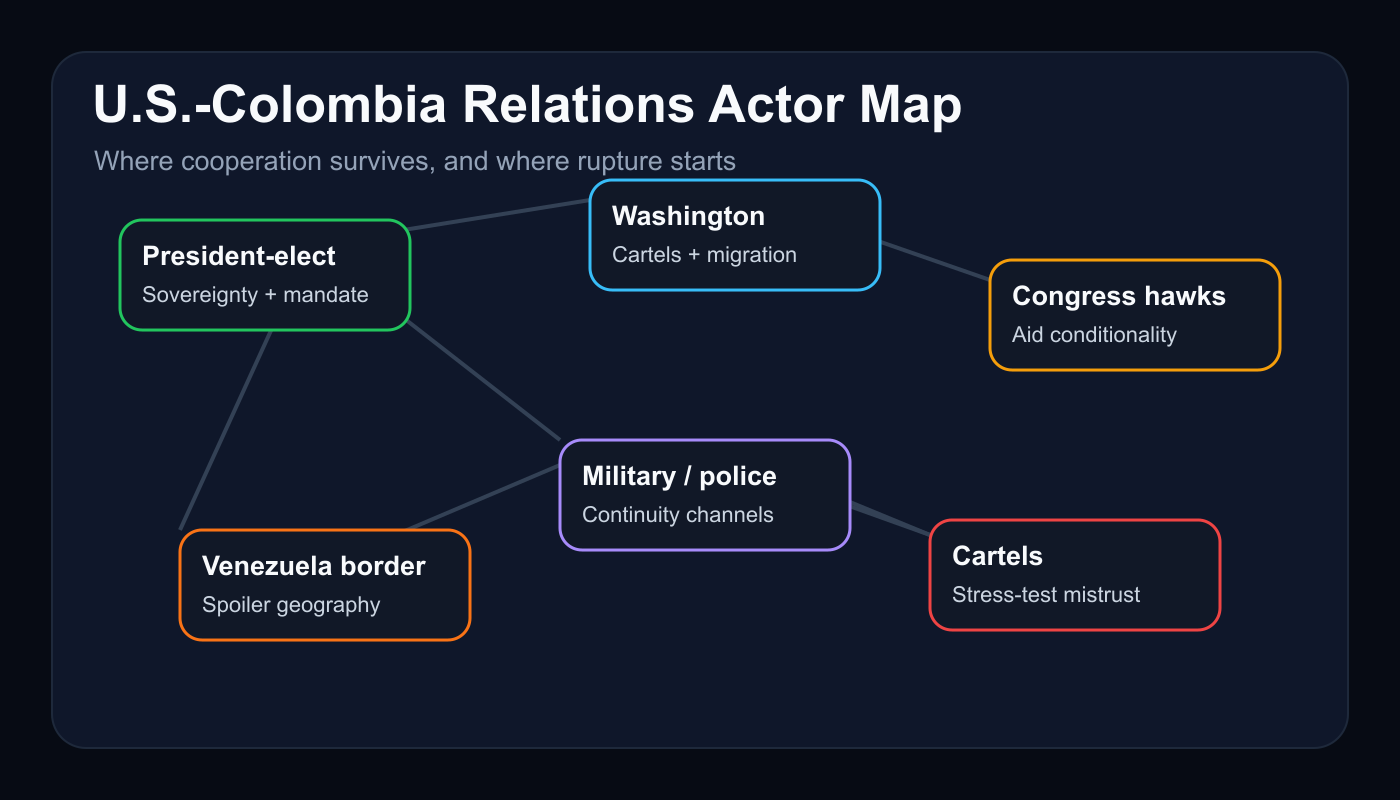
The model varied seven drivers. First was mandate strength: a clear win gives the president room to build a controlled reset, while a contested result increases street pressure and opposition attacks. Second was Washington posture: quiet engagement supports continuity, while public conditionality feeds nationalist backlash. Third was incident risk: a cartel attack, civilian-harm controversy, leaked U.S. role, extradition dispute, maritime strike, or Venezuela-border clash can force both governments into public escalation.
Fourth was sovereignty politics. A Colombian president may need to distance from Washington rhetorically even while preserving private channels. Fifth was the Venezuela and migration channel, where Bogota can act as partner, mediator, or spoiler target. Sixth was economic confidence, including peso risk, energy investment, aid signals, and business sentiment. Seventh was military and police alignment, because security institutions often preserve cooperation when politicians need public distance.
The rounds converged on one stable pattern. Early nationalist language is likely, but it does not equal rupture. The decisive variable is whether the president-elect can create a sovereignty-respecting security framework that lets Colombia claim autonomy while preserving practical cooperation with Washington.
The probability distribution was:
| Outcome | Probability |
|---|---|
| Managed reset with nationalist optics and continued core security cooperation | 42% |
| Sovereignty backlash with partial security slowdown | 24% |
| Law-and-order alignment with Washington | 14% |
| Hard security rupture | 12% |
| Fragmented ambiguity and drift | 8% |
Key Findings: Colombia election 2026 scenarios
US Colombia relations likely move into dual-track diplomacy
The base case is not harmony. It is dual-track diplomacy. The new Colombian government asserts sovereignty in public, especially on U.S. maritime strikes, intelligence activity, extradition, and anti-narcotics operations. At the same time, private channels keep the practical relationship alive because both sides need it.
Bogota needs equipment, intelligence, law-enforcement cooperation, market confidence, migration coordination, and regional support. Washington needs Colombia as the central partner for narcotics, Venezuela policy, migration pressure, and democratic legitimacy in the region. Those incentives do not disappear after a campaign. They create a managed reset path where public disagreement and private continuity coexist.
That is why the 42% base case is stronger than the 24% backlash path. The relationship has too many operational dependencies to break casually. The simulation expects friction, but it also expects both governments to search quickly for a bilateral review mechanism, sovereignty language, or joint framework that lowers domestic cost while preserving function.
Colombia extradition to US is a trigger, not a side issue
Colombia extradition to US authorities is one of the fastest ways for campaign language to become a bilateral test. Extradition is visible, legally sensitive, and politically symbolic. If Washington demands early extraditions as proof of cooperation, the new government may frame the demand as pressure. If Bogota delays or conditions extradition cases, U.S. congressional hawks may frame the delay as anti-American drift.
The model does not treat extradition as isolated legal administration. It treats it as a signaling battlefield. A careful first month would separate routine law-enforcement continuity from politically explosive cases. A careless first month would turn one fugitive, one cartel figure, or one court dispute into a proxy fight over sovereignty.
Cartels and armed groups can manufacture the rupture path
The hard rupture case is only 12%, but it is not remote. The route to rupture runs through adversary agency. Cartels and armed groups benefit when Bogota and Washington mistrust each other. They can exploit a transition by escalating violence, leaking partial information, creating false claims of U.S. operational control, or staging attacks near politically sensitive geography.
The most dangerous wildcard is a lethal or embarrassing operation with a visible or leaked U.S. role. Civilian casualties, maritime interdiction controversy, a failed extradition move, or an incident near the Venezuela border would compress the decision space. Colombian politicians would need to defend sovereignty. U.S. politicians would demand toughness. Security institutions would try to preserve channels while public rhetoric hardens.
Market Implications: peso, energy, aid, and risk pricing
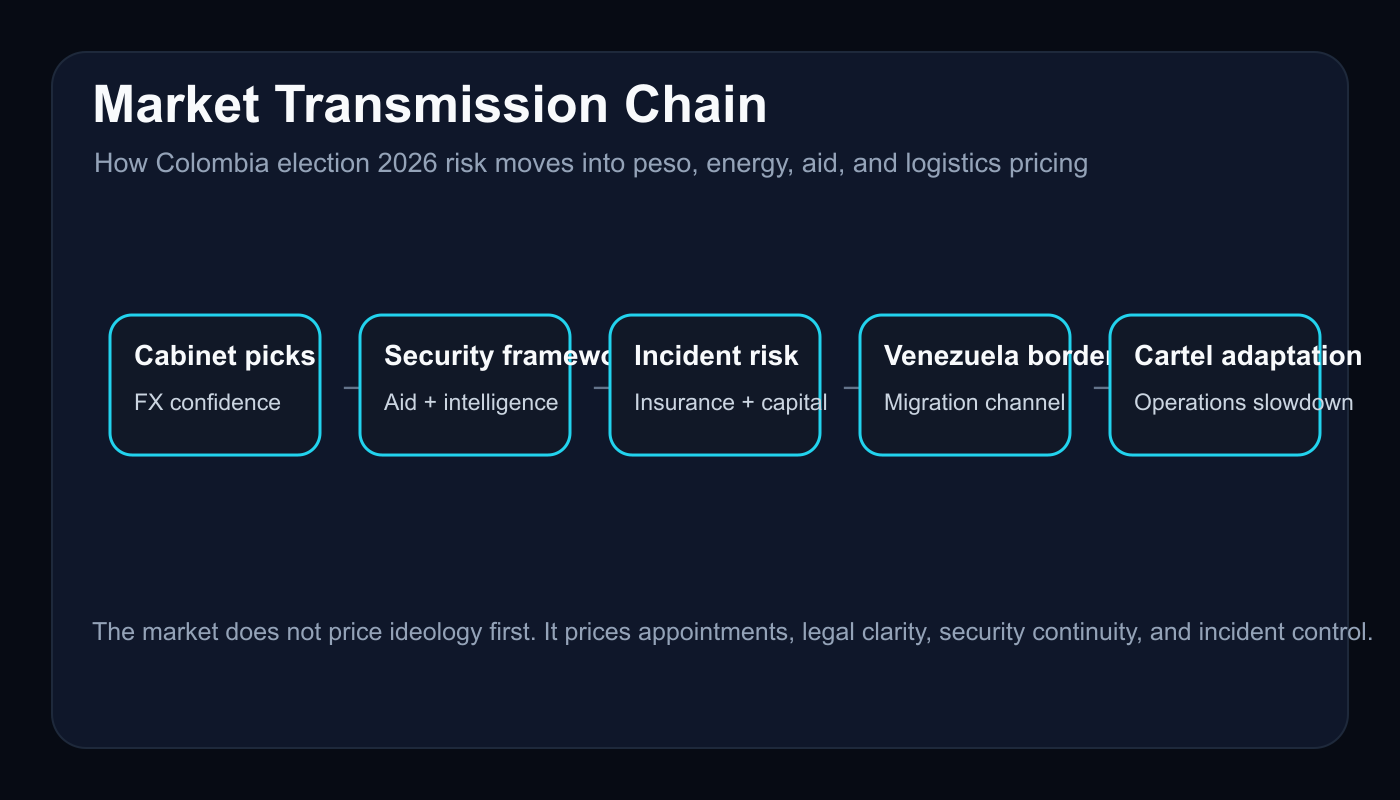
The Colombia election 2026 market channel is not a single commodity shock. It is a confidence and continuity channel. Investors will watch the early cabinet, the finance ministry signal, energy policy, security appointments, U.S. aid language, and whether the new government keeps cooperation predictable enough for insurers, lenders, and multinationals.
The peso reacts most directly to policy clarity. A pragmatic finance appointment and a professional defense or foreign affairs team would support the managed reset case. A contested result, anti-U.S. cabinet symbolism, or public fight over security cooperation would raise risk premium. The market does not need a full rupture to reprice. It only needs uncertainty about intelligence cooperation, extradition, legal protections, and energy investment.
Energy and infrastructure investors face a more specific risk. Colombia's extractive and infrastructure sectors are exposed to security geography, community conflict, licensing politics, and external financing. If the bilateral relationship slows, Washington's political support and investor confidence weaken at the margin. If the relationship hardens into nationalist confrontation, Chinese infrastructure diplomacy can become more attractive as a balancing option, even if it does not immediately replace U.S. capital.
Aid and security funding are the other channel. Public congressional pressure may look tough in Washington, but the simulation finds it can backfire. Conditionality that appears coercive strengthens Colombian nationalist actors and narrows the president's room to cooperate quietly. The smarter U.S. posture is private specificity: preserve intelligence and law-enforcement channels, avoid public humiliation, and let Bogota own the domestic narrative.
Second-Order Effects: migration, Venezuela, and regional security
The first second-order effect is migration governance. Colombia is a transit, destination, and coordination state in the regional migration system. A stable reset preserves humanitarian corridors, border coordination, and U.S.-Colombia planning. A backlash slows technical work and gives smugglers more room to adapt.
The second effect is Venezuela policy. Caracas has an incentive to exploit U.S.-Colombia friction. If Bogota and Washington enter a public fight, Venezuela can present itself as a victim of U.S. regional pressure while probing border vulnerabilities. If the reset is managed, Colombia keeps more flexibility: it can talk sovereignty in public while coordinating security, migration, and border monitoring in private.
The third effect is regional imitation. Ecuador, Panama, and other neighbors will read the first 90 days as a signal about how Washington handles security demands under nationalist pressure. If Colombia gets a respectful framework, others may ask for quiet support. If Colombia is publicly pressured, governments will become more cautious about visible alignment with Washington.
The fourth effect is opposition strategy inside Colombia. The opposition can attack the president from either direction: reckless softness on cartels or submissiveness to Washington. That means the president's best path is procedural legitimacy. Cabinet choices, review mechanisms, judicial discipline, and clear public rules matter because they deny the opposition a clean attack line.
Risk Assessment: will Colombia election affect US relations
The simulation could be wrong in three main ways. First, it may understate ideological rupture if the winner receives a strong mandate to break with Washington and appoints officials hostile to security cooperation. In that case, the 24% sovereignty backlash path would become the new base case.
Second, it may understate the speed of crisis if an incident lands before the new administration has built channels. A civilian-harm event, leaked U.S. intelligence role, extradition dispute, or Venezuela-border clash in the first two weeks would be more dangerous than the same incident after a framework exists.
Third, it may overstate institutional continuity. Military, police, judicial, and diplomatic channels can preserve cooperation, but only if political leaders tolerate that continuity. If the president or Washington makes public loyalty tests the center of the relationship, institutions lose room to manage.
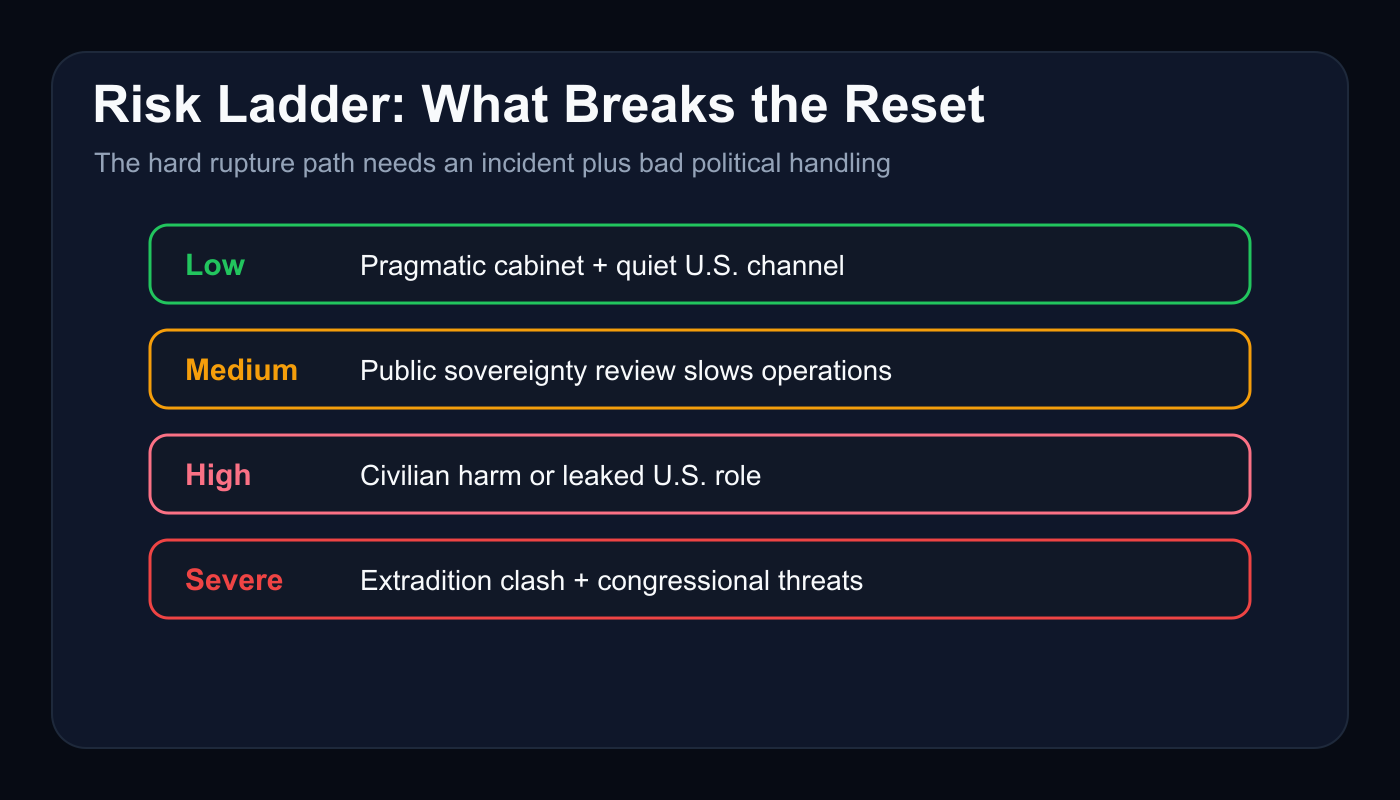
The uncertainty band around the 42% managed reset should be read as conditional. It depends on pragmatic appointments, disciplined U.S. messaging, no early civilian-harm controversy, and a sovereignty-respecting review mechanism. Remove two of those conditions and the backlash path rises quickly. Add a catalytic incident and the 12% hard rupture path becomes the active scenario.
Conclusion
Colombia election 2026 is best understood as a 90-day governance test for US Colombia relations. The likely path is not a clean pro-Washington alignment or a dramatic break. It is a managed reset with nationalist optics, private continuity, and selective friction around the most sensitive parts of the security relationship.
The operational takeaway is simple. Watch cabinet appointments, not slogans. Watch the first extradition dispute, not the first speech. Watch whether Washington uses public pressure or private channels. Watch whether cartels can create a crisis before Bogota and Washington have built a sovereignty-respecting framework.
The model's base case is 42% managed reset. The warning is that the rupture pathway does not require a grand ideological shift. It requires one bad incident, one leaked U.S. role, one extradition clash, and two governments trapped by their own public rhetoric. That is the risk to price now.