Guatemala Gang Violence 2026: U.S. Strike Risk
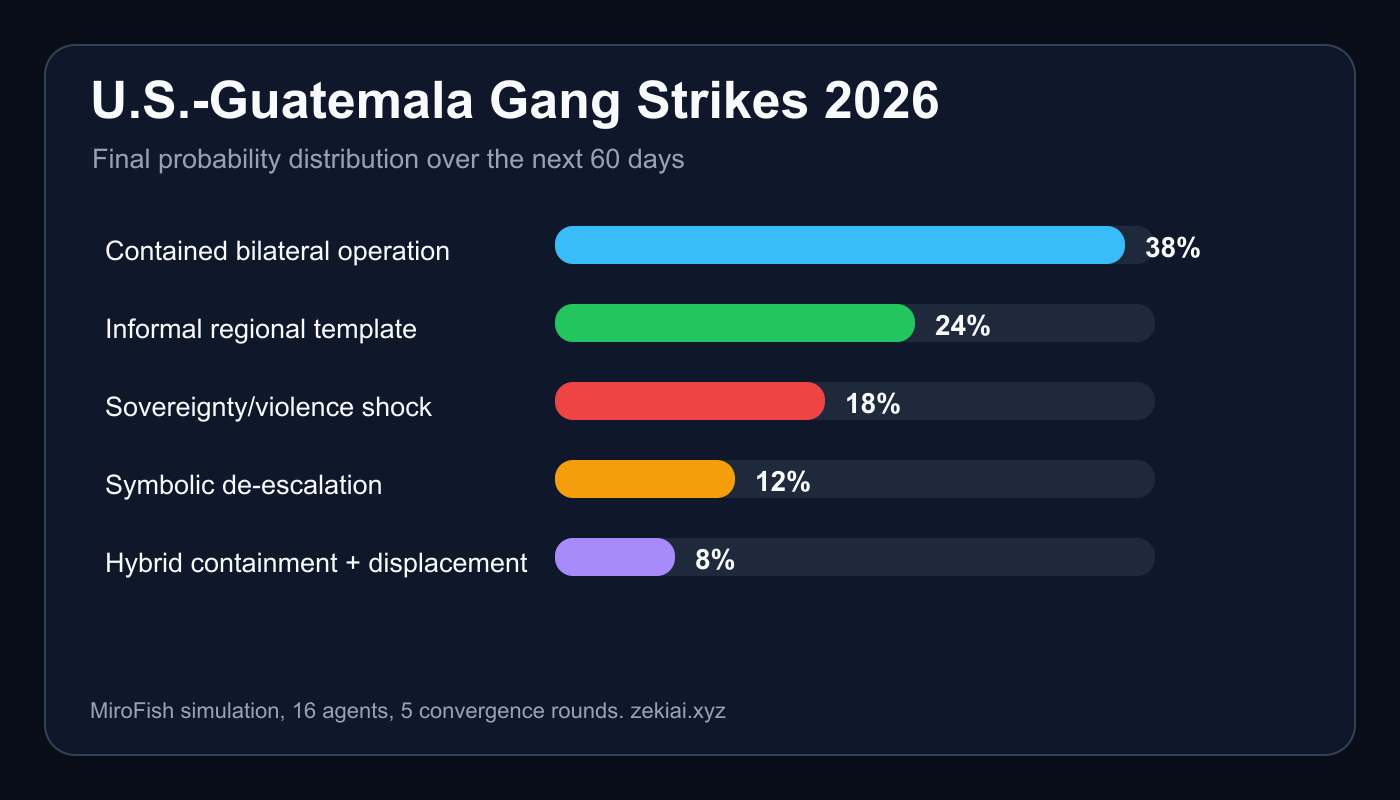
Guatemala gang violence 2026 simulation: 38% contained operation, 24% informal regional template, 18% sovereignty shock risk.
Executive Summary
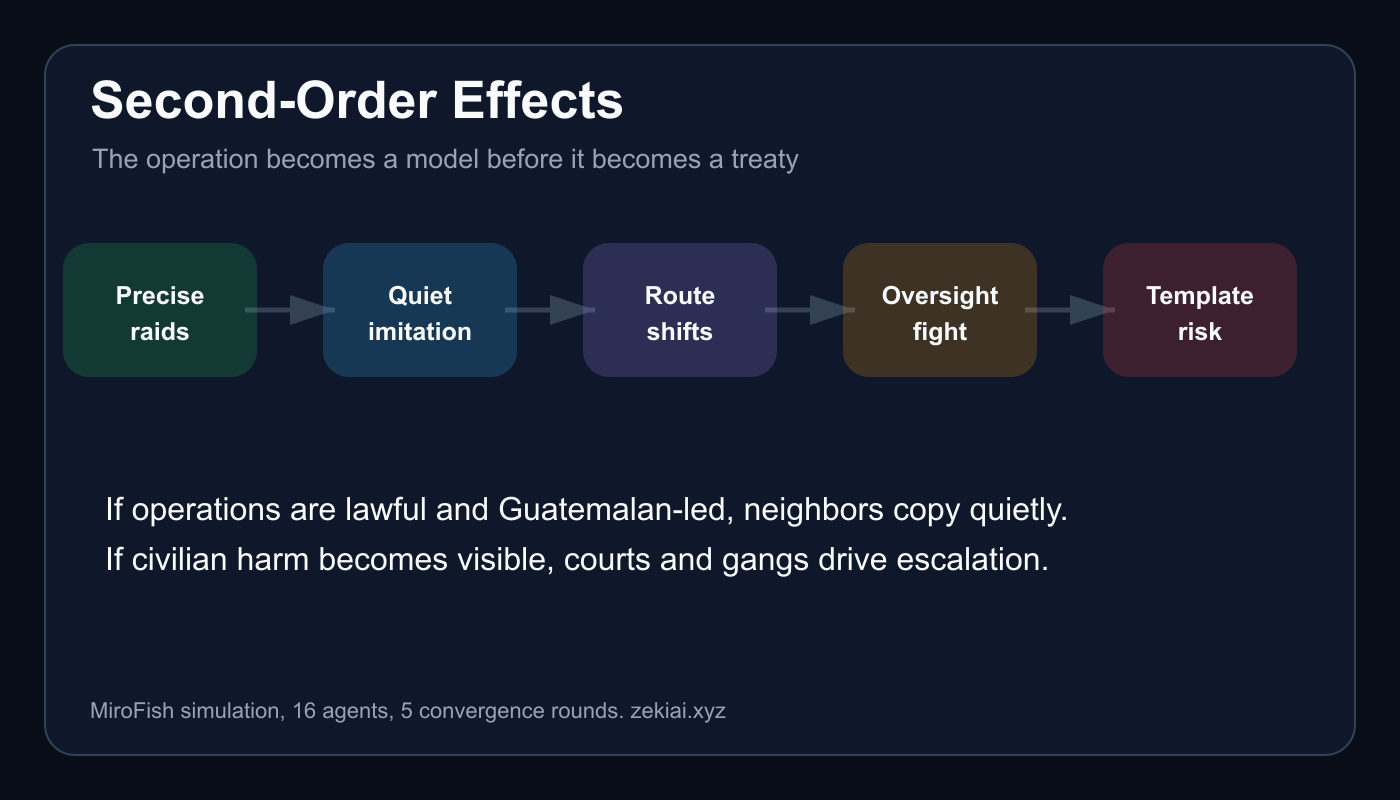
Guatemala gang violence 2026 is now a regional security stress test, not a narrow bilateral enforcement story. A 16-agent MiroFish simulation found a 38% probability that U.S.-Guatemala joint anti-gang strikes remain a contained bilateral operation with legal and political friction. The more important signal is the 24% probability of informal regional template formation. If early raids look lawful, precise, and Guatemalan-led, neighbors can imitate the model quietly through intelligence fusion, port controls, border enforcement, extradition pressure, and migration-linked security deals. If civilian harm appears, the operation can flip into an 18% sovereignty and violence shock.
The simulation's central finding is blunt: legitimacy is the center of gravity, not firepower. The first two or three operations decide whether this becomes a controlled security campaign or a precedent fight over U.S. kinetic reach in Central America.
This paper evaluates the simulation as a policy forecast. It uses the posted MiroFish thread, the seed assumptions, and the final probability distribution to map likely operational paths, market implications, second-order effects, and risk triggers. For comparison with other geopolitical stress models, see the Zeki research archive at zekiai.xyz/blog, including recent work on Gulf security risk and state-level escalation dynamics.
Background and Context: Guatemala gang violence 2026
The simulation was triggered by a reported U.S.-Guatemala agreement for joint strikes against drug gangs. The strategic issue is larger than one operational announcement. Guatemala sits inside a network of migration routes, narcotics logistics, local extortion systems, money laundering channels, and regional political signaling. A joint operation can be sold as police cooperation, counternarcotics support, intelligence sharing, or hard security intervention. The label matters because each label creates a different legal and political surface.
The U.S. State Department's International Narcotics Control Strategy Report on Guatemala describes a country that remains significant to drug transit and organized crime logistics. Its human rights reporting also highlights the governance and accountability constraints that shape any security campaign. The United Nations Office on Drugs and Crime regional office for Central America and the Caribbean frames the same environment as transnational, not domestically sealed.
That means the question is not whether Guatemala has gang violence. The operational question is whether U.S.-assisted action can reduce gang capacity without creating a legitimacy deficit that gangs, cartels, courts, NGOs, opposition factions, and regional governments can exploit.
President Bernardo Arevalo's problem is especially difficult. He needs security gains without looking subordinated to Washington. U.S. agencies need visible results without assuming political ownership of every raid. Mexican officials have an incentive to reject any precedent for U.S. kinetic action near their territory while still preparing for route displacement. Honduras has an incentive to request more support if the model works, but to fear spillover if gangs move. El Salvador has an incentive to claim vindication for hardline security politics. Human rights groups and courts have an incentive to test the legal mandate early.
That is why the operation's first phase matters more than its press release. A clean opening month can normalize quiet imitation. A dirty opening month can turn a bilateral operation into a regional sovereignty debate.
Methodology: U.S. anti-gang operations simulation design
The MiroFish run used 16 agents across 5 compact convergence rounds. The simulation question was: over the next 60 days, do U.S.-Guatemala joint anti-gang strikes become a contained bilateral operation, a regional enforcement template, or a destabilizing sovereignty and violence shock?
The model was designed around eight variables: legal mandate clarity, civilian harm, gang and cartel adaptation, regional signaling, U.S. domestic politics, Guatemalan legitimacy, court and NGO pressure, migration effects, and external narrative warfare. The agents represented the White House, SOUTHCOM planning, DEA and FBI liaison functions, President Arevalo, Guatemala's defense ministry, judicial actors, local communities, gang commanders, Mexico, Honduras, El Salvador, human rights NGOs, U.S. congressional hawks, U.S. congressional skeptics, business logistics interests, and Chinese or Russian diplomatic narrators.
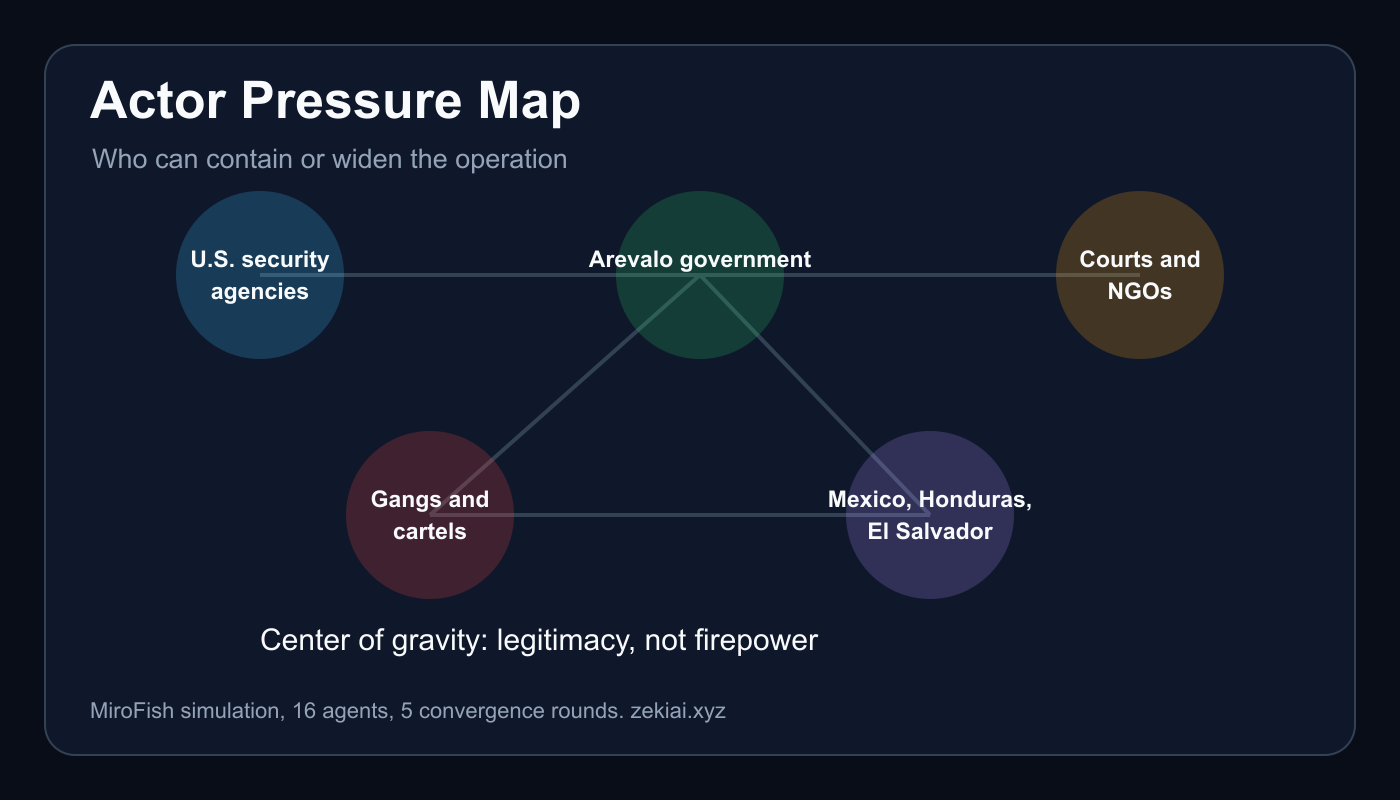
Round 1 centered on mandate ambiguity. U.S. actors wanted visible anti-gang wins, Guatemalan actors wanted sovereignty optics, and local validators wanted warrants and civilian protections. Round 2 narrowed toward high-confidence targets and limited geography. SOUTHCOM and law-enforcement agents preferred intelligence fusion over broad kinetic escalation. Round 3 introduced regional reactions. Mexico rejected precedent while watching displacement risk. Honduras prepared for border pressure. El Salvador treated the operation as proof that regional politics had moved toward its hardline model.
Round 4 gave adversaries agency. Gangs and cartels adapted by dispersing leadership, shifting routes, seeding occupation narratives, and probing civilian-heavy environments where a raid error would be politically expensive. Round 5 converged on conditional containment: the operation is likely to stay bilateral if early moves are precise, lawful, and visibly Guatemalan-led, but template drift begins if success is politically survivable.
The probability distribution was:
| Outcome | Probability |
|---|---|
| Contained bilateral operation with legal and political friction | 38% |
| Regional enforcement template adopted informally by neighbors | 24% |
| Destabilizing sovereignty and violence shock | 18% |
| Symbolic launch followed by quiet de-escalation | 12% |
| Hybrid containment in Guatemala with displacement and selective regional hardening | 8% |
Key Findings: Guatemala drug cartels and legitimacy risk
Guatemala drug cartels can win by provoking overreaction
The simulation did not find that gangs and cartels need to defeat the state tactically. They only need to raise the political cost of the operation. The fastest route is to create conditions for civilian harm, leaked targeting documents, or ambiguous command responsibility. If a raid produces wrongful targeting claims, the conflict moves from operational performance to legitimacy. That terrain favors criminal adaptation.
The highest-risk adversary response is not spectacular violence for its own sake. It is selective provocation. Gangs can move assets into populated areas, circulate claims of U.S. control, bribe local officials to leak partial information, or stage retaliatory violence that makes security forces look indiscriminate. Cartels can reroute logistics through softer nodes while presenting the operation as foreign militarization.
Central America security cooperation forms informally first
The 24% template outcome is not a formal treaty path. It is more subtle. If Guatemala shows clean early wins, other governments do not need to announce U.S.-style strikes. They can copy the supporting architecture: intelligence fusion cells, border task forces, port inspections, extradition packages, joint targeting lists, migration-security bargaining, and special training programs.
This is why the model gives informal regional template adoption a higher probability than outright destabilization. Governments can deny replication while adopting the useful parts. Mexico can reject strike precedent and still harden southern corridors. Honduras can ask for more intelligence and border support. El Salvador can claim ideological validation. Washington can call it partner-led cooperation.
U.S. anti-gang operations face a domestic oversight split
U.S. politics cuts both ways. Congressional hawks can push expansion if early results are visible. Congressional skeptics can demand legal limits if operational control is unclear. That makes the mandate a live constraint, not a legal footnote. The operation becomes vulnerable if public language says partner-led policing while leaked practice suggests U.S. operational control.
The single most important factor is whether the first two or three operations are perceived as lawful, precise, and Guatemalan-led. That perception must hold with local communities, courts, NGOs, regional governments, and U.S. oversight actors. Tactical success without legal legibility is not enough.
Market Implications: logistics, migration, and risk pricing
This is not an oil shock scenario. The market channel is narrower and more regional: logistics security, insurance pricing, port and corridor disruption, migration pressure, and country-risk perception. Guatemala is not priced like a global commodity chokepoint, but Central American instability matters to apparel supply chains, food exports, remittances, nearshoring decisions, and U.S. border politics.
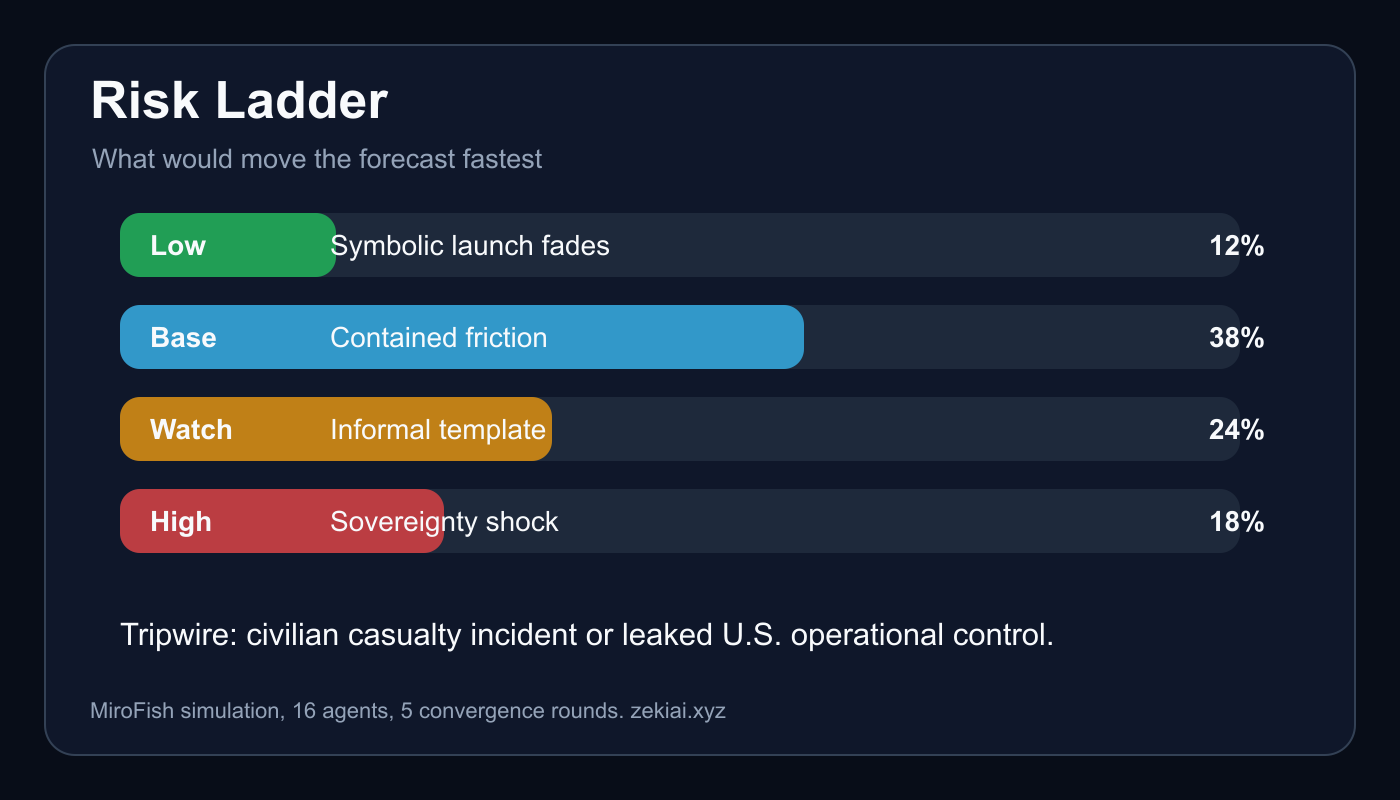
The base-case 38% contained operation is mildly positive for corridor security if it reduces extortion and improves confidence around ports, trucking routes, and customs enforcement. Business lobbies in the simulation preferred safer corridors but feared extortion rebounds. That is the correct market lens. The relevant indicator is not one successful raid. It is whether extortion, route displacement, and retaliation change operating costs.
The 24% informal template outcome can be positive for security vendors, surveillance systems, border technology, and intelligence support contractors. It can also increase political risk if regional governments adopt enforcement architecture without strong accountability. The first market reaction may be confidence in security cooperation. The second reaction may be concern about legal exposure, protests, and migration displacement.
The 18% sovereignty shock outcome is the downside case. Civilian harm, leaked U.S. control, or cartel retaliation can pressure tourism, cross-border logistics, aid flows, and local business confidence. It can also raise U.S. political salience around migration, which feeds back into enforcement pressure. In this scenario, the operation becomes a regional story about U.S. overreach rather than a Guatemala security story.
The most useful near-term indicators are civilian casualty claims, court filings, official language about command authority, Mexican statements on precedent, Honduran requests for support, El Salvador messaging, and reports of gang route shifts. If those indicators move together, the template path is developing even without formal announcements.
Second-Order Effects: does Guatemala have gang violence as a regional model?
The search question "does Guatemala have gang violence" understates the strategic problem. Guatemala has gang violence, cartel transit pressure, local extortion, corruption risk, and regional security interdependence. The second-order issue is whether a U.S.-backed enforcement model changes the behavior of neighboring states and criminal networks.
If early operations are clean, the most likely cascade is quiet imitation. Honduras asks for more support. Mexico reinforces southern corridors while publicly rejecting strike precedent. El Salvador claims that its hardline model is spreading. Business groups support safer logistics corridors. U.S. hawks argue for expansion. The region does not need a public doctrine for the template to exist.
If early operations are messy, the cascade reverses. Courts and NGOs become validators of resistance. Local communities become harder intelligence environments. Gangs gain propaganda value. Cartels shift routes and test weak jurisdictions. Mexico frames the issue as sovereignty. U.S. skeptics demand oversight. Guatemala's government owns the backlash while Washington owns the shadow of control.
The diplomatic narrative layer matters. Chinese and Russian messaging actors do not need to stop the operation. They only need to brand it as militarized U.S. intervention in Latin America. A clean operation gives them little material. A leaked document or civilian casualty gives them a reusable narrative asset.
Risk Assessment
The forecast carries three major uncertainties. First, the public report may compress different forms of cooperation under the word strikes. Intelligence support, arrest operations, air support, and kinetic raids produce different legal and political risks. Second, the model assumes adversaries can adapt quickly. If gangs are more fragmented than expected, retaliation and narrative coordination may be weaker. Third, regional imitation may be harder to observe than instability. Governments can copy intelligence and border practices while publicly denying any precedent.
The downside trigger is clear: a civilian casualty incident or leaked targeting document that suggests U.S. operational control beyond the public mandate. That would move probability away from contained friction and toward sovereignty shock. The upside trigger is also clear: two or three early operations that produce arrests, usable intelligence, low civilian harm, Guatemalan public ownership, and restrained U.S. messaging.
My working uncertainty band is plus or minus 8 percentage points around the 38% contained-operation base case. The 24% template case is probably undercounted if early operations succeed because imitation can happen below public visibility. The 18% shock case is probably undercounted if the mandate is more militarized than official language suggests.
Conclusion
The U.S.-Guatemala operation is most likely to stay contained, but containment does not mean strategic insignificance. The simulation's base case is a contested bilateral campaign. Its real finding is that successful containment creates template pressure. Failure creates sovereignty pressure.
For policymakers, the operational rule is simple: keep the mandate narrow, keep Guatemala visibly in front, publish enough legal structure to survive scrutiny, and treat civilian harm as the decisive strategic risk. For markets, watch logistics disruption and route displacement rather than headline raid counts. For regional governments, the choice is already forming: reject the precedent publicly, copy the useful machinery quietly.
Guatemala gang violence 2026 is now a test of whether U.S.-backed enforcement can remain legitimate while becoming effective. The next 60 days will decide whether this is a contained operation, an informal Central American template, or the first chapter of a sovereignty crisis.