US Iran Peace Deal 2026: Qatar Talks Survive
US Iran peace deal 2026 simulation finds a 42% chance Qatar talks produce a thin de-escalation framework within 10 days.
Executive Summary
The US Iran peace deal 2026 question has shifted from whether Washington and Tehran can reach a grand bargain to whether the Qatar channel can survive fresh kinetic pressure long enough to produce a narrow off-ramp. A 16-agent MiroFish simulation run on May 26, 2026 assigned a 42% probability that the diplomatic channel survives and produces a thin de-escalation framework within 10 days. The single most important finding is blunt: new US strikes do not automatically kill diplomacy if Iran can answer symbolically without US deaths, Gulf facility damage, or a shipping panic.
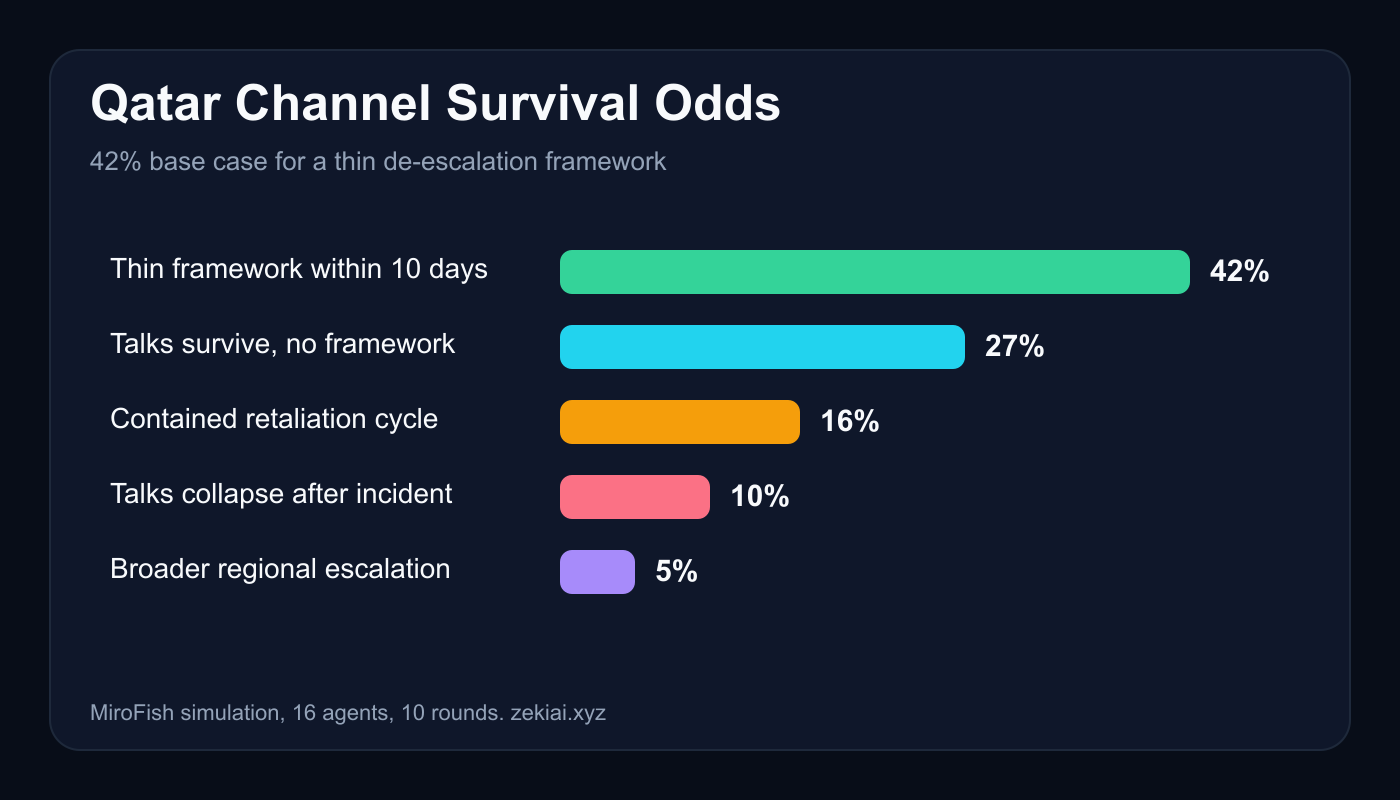
This is not a peace forecast. It is a channel-survival forecast. The model's base case is an ambiguous package built around strike restraint, Gulf non-targeting, humanitarian or sanctions facilitation, and continued Qatar/Oman mediation. That package lets Washington claim coercive leverage worked, while Tehran claims resistance preserved deterrence and opened relief channels. Both narratives can be true enough for domestic consumption.
The distribution is asymmetric. The simulation gave 69% combined probability to the channel surviving in some form, either with a thin framework at 42% or without a framework inside 10 days at 27%. It assigned 16% to a contained retaliation cycle that delays progress, 10% to collapse after a casualty, proxy, or maritime incident, and 5% to broader regional escalation involving Israel, Hezbollah, or Gulf shipping.
Background and Context: US Iran Talks Under Fire
The current diplomatic problem is not a clean sequence of war, then talks, then peace. It is coercive bargaining conducted while missiles, drones, domestic politics, oil markets, and regional security actors all move at once. The seed scenario for this simulation used reporting that the United States had launched new strikes on southern Iran or Iran's Gulf Coast while talks to end the Iran war resumed in Qatar. It also incorporated the market signal that oil prices had slid on hopes for a US-Iran peace deal, even as Tehran publicly said no deal was imminent.
That contradiction is the point. Markets often search for a binary outcome: peace or escalation. The regional system is more likely to produce something in between. A limited framework can reduce immediate risk without resolving the nuclear file, sanctions, Israeli security demands, Iranian deterrence needs, or the question of proxy autonomy.
Three background facts frame the analysis. First, the International Atomic Energy Agency remains the authoritative source for monitoring Iran's nuclear file, and its Iran focus page shows why verification remains a durable constraint on any durable accord: IAEA Iran updates. Second, Gulf energy flows remain systemically important. The US Energy Information Administration has repeatedly described the Strait of Hormuz as one of the world's most important oil chokepoints: EIA on the Strait of Hormuz. Third, Qatar and Oman have unique value because they can host quiet formulas that neither Washington nor Tehran wants to sell as capitulation.
For continuity, this post should be read beside Zeki's earlier Iran simulations on the same conflict chain: US-Iran nuclear deal endgame odds, Iran peace deal and Hormuz reopening risk, and Strait of Hormuz oil prices toll risk. The pattern across the series is consistent: the Gulf system rewards ambiguity when escalation costs become visible.
Methodology: 16-Agent MiroFish Simulation
The simulation used the MiroFish framework: a multi-agent deliberation model designed to stress test geopolitical scenarios by assigning each agent a role, incentive structure, fear set, and bargaining constraint. This run used 16 agents across 10 rounds. The question was specific: after new US strikes on southern Iran while Qatar talks resume, does the diplomatic channel survive and produce a de-escalation framework within 10 days?
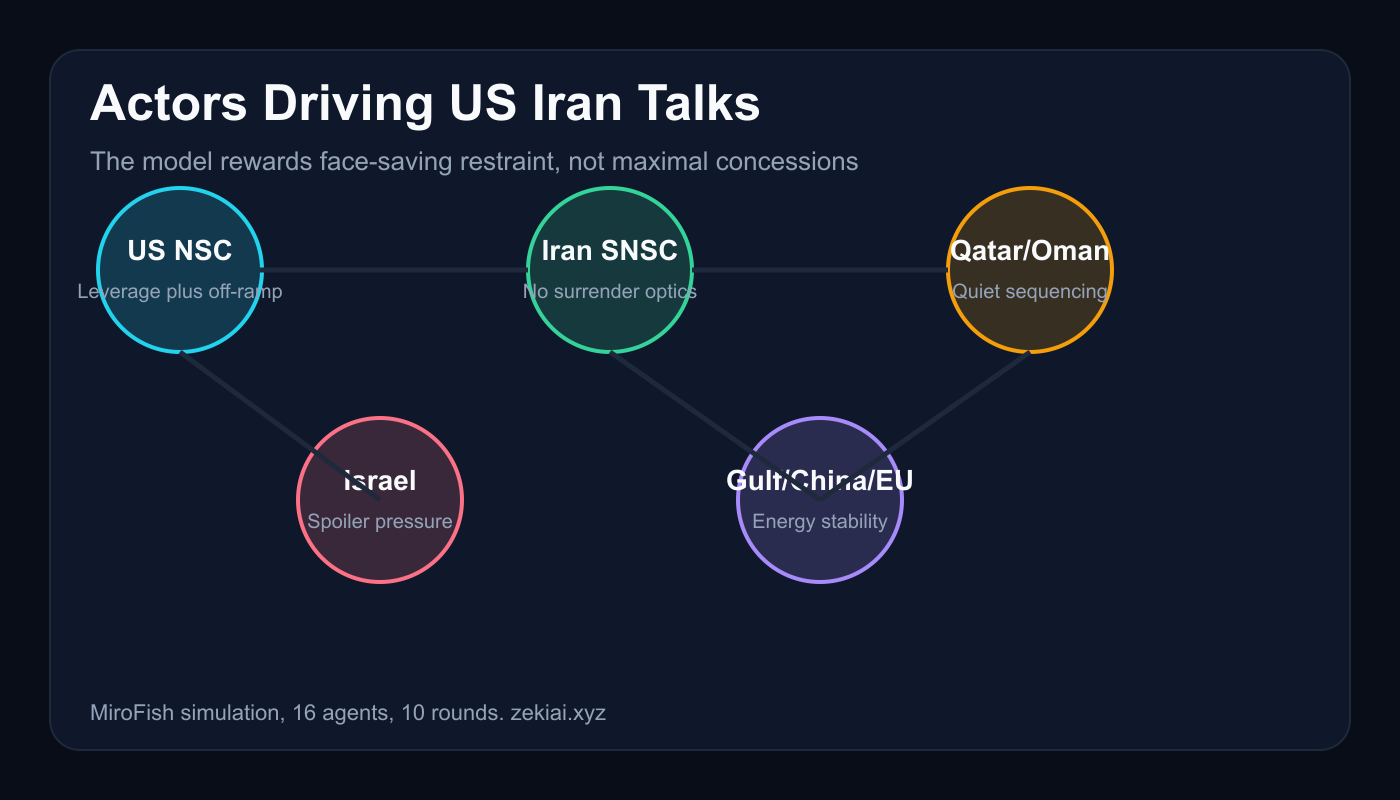
The agents were: US National Security Council, Pentagon CENTCOM commander, White House political adviser, Iranian Supreme National Security Council, IRGC Aerospace commander, Iranian Foreign Ministry negotiator, Qatar mediator, Oman backchannel envoy, Israeli security cabinet, Hezbollah political-military liaison, Saudi energy/security adviser, UAE port/oil security planner, China energy strategist, EU diplomatic coordinator, oil market and insurance analyst, and Hajj/Gulf security coordinator.
The model was not asked to predict a comprehensive settlement. It was asked to distinguish five operational outcomes:
| Outcome | Probability |
|---|---|
| Diplomatic channel survives and produces a thin framework within 10 days | 42% |
| Channel survives as coercive stalemate with no framework inside 10 days | 27% |
| Limited retaliation cycle delays framework but remains contained | 16% |
| Talks collapse after casualty, proxy, or maritime incident | 10% |
| Broader regional escalation involving Israel, Hezbollah, or Gulf shipping | 5% |
The most important modeled variable was whether Iran could restore deterrence through a calibrated response that avoided US deaths, Gulf facility damage, or a shipping panic while keeping the Qatar/Oman channel politically defensible.
Key Findings: US Iran Talks Survive More Often Than They Collapse
US Iran Talks Are Likely To Stay Open
The simulation's strongest signal is that both Washington and Tehran need the channel. Washington needs a way to convert strikes into a political result rather than an indefinite escalation ladder. Tehran needs relief, regime security, and a way to demonstrate it was not bombed into surrender. That mutual need does not create trust. It creates a narrow overlap where mediators can work.
In round six, the Oman agent proposed the formula that became the model's center of gravity: no public US apology, no Iranian capitulation, limited strike pause, humanitarian or sanctions facilitation, and Gulf maritime non-targeting. By round ten, the agent field had converged on an ambiguous framework as the modal outcome. The framework is not clean. It is precisely useful because it is not clean.
US Strikes Iran Without Necessarily Ending Diplomacy
The phrase US strikes Iran usually implies a binary break. The simulation disagreed. New strikes can be framed as leverage if Washington can say it restored deterrence and Tehran can answer in a way that restores face without killing Americans. The IRGC Aerospace agent began the simulation demanding visible retaliation credibility. By the middle rounds, it began accepting a measured response plus talks path, provided the response preserved deterrence optics.
This is the core paradox. A calibrated strike exchange can make an agreement more sellable if both sides use it to claim strength. It also narrows the margin for error. One autonomous militia attack, one misread drone alert, or one tanker incident can move the system from bargaining to compulsion faster than mediators can react.
Iran Oil Prices Can Misread The Military Tempo
The Iran oil prices signal is useful but incomplete. Oil and insurance markets can ease on headlines about a framework, then reprice violently on maritime rumors, drone alerts, or Israeli objections. The oil market/insurance agent warned that markets may price peace while militaries remain in coercive bargaining mode.
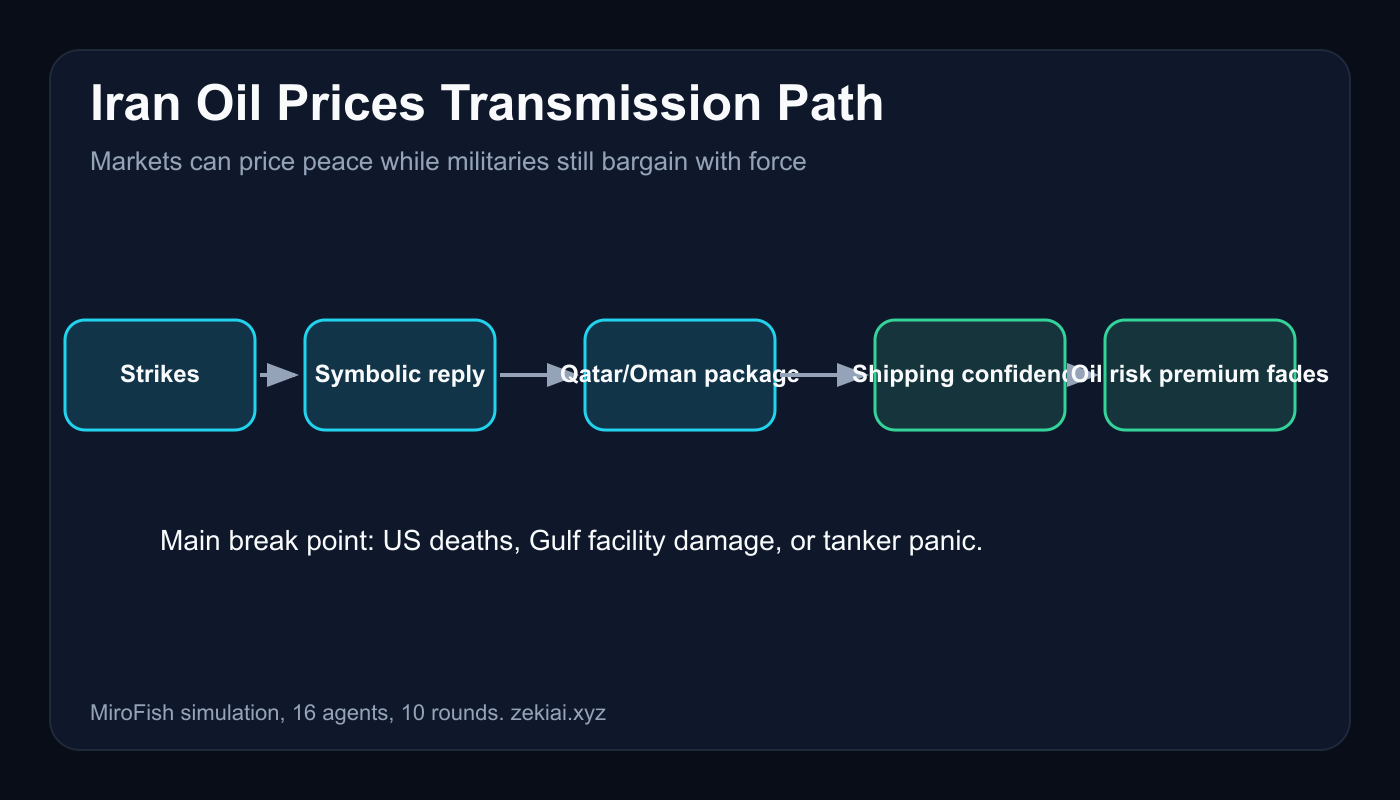
The model's base case implies a temporary Gulf risk premium whipsaw, not a straight relief rally. If headlines confirm continued Qatar/Oman talks, crude and insurance risk could ease. If a militia strike kills US personnel or a Gulf facility is hit, the same market can reverse because the diplomatic channel would no longer control the tempo.
Market Implications
The market implication is not simply lower oil. It is higher sensitivity to tactical signals. In the 42% framework scenario, the first-order effect is a decline in the immediate war premium. Shipping confidence improves if the framework includes Gulf non-targeting language. Insurers would still require evidence that drones, mines, and proxy units are being restrained, but headline risk would fall.
In the 27% stalemate scenario, talks continue but markets do not get a clean catalyst. That is the environment most likely to produce false breakouts in crude, gold, and defense equities. Traders price a deal on mediator headlines, then reverse when Tehran or Washington denies concessions.
In the 16% contained retaliation scenario, oil and gold should carry a higher intraday volatility premium. The simulation points to symbolic Iranian retaliation as the key swing mechanism. If retaliation avoids deaths and shipping disruption, markets may treat it as theater. If it creates casualties, the distribution shifts toward collapse.
For shipping, the key assets are not only tankers in the Strait of Hormuz. Port operations in the UAE, Saudi facility defense, insurance clauses, and rerouting rumors become part of the same price mechanism. For gold, the clean signal is whether escalation stays contained. For defense equities, the signal is whether US force protection moves from deterrent posture to active campaign posture.
Second-Order Effects
The first second-order effect is diplomatic branding. If a framework emerges, it will be sold differently in every capital. Washington will say strikes forced Iran back to conditions. Tehran will say resistance preserved sovereignty and opened relief channels. Qatar and Oman will say quiet mediation prevented a regional fire. The same document can carry all three narratives because ambiguity is the product.
The second effect is Israeli pressure. The Israeli security cabinet agent resisted premature compromise throughout the run. If Israel concludes that a US-Iran framework preserves too much Iranian capability, spoiler pressure rises. That does not require Israel to reject diplomacy publicly. It can show up through intelligence leaks, strike timing, or pressure on Washington's domestic coalition.
The third effect is proxy autonomy. Hezbollah's modeled incentive was to avoid a major Lebanon front, which reduced one escalation path. That does not eliminate risk from other militia nodes. The biggest wildcard remains an autonomous or semi-autonomous strike that kills US personnel or hits Gulf energy infrastructure. Leaders may then be forced to respond before mediators can sequence restraint.
The fourth effect is Hajj and Gulf domestic security. The Hajj/Gulf security coordinator added an underpriced restraint factor: pilgrim flows and panic avoidance create a temporary incentive for calm. That incentive does not solve the war. It can create a window where all sides prefer an ugly pause over a dramatic escalation.
Risk Assessment
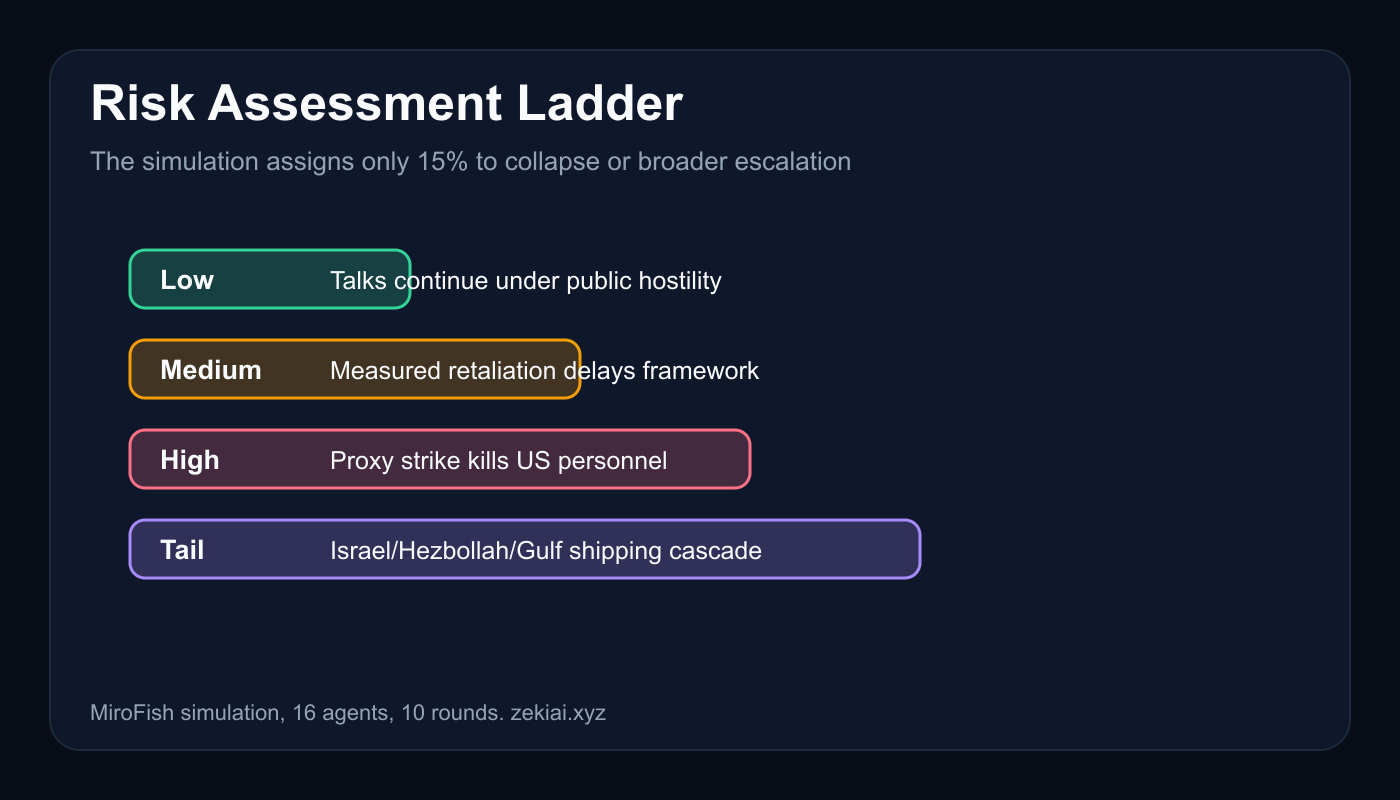
The simulation can be wrong in three ways. First, it may overestimate leader control over proxies. The 42% framework case assumes Tehran can calibrate retaliation and communicate restraint through enough channels. If proxy autonomy is higher than modeled, the collapse probability should rise.
Second, it may underestimate domestic political constraints in Washington. A framework sold as vague restraint can be attacked as weakness if US strikes are followed by Iranian defiance. The White House political adviser agent required victory language for any package. If that language is unavailable, the 27% stalemate outcome becomes more likely.
Third, it may underestimate Israeli willingness to act independently. The Israeli agent was the most persistent external spoiler. If Israel believes the United States is accepting a cosmetic deal, the system could face a separate escalation track that Qatar and Oman cannot control.
The probability bands should therefore be read as conditional. If there are no US deaths, no Gulf facility hit, no tanker panic, and no major Israeli escalation, the framework probability is materially above 42%. If any one of those events occurs, the collapse and broader escalation bucket can move from 15% combined toward the center of the distribution.
Conclusion
The answer to will US Iran talks in Qatar survive strikes is yes, but only in a narrow and unsentimental sense. The channel can survive because neither side needs a full peace deal to claim progress. They need a face-saving pause that lowers the immediate probability of Gulf escalation.
The simulation's base case is a thin Qatar/Oman-backed de-escalation framework within 10 days, not a durable settlement. It is built on ambiguity, reciprocal restraint, humanitarian or sanctions facilitation, and Gulf non-targeting. That is enough to matter for oil, shipping, gold, and regional force posture.
The decisive variable is not whether leaders say they want peace. It is whether Iran's response restores deterrence without killing Americans or panicking Gulf energy markets. If that line holds, the US Iran peace deal 2026 path stays alive. If it breaks, diplomacy becomes a casualty-management exercise.