US Iran Nuclear Deal 2026: Endgame Odds
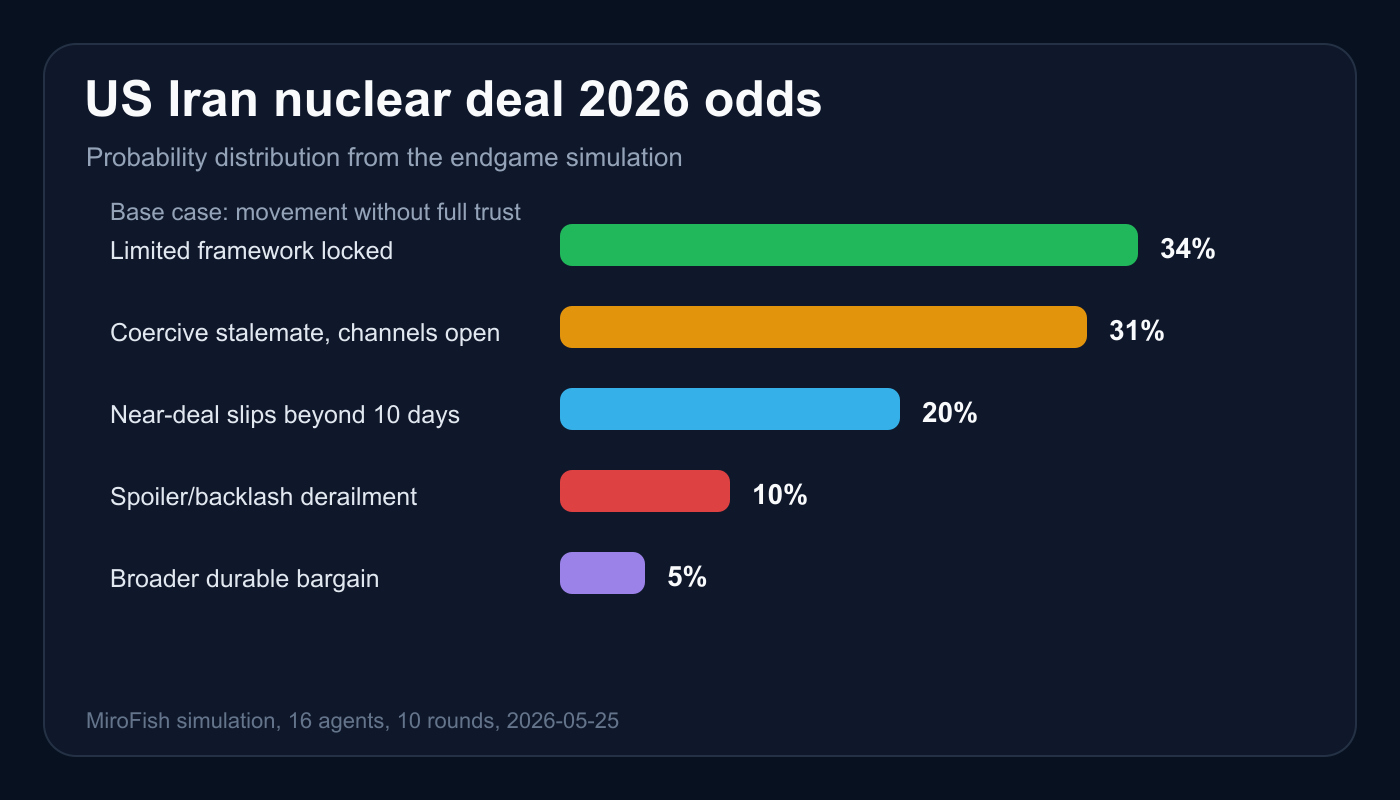
US Iran nuclear deal 2026 simulation: 34% limited framework, 31% coercive stalemate, and sanctions sequencing as the decisive hinge.
Executive Summary
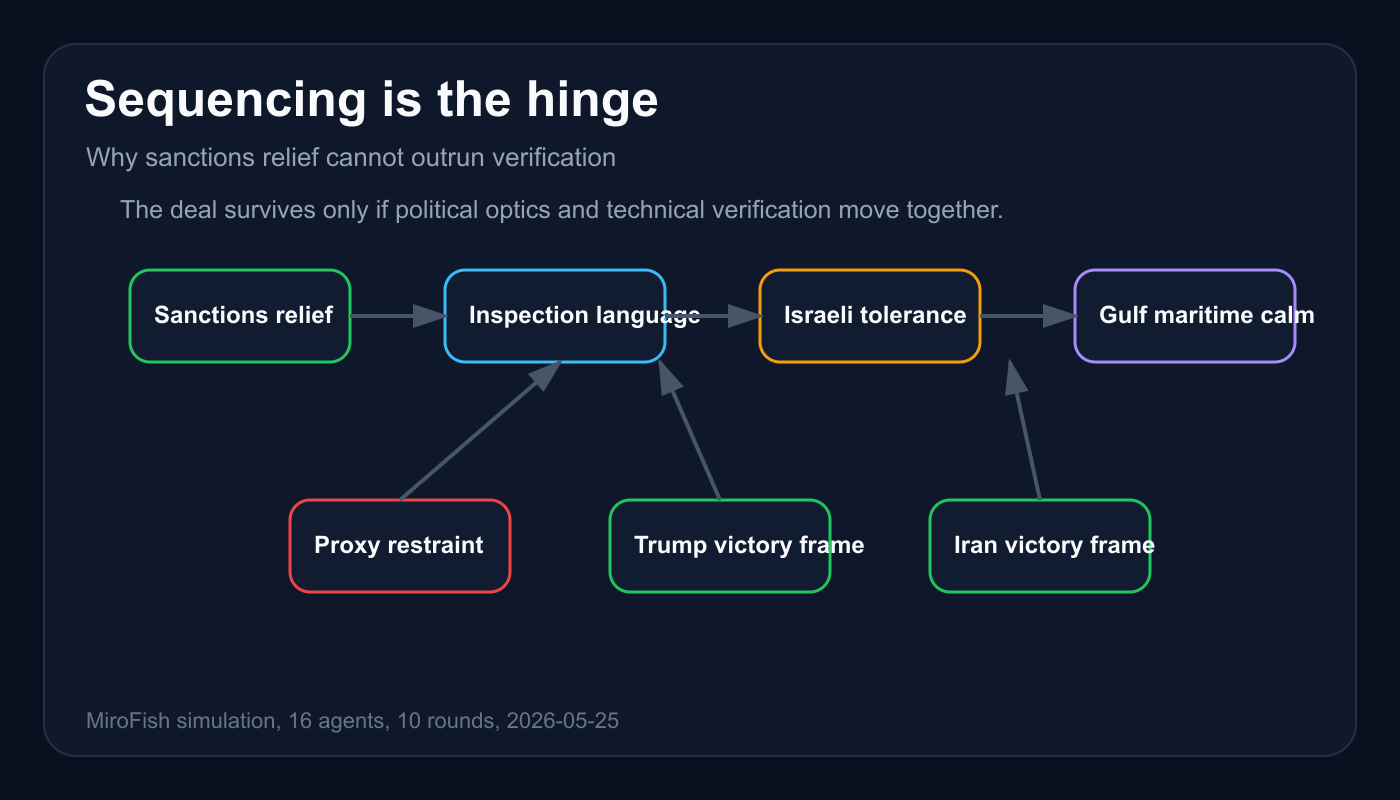
US Iran nuclear deal 2026 risk is now concentrated in sequencing, not intent. A 16-agent, 10-round MiroFish simulation of the endgame after Trump reportedly told negotiators "do not rush" assigned a 34% probability to a usable limited framework being locked within 10 days. The next largest bucket was not collapse. It was a 31% coercive stalemate with channels still open. That means the central question is not whether Washington and Tehran want a headline. They do. The question is whether sanctions relief, inspection language, Israeli tolerance, Gulf maritime calm, and proxy restraint can be made simultaneous enough to survive first contact with politics.
The simulation's core finding is specific: "do not rush" reads as deadline-softening, not deal death. It gives negotiators room to avoid an embarrassing text. It also gives maximalists and spoilers room to reopen settled terms. The base case is therefore a provisional nuclear and security framework, not a durable grand bargain. Markets should expect initial oil-risk compression if a framework is announced, followed quickly by fights over implementation, verification, and proxy conduct.
This paper converts the published X simulation into a research-style assessment for diplomats, energy desks, shipping risk teams, policy analysts, and anyone tracking the Trump Iran deal endgame. It should be read alongside Zeki's prior Iran simulations, including the May 24 Iran peace deal and Hormuz reopening model, the April 13 Strait of Hormuz crisis simulation, and the April 12 US-Iran peace deal simulation. Across those models, one pattern keeps repeating: paper de-escalation is easier than operational trust.
Background and Context: US Iran Peace Deal Update
The simulation trigger was the reported endgame around a possible US-Iran peace, nuclear, and security framework, with Trump telling negotiators not to rush into a deal. The phrase matters because it can be read two ways. In a constructive reading, it gives both sides time to write sanctions, inspections, and political optics into a document that can survive. In a destructive reading, it signals that the deadline is soft, that Washington is still available for pressure, and that opponents can punish compromise before relief arrives.
The broader context is a familiar bargaining trap. Iran wants tangible sanctions relief, regime security, and a victory narrative that does not look like capitulation. The United States wants nuclear limits, inspection credibility, and a deal Trump can describe as tougher than prior Democratic frameworks. Israel wants hard constraints, freedom of action, and US alignment on preventing a nuclear weapon. Gulf states want maritime stability and proxy quiet. China wants stable energy flows. Russia benefits from US distraction, but not from an uncontrolled regional shock that damages its own diplomatic position.
The nuclear file cannot be separated from verification. The International Atomic Energy Agency remains the technical reference point for safeguards, access, baselines, and monitoring: IAEA safeguards overview. A framework that includes inspection language but leaves access timelines vague will not carry the same political weight as one that names procedures, baselines, and snapback conditions. The simulation found that inspection language is not a footnote. It is the bridge between US toughness, Iranian face-saving, Israeli conditional tolerance, and Gulf confidence.
Sanctions relief is the second half of that bridge. US Treasury sanctions architecture remains the channel through which relief, waivers, licenses, and enforcement posture become real: Treasury Iran sanctions. Tehran needs early visible economic signal. Washington needs reversibility. Congress and hawkish policy actors will attack any front-loaded relief as surrender. That is why sequencing dominates the model. The same concession can stabilize or destroy the framework depending on what is released first, what is inspectable first, and what each side can say publicly.
Energy markets sit behind the diplomacy because any US-Iran de-escalation changes Gulf risk pricing. The US Energy Information Administration's chokepoint analysis explains why Gulf shipping routes and the Strait of Hormuz remain central to oil-market stability: EIA world oil transit chokepoints. Even though this simulation was not primarily a Hormuz reopening model, the market implication is direct. If talks produce credible maritime de-escalation, oil risk premium falls. If talks produce ambiguity plus a proxy incident, the premium returns faster than it left.
Methodology: US Iran Nuclear Talks Simulation
MiroFish ran 16 agents through 10 rounds. Each agent represented an institution, coalition, or pressure node with different incentives and constraints. The agents were: US President and White House, US lead negotiator, US hawkish senator, Iran Supreme Leader circle, Iran Foreign Ministry, IRGC economic and security bloc, Israeli prime minister, Israeli security establishment, Saudi and UAE Gulf security bloc, Oman and Qatar mediator, EU diplomat, China energy strategist, Russia strategist, IAEA verification technocrat, oil market analyst, and proxy network commander composite.
The question was narrow: will the US and Iran lock a usable peace, nuclear, and security framework in the next 10 days, or will talks drift back into coercive stalemate? The model did not treat "deal" as a binary. It separated provisional framework, open-channel stalemate, delayed near-deal, spoiler derailment, and durable broad bargain. That distinction matters because public language can make every outcome sound like progress while the operational reality differs sharply.
The rounds moved through opening priors, sanctions sequencing, Israeli red lines, Iranian face-saving, Gulf and oil-market pressure, proxy autonomy, the meaning of "do not rush," verification text, cluster convergence, and final probability assignment. Agents repeatedly converged on a central mechanism: a limited framework is possible if sanctions relief and inspection language are paired tightly enough that every principal actor gets a defensible story. It fails if one side receives relief or leverage before the other side receives visible restraint.
The simulation produced the following final probability distribution:
| Outcome | Probability |
|---|---|
| Usable limited framework locked within 10 days | 34% |
| Talks drift into coercive stalemate but channels remain open | 31% |
| Near-deal slips beyond 10 days with public optimism preserved | 20% |
| Spoiler incident or Israeli, US, or Iranian backlash derails talks | 10% |
| Broader bargain with durable nuclear and security package | 5% |
This distribution should be interpreted as a near-term decision map, not a long-run forecast. The 10-day horizon is important. A limited framework can be locked quickly if negotiators narrow ambition. A durable bargain cannot. Conversely, a stalemate with channels open can look like failure on television while preserving a path to later agreement.
Key Findings: Iran Sanctions Relief and Verification
US Iran Nuclear Deal 2026: Limited Framework Beats Grand Bargain
The modal outcome is a usable limited framework at 34%. That is not a peace settlement in the full sense. It is a controlled communique or provisional framework that keeps talks alive, freezes the most dangerous nuclear and security moves, and creates a calendar for inspections and relief. It would likely include partial nuclear commitments, phased sanctions language, mediator-backed de-escalation channels, and enough ambiguity for each side to claim it did not surrender.
The broader durable bargain reached only 5%. That is the key correction to headline-driven analysis. The system can produce a political win before it produces strategic settlement. The gap between those two outcomes is where implementation risk lives.
Iran Sanctions Relief: Sequencing Is the Deal Hinge
Iran sanctions relief is the decisive bargaining object because it is both economic value and political symbolism. Front-load it too much and Washington's hawks call the deal weakness. Delay it too much and Tehran cannot sell restraint internally. Make it reversible and the US gains leverage, but Iran questions whether the relief is real. Make it irreversible and opponents of the deal gain ammunition.
The simulation found that sanctions relief must be paired with inspection and nuclear-limit language, not placed in a separate bucket. A schedule that says relief follows verifiable steps is more durable than a promise that says relief follows trust. That is why the IAEA verification technocrat had outsize influence in the later rounds. Technical wording became the political escape hatch.
US Iran Peace Deal Update: "Do Not Rush" Lowers Deadline Risk
Trump's "do not rush" instruction reduced the probability of an embarrassing rushed text. It also lowered the chance that either side would be forced into visible capitulation inside an artificial deadline. In the model, that helped the limited-framework scenario.
But the same phrase raised the 31% coercive-stalemate bucket. Delay is not neutral. It gives the IRGC bloc, US hawks, Israeli political actors, and proxy networks more time to test boundaries. A slower process improves text quality only if mediators keep control of the sequencing calendar. If not, slow becomes drift.
US Iran Nuclear Talks: Israeli Security Tolerance Is Conditional
The Israeli agents split. The prime minister was structurally resistant to enrichment ambiguity, while the security establishment became conditionally tolerant if verification and snapback were credible. That distinction matters. Israeli politics may stay publicly hard even if Israeli security professionals prefer a bounded, inspectable framework over collapse.
The practical implication is that side assurances matter. Washington may need to provide Israel with intelligence-sharing, snapback language, and freedom-of-action assurances while preventing those assurances from becoming public humiliation for Tehran. The model treats that as difficult but possible.
Market Implications: Oil Risk, Shipping, and Gold
The first market effect of a limited US Iran nuclear deal 2026 framework would likely be oil-risk premium compression. Not a full normalization. Compression. Traders would mark down immediate Gulf escalation risk because channels remain open and negotiators have a document. Brent risk premium, regional freight, and insurance anxiety should ease if the framework contains credible inspection and maritime language.
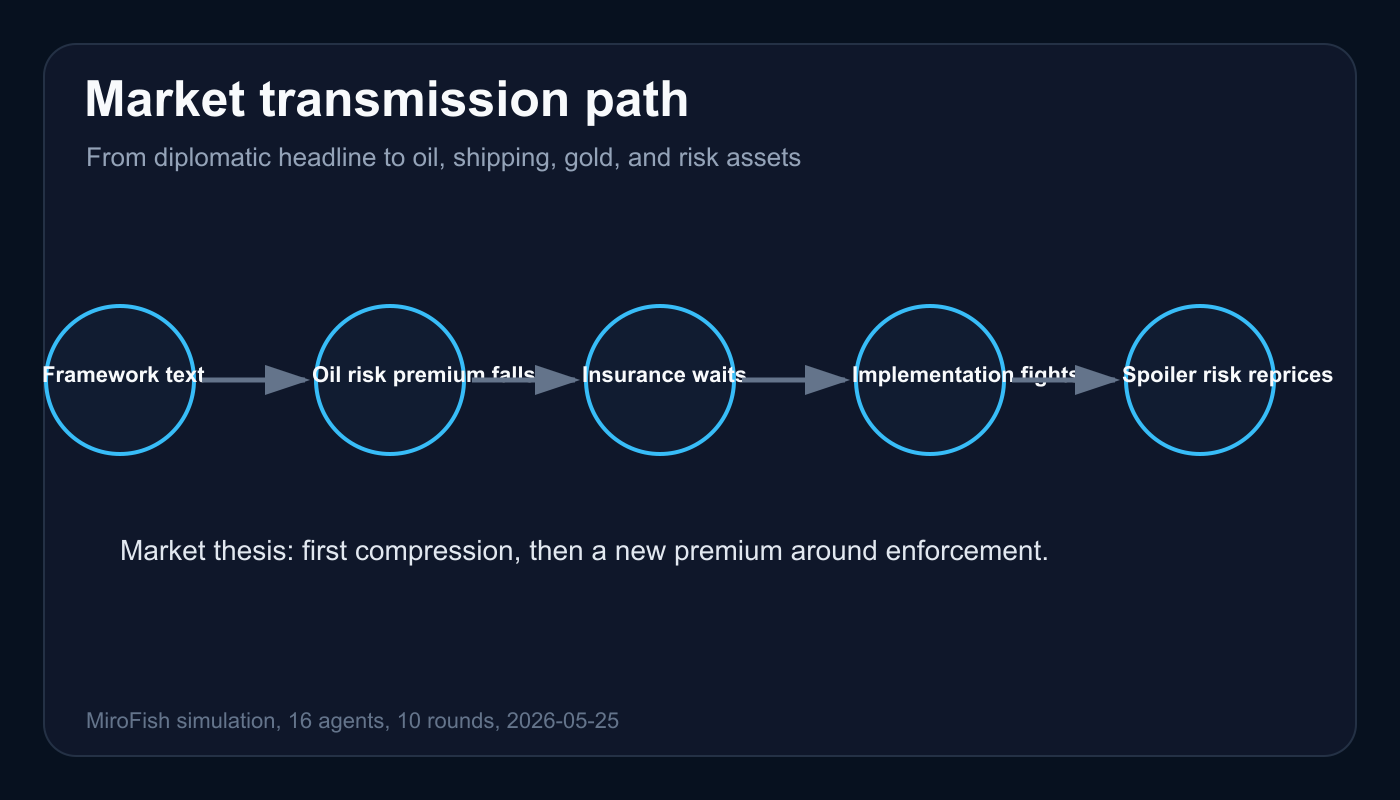
The second effect is a shift in what markets watch. Before a framework, the market watches speeches. After a framework, the market watches implementation evidence: IAEA access, relief licenses, tanker insurance, militia attacks, Gulf naval posture, Israeli statements, and congressional reactions. That means the pricing variable moves from "will they announce" to "can they execute without a humiliating violation."
Oil should respond fastest to maritime calm and slower to nuclear technicalities, but the two are linked. A proxy incident can make nuclear verification look cosmetic. A verification dispute can make maritime calm look temporary. Gold and defense equities benefit from any sign that the framework is stalling. Risk assets benefit if the limited-framework path begins to accumulate quiet days.
The 31% coercive-stalemate bucket is market-relevant because it does not equal war. It implies channels remain open, pressure remains active, and no clean relief arrives. In that path, oil premium may stay sticky rather than spike. Diplomatic headlines continue, but companies and insurers avoid assuming a durable reset.
Second-Order Effects: Proxy Autonomy and Regional Bargaining
The underpriced risk is proxy autonomy. The simulation's biggest wildcard was a maritime, militia, drone, or regional incident before the framework is locked. Tehran has influence over aligned networks, but influence is not perfect control. Local commanders have incentives, fears, and reputations of their own. A single incident can harden Washington, strengthen Israeli resistance, and give Iranian hardliners a reason to reject intrusive language.
If a limited framework is announced, Gulf states become implementation auditors. Saudi and UAE actors will judge the deal less by nuclear phrasing and more by whether shipping, drones, militias, and maritime harassment actually quiet down. If they see calm, they can support the framework quietly. If they see ambiguity, they will press Washington for stronger guarantees.
China's role is stabilizing but self-interested. It wants predictable energy flows and discounted supply without a US-Iran military crisis. That gives Beijing reason to encourage quiet implementation, but not reason to help Washington own the diplomatic win. Russia's incentives are more conflicted. Moscow benefits from US distraction, but a major Gulf shock can create costs and uncertainties that exceed the value of friction.
The second-order effect for US domestic politics is ownership. If Trump owns the deal, he can sell limited relief as leverage. If opponents define the first week, the same relief becomes weakness. That is why the simulation treats communication sequencing as part of the policy architecture, not a public-relations afterthought.
Risk Assessment: Will US Iran Nuclear Deal Happen in 2026?
The answer from this simulation is yes, a limited framework can happen, but durable peace is the wrong baseline. The near-term odds favor constrained movement: 34% limited framework plus 20% delayed near-deal equals a 54% probability that negotiations remain substantively alive and close to text. The risk is that this gets misread as a solved conflict. It is not solved. It is transferred into implementation.
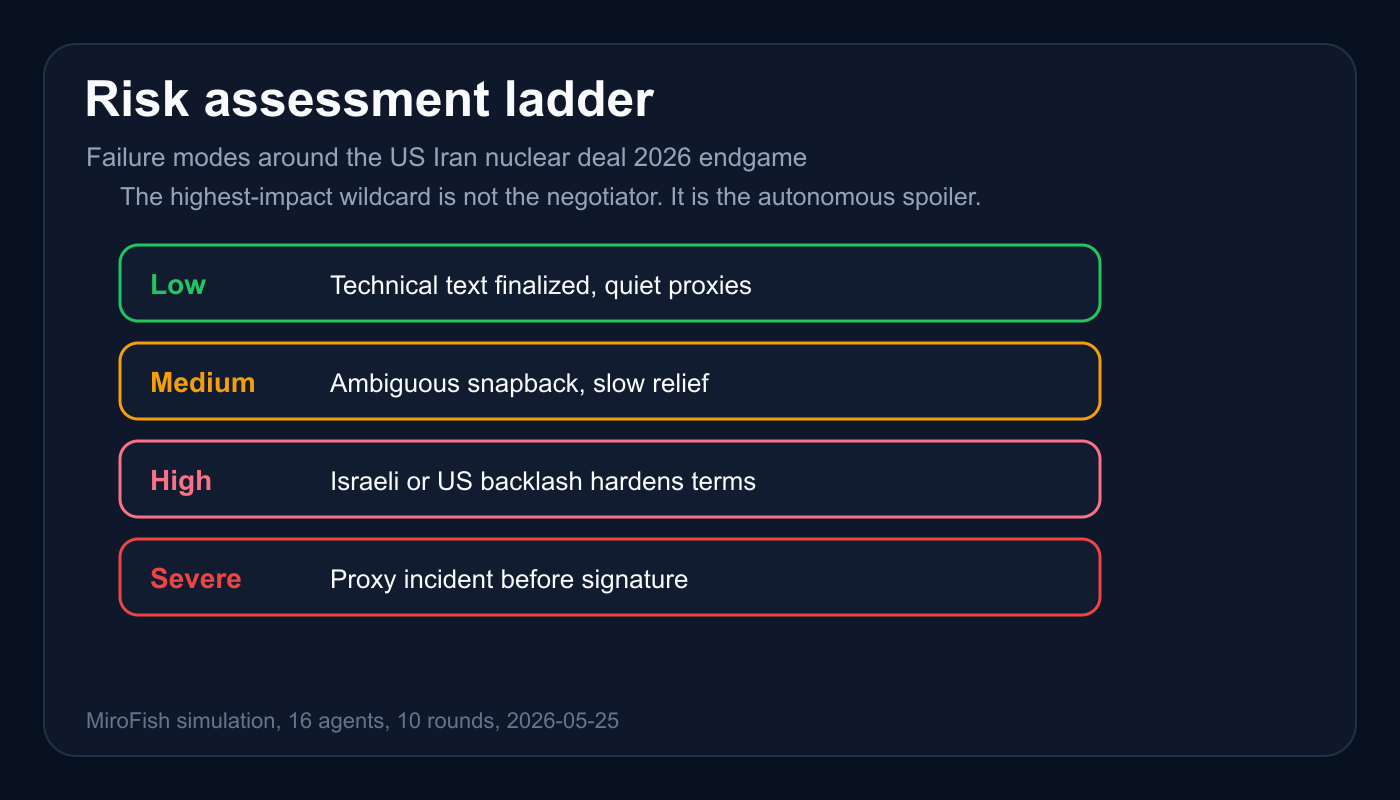
The main downside path is not immediate total collapse. It is coercive stalemate at 31%. That path keeps channels open while pressure continues. It allows every side to say diplomacy is alive while preparing for failure. The more dangerous 10% derailment path requires a sharper trigger: a spoiler incident, Israeli backlash, US congressional escalation, or Iranian internal panic around inspections and relief sequencing.
The simulation can be wrong in three ways. First, it may underweight private bilateral commitments not visible in public reporting. If Washington and Tehran have already settled inspection and relief sequencing privately, the 34% limited-framework bucket may be too low. Second, it may overweight rational control over proxies. If autonomous actors are less controllable than modeled, the 10% derailment bucket may be too low. Third, it may underweight leader psychology. If Trump prefers the drama of delay over the discipline of implementation, the 31% stalemate path grows.
A practical uncertainty band would put limited-framework odds between 28% and 42%, stalemate between 25% and 38%, delayed near-deal between 15% and 25%, derailment between 7% and 16%, and durable broad bargain between 2% and 8%. The rank order matters more than the exact point estimate.
Conclusion
The US Iran nuclear deal 2026 endgame is not a binary peace-or-war moment. It is a sequencing test. The simulation's 34% base case says a usable limited framework is the single most likely outcome inside 10 days. The combined 51% across stalemate and delayed near-deal says the road remains narrow, slow, and politically exposed.
The decisive variable is whether sanctions relief can be paired with inspection and nuclear-limit language tightly enough that Trump can claim leverage, Iran can claim victory, Israel can claim enforceability, and Gulf states can claim reduced proxy and maritime risk. If that pairing holds, oil risk premium compresses and diplomacy moves into implementation. If it fails, the conflict does not need to explode immediately. It can drift back into coercive stalemate with every channel open and every actor armed with a reason not to trust the next sentence.
The research takeaway is blunt: price the framework, not the fantasy. A limited deal is plausible. A durable bargain is not the base case. The next signal to watch is not another optimistic quote. It is the first concrete pairing of sanctions relief, IAEA-visible access, snapback language, and proxy restraint.