Iran Peace Deal 2026: Hormuz Reopening Risk
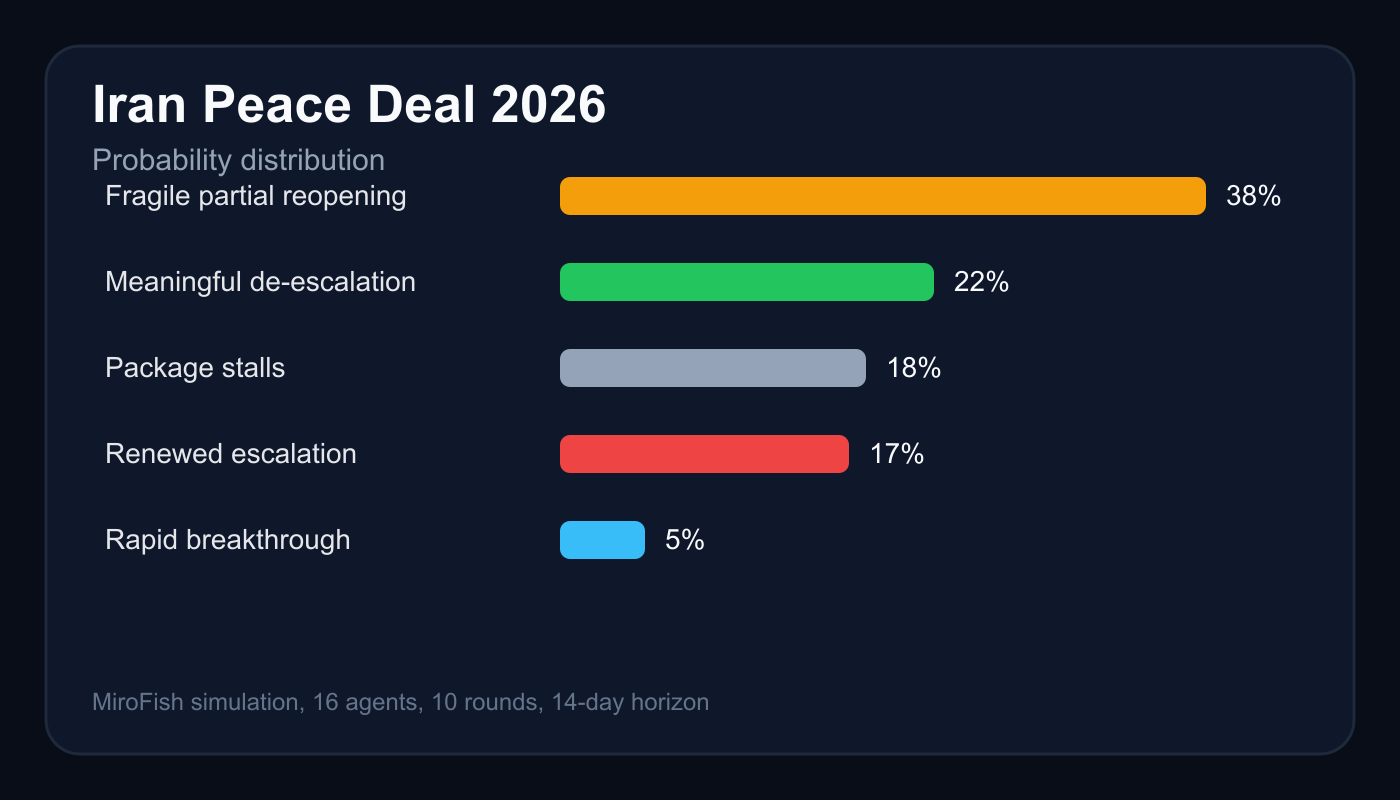
Iran peace deal 2026 simulation: 38% fragile Hormuz reopening, 22% de-escalation, 17% renewed maritime escalation risk.
Executive Summary
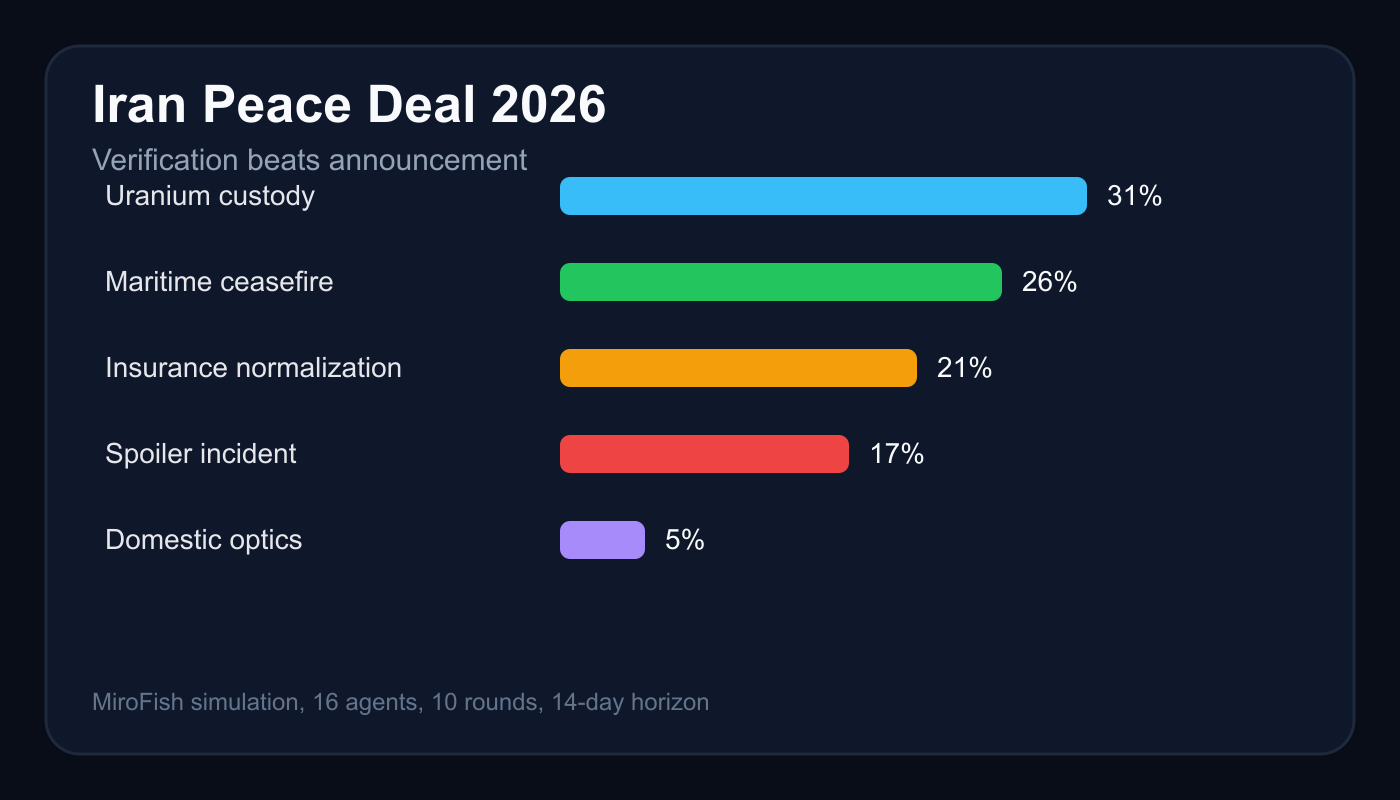
Iran peace deal 2026 risk is now a verification problem, not a headline problem. A 16-agent, 10-round MiroFish simulation of the reported Trump-era Iran package assigned a 38% probability to a fragile partial reopening of the Strait of Hormuz, with escorted or limited commercial traffic, continued incidents, and unresolved nuclear verification disputes. The clean de-escalation case reached only 22%. Renewed maritime escalation sat at 17%. The central finding is sharp: the market should not ask whether a deal is announced. It should ask whether uranium custody, maritime ceasefire rules, and insurance normalization move together inside the first 14 days.
This paper converts the simulation into a research-style assessment for diplomats, energy traders, shipping risk teams, and geopolitical analysts. It should be read with Zeki's prior Gulf models, including the May 22 Strait of Hormuz oil price simulation, the May 19 Gulf strike pause model, and the earlier April 26 U.S.-Iran talks and Hormuz escalation model. The pattern across simulations is consistent. Hormuz risk rarely resolves through one speech. It resolves through repeated evidence that vessels can move, insurers can underwrite, and military actors can avoid humiliating each other.
Background and Context: Strait of Hormuz News
The news trigger was a reported near agreement in which Trump said an Iran deal was largely negotiated and that reopening the Strait of Hormuz was part of the package. The seed document also referenced reports that U.S. officials believed Iran had agreed to give up enriched uranium, while Britain prepared for a possible mission connected to clearing the Strait. Those claims create a diplomatic opening, but also a highly exposed failure point. Every side can support the phrase "peace deal" while disagreeing on what must happen first.
The Strait of Hormuz is the world's most important oil transit chokepoint. The U.S. Energy Information Administration's chokepoint analysis describes why Hormuz matters for global energy flows and price stability: EIA world oil transit chokepoints. A political headline around Hormuz therefore moves more than sentiment. It changes freight assumptions, war-risk insurance, naval readiness, Gulf producer behavior, Asian refiner procurement, and options pricing.
The nuclear side is equally important. The International Atomic Energy Agency remains the global reference point for safeguards and verification: IAEA safeguards overview. If a deal includes enriched uranium transfer, storage, dilution, removal, or custody language, the operational question is whether that concession is visible enough to satisfy Washington, Europe, Israel, and insurers before spoilers can test the maritime environment.
This is why the simulation did not model peace versus war as a binary. It modeled sequencing. Does Iran receive enough face-saving relief to keep economic actors inside the deal? Does the IRGC maritime command lose leverage too quickly? Does Israel view the uranium concession as real or cosmetic? Do tankers return because the sea is quiet, or do they wait because the paper deal has not changed operational risk? These are not secondary details. They are the mechanism.
Methodology: Iran Nuclear Deal 2026 Stress Test
The simulation used 16 agents across 10 rounds on a 14-day horizon. Each agent represented a decision node with incentives, constraints, fears, and timing mismatches. The agents were: Trump White House, U.S. State and NSC deal team, Iran Supreme Leader office, IRGC maritime command, Iranian economic technocrats, Israeli security cabinet, Gulf GCC mediators, Oman and Qatar channels, UK government and navy, EU diplomats, China energy security planners, India energy and diaspora policy team, Japan and Korea importers, tanker insurers and shipping firms, Russia spoiler strategists, and the global oil market.
The model's question was narrow: over the next 14 days, does the near-announced Iran package produce a durable reopening of the Strait of Hormuz, or does it collapse into renewed maritime and military escalation? That framing matters because the immediate period after announcement is the danger zone. Public optimism can run ahead of implementation. Markets can price a breakthrough before verification. Spoilers can act before deconfliction channels are hardened. Domestic audiences can punish concessions before economic relief arrives.
The simulation advanced through 10 rounds: announcement shock, verification bottleneck, Iranian dual track behavior, Strait sequencing, spoiler incentives, UK naval planning, China and India pressure, market testing, domestic optics, and final convergence. The agents repeatedly returned to the same bottleneck. A peace package can survive political noise if maritime safety and nuclear verification reinforce each other. It becomes fragile when either side is asked to trust words while surrendering leverage.
Key Findings: Strait of Hormuz News Signals
Iran Peace Deal 2026: The Base Case Is Fragile Reopening
The largest probability bucket was not clean peace. It was fragile partial reopening at 38%. In this scenario, commercial traffic resumes through limited corridors, escorted movement, or phased insurer-approved routes. Incidents continue at a lower level. Verification disputes continue in parallel. Diplomats call the deal alive. Markets call it unproven.
The final probability table:
| Outcome | Probability |
|---|---|
| Fragile partial reopening, escorted traffic, continued incidents | 38% |
| Meaningful 14-day de-escalation with insurance normalization | 22% |
| Package stalls after announcement, partial disruption continues | 18% |
| Collapse into renewed maritime escalation | 17% |
| Rapid verified diplomatic breakthrough and durable reopening | 5% |
The table shows why the correct baseline is neither triumphalism nor panic. The modal result is movement without trust. That is enough to reduce an immediate closure premium, but not enough to restore a normal shipping environment.
Iran Nuclear Deal 2026: Verification Is the Political Bridge
The reported enriched-uranium concession is the center of gravity. If it is inspectable, sequenced, and tied to visible maritime restraint, it gives Washington a defensible victory and Tehran a path to relief. If it is vague, delayed, or reversible in ways that look cosmetic, it becomes the reason Israel, Congress, European diplomats, and insurers discount the package.
The simulation found that verification does not need to be perfect in the first 14 days. It needs to be credible enough to stop actors from moving into worst-case planning. A named custody mechanism, IAEA-visible steps, explicit limits on enrichment activity, and a timetable for sanctions relief would reduce the spoiler window. A broad political announcement with ambiguous uranium language would extend it.
Strait of Hormuz Oil Price Impact: Insurers Vote First
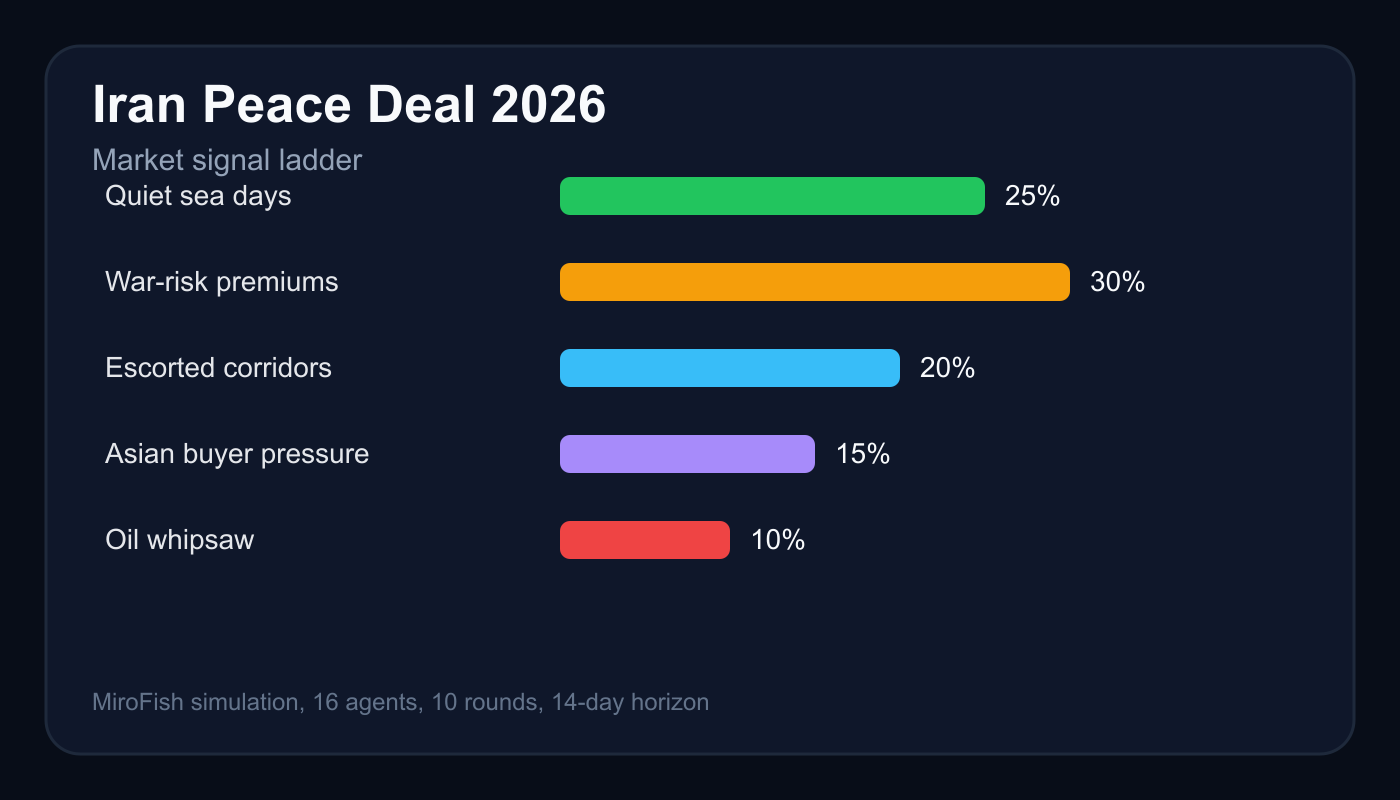
The most market-relevant finding is that insurers and shipowners are the true referendum on reopening. Governments can announce safe passage. Tanker operators decide whether to move metal through the water. Underwriters decide what that movement costs. If quiet sea days accumulate and escorts remain technical, war-risk premiums should fall. If one vessel is detained, mined, hit by a drone, or credibly threatened after the announcement, the deal starts to price like theater.
The simulation's deal-killer was specific: a missile, drone, mine, or seizure incident killing foreign sailors or plausibly tied to IRGC elements after announcement. That event would connect nuclear mistrust to maritime fear in one image. It would also force leaders to defend escalation or look weak.
Market Implications: Strait of Hormuz Oil Price Impact
The first market move should appear in war-risk insurance, freight rates, and tanker availability before spot oil fully reprices. Crude futures can spike or fade on headlines, but the cleaner signal is whether shipowners accept normal routes without extraordinary guarantees. If the 38% fragile reopening case unfolds, Brent and regional freight should shed some headline premium while retaining a sticky risk band. That means rallies fade on diplomatic progress, but dips remain vulnerable to any incident in the Gulf.
The 22% meaningful de-escalation case would require three confirmations. First, enriched uranium custody or transfer must be visible enough for external actors to treat the concession as real. Second, maritime ceasefire rules must be explicit enough that IRGC-linked actors, proxies, Gulf navies, and Western forces know what conduct breaks the deal. Third, insurers must see quiet sea days and official deconfliction channels working in practice.
The 17% renewed escalation case is lower than the fragile reopening case, but it is not small. A 17% event with oil chokepoint exposure is material. The market implication is not to price closure as the base case. It is to price optionality around a failed reopening. Shipping risk, energy options, gold, and defense equities can move on evidence that the deal is stalling before a full military clash occurs.
For Asian importers, the incentive structure is stabilizing. China, India, Japan, and Korea want Gulf flows without a U.S.-Iran war. They are likely to push for quiet implementation rather than maximal public pressure. That buyer pressure helps explain why rapid durable breakthrough is only 5%, but full collapse is not dominant either. Large customers want the Strait open and have channels to tell Tehran that symbolic leverage is worth less than continued energy trade.
Second-Order Effects
If the package partially reopens Hormuz without resolving verification, then shipping markets become the enforcement mechanism. Diplomats will claim progress. Insurers will price doubt. The gap between those two signals will become the best real-time indicator of whether the deal is alive.
If Britain or European navies take a narrow clearing, escort, or deconfliction role, then they can stabilize traffic by reducing uncertainty. If that role is framed by Iranian hardliners as coercive foreign control of the Strait, then it can become a grievance engine. The same ships can be stabilizing or destabilizing depending on mandate, language, and proximity to Iranian forces.
If Israel concludes the uranium concession is real, then its incentive shifts toward monitoring and preserving leverage. If Israel concludes the concession is cosmetic, then the spoiler window widens. The simulation did not need Israel to actively attack for risk to rise. It only needed Israeli distrust to make Washington demand more proof, Tehran resist humiliation, and markets doubt the timetable.
If Russia prefers U.S. distraction and higher energy leverage, then ambiguity becomes useful. Russia does not need to close Hormuz. It benefits if Washington is forced to spend attention, if oil risk premium stays elevated, and if the deal appears fragile enough to weaken U.S. credibility.
If China and India coordinate quiet pressure, then Tehran has a face-saving path to maritime restraint. They can argue for energy stability without appearing to enforce a Western demand. That makes Asian buyer pressure one of the underrated stabilizers in the model.
Risk Assessment
The main model risk is information quality. The simulation used reported claims from a fast-moving news environment. If the underlying deal terms are materially stronger than reported, the 22% meaningful de-escalation path rises. If the uranium concession is weaker, delayed, or internally contested, the 38% fragile reopening bucket can slide toward the 18% stall or 17% renewed escalation buckets.
The second model risk is actor discipline. The framework assumes major stakeholders understand that a post-announcement maritime casualty could destroy the package. That does not eliminate rogue, proxy, deniable, or misattributed action. Hormuz is a dense operating environment. Mines, drones, patrol boats, misidentification, and electronic interference can create escalation without a centralized decision for war.
The third model risk is market reflexivity. If oil prices fall quickly after the announcement, policymakers may treat the market reaction as proof the deal is working. That can reduce urgency around verification. If premiums remain sticky, leaders may interpret the market as hostile or politically motivated. Both reactions can distort implementation.
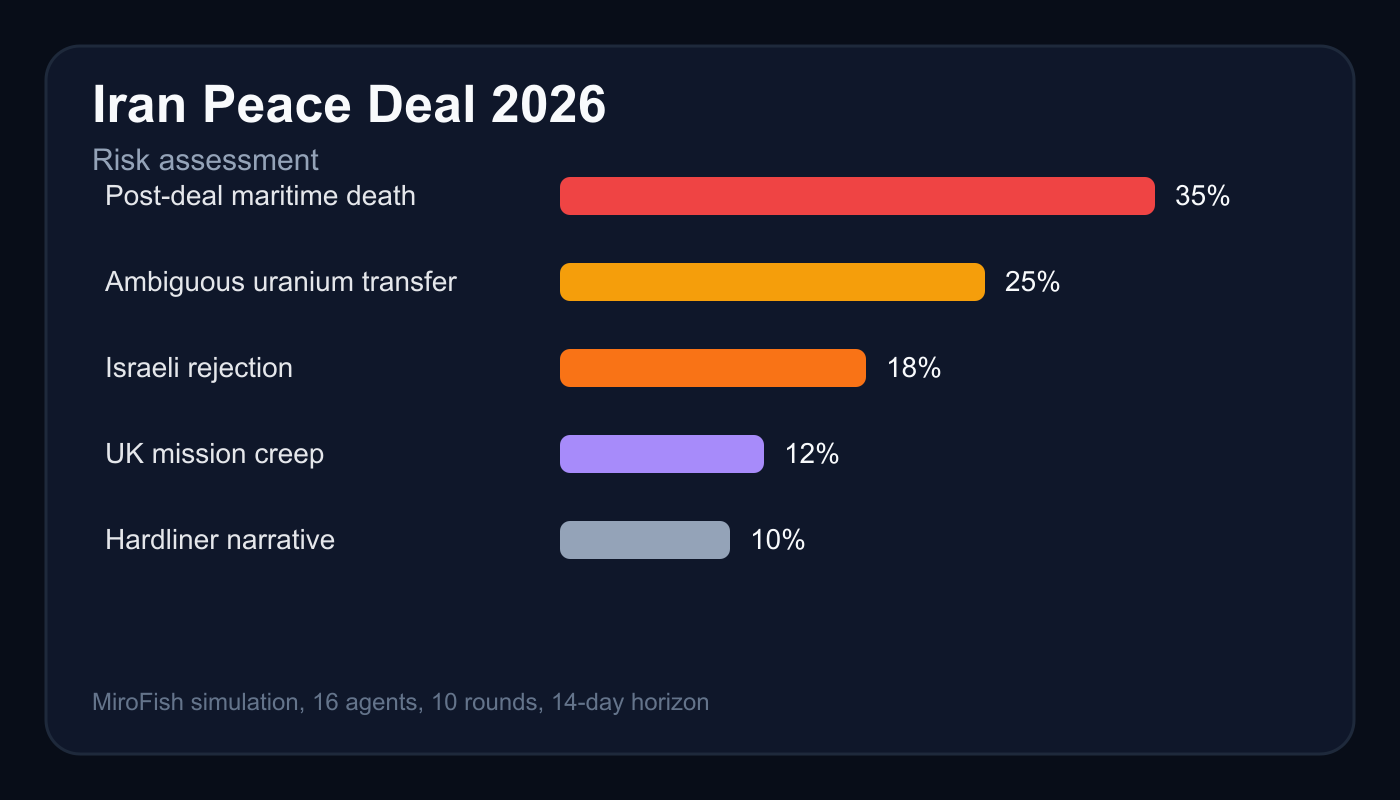
The uncertainty band is therefore wide but structured. Durable breakthrough sits at 5% because it requires nuclear, maritime, domestic, and market clocks to align quickly. Fragile reopening leads at 38% because it requires less trust and more choreography. Renewed escalation sits at 17% because a single post-deal fatal incident can collapse the distance between diplomacy and retaliation.
Conclusion
The Iran peace deal 2026 simulation points to one practical conclusion: watch implementation, not announcement language. A deal that reopens the Strait of Hormuz on paper but fails to align uranium verification, maritime ceasefire rules, and insurance normalization is not peace. It is a pause with a price tag.
The base case is fragile partial reopening. That is better than closure, but it is not durable stability. The signal stack is clear. If enriched uranium custody becomes visible, if GCC, Oman, and Qatar monitoring channels harden, if UK or European naval roles remain technical, and if insurers lower premiums after quiet sea days, the deal can move toward the 22% de-escalation path. If a vessel is hit, seized, mined, or credibly threatened after the announcement, the package collapses toward the 17% escalation path.
The market should treat Hormuz reopening as a process measured in ships, premiums, custody documents, and quiet nights at sea. Speeches start the clock. Verification decides whether it stops.