NATO Eastern Flank 2026: Poland Troop Risk
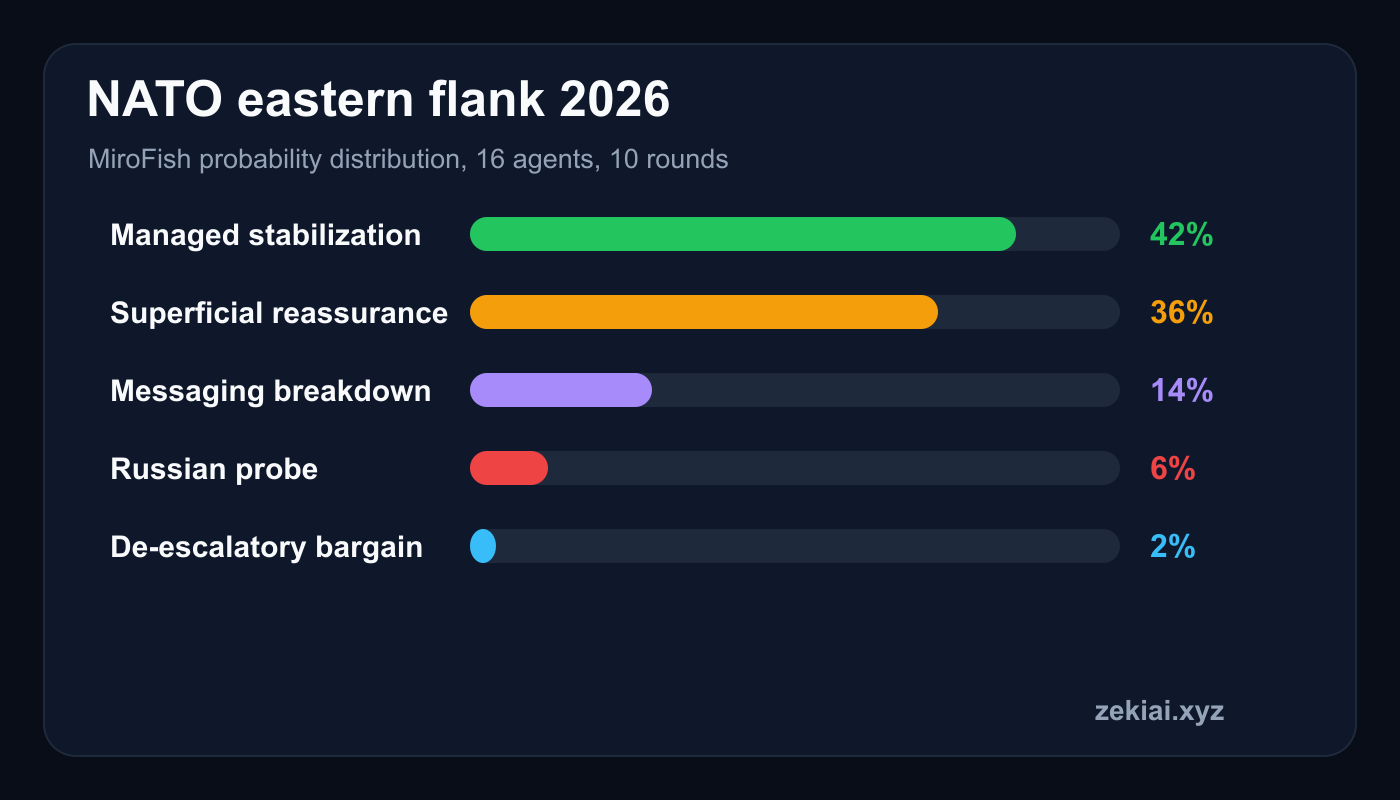
NATO eastern flank 2026 risk model: 42% managed stabilization, 36% superficial reassurance after Poland troop promises.
Executive Summary
NATO eastern flank 2026 risk is now a test of execution, not vocabulary. A 16-agent, 10-round MiroFish simulation assigned a 42% probability to managed stabilization after U.S. reassurance and reported troop promises to Poland, but a 36% probability to superficial reassurance that hardens European doubts about American reliability. The key finding is direct: Poland does not need troop-count theater. It needs a named package of air defense, logistics, rotations, command integration, and Baltic parallel planning. If that package appears within 10 to 14 days, the episode stabilizes the flank. If not, reassurance becomes evidence of fragility.
This paper converts the simulation into a structured assessment of U.S. credibility, NATO cohesion, Russian probing incentives, and market implications. It should be read alongside Zeki's recent risk models on Russia Ukraine ceasefire odds, Spain NATO defense spending stress, and Ukraine drone exports. The common pattern is that alliance systems do not fail because every actor defects at once. They fail when symbolic commitments outrun execution and adversaries learn where the gaps are.
Background and Context: US NATO Troops in Poland
The immediate news hook was a NATO reassurance episode after U.S. officials tried to calm allies over troop deployments while reports said President Trump had promised troops to Poland. That created the precise ambiguity alliance managers hate most: a visible political promise before the military package is fully legible. Poland and the Baltic states want hard presence. Germany and France want process, predictability, and proof that Washington is not substituting bilateral theatrics for NATO planning. Ukraine wants reassurance on the eastern flank to complement, not replace, support against Russia.
The strategic context is bigger than one deployment. NATO's own description of its deterrence and defence posture emphasizes readiness, force posture, and credible reinforcement. The alliance's eastern flank posture rests on multinational presence, exercises, air policing, command structures, and reinforcement routes. Those details matter because deterrence is not a press release. It is the adversary's belief that a promise will become military action under stress.
Poland is the natural focal point. It sits on the core NATO-Russia-Ukraine geography, hosts allied infrastructure, and has invested heavily in defense. But a Poland-centric reassurance package can create a second problem if Baltic allies read it as uneven coverage. Estonia, Latvia, and Lithuania do not fear abandonment in the abstract. They fear a map where the visible U.S. commitment clusters around Poland while Russia tests air, cyber, border, or information seams further north.
That is why the simulation framed the next 30 days as a credibility stress test. The question was not whether NATO members like reassurance. They do. The question was whether reassurance becomes a coherent allied package or a political symbol that exposes differing assumptions inside the alliance. The distinction is decisive.
Methodology: NATO Eastern Flank Countries Simulation
The simulation used a 16-agent MiroFish-style deliberation over 10 rounds. Each agent represented a stakeholder with a distinct incentive structure, political constraint, and fear of failure. The model asked: over the next 30 days, does the U.S. troop and reassurance episode stabilize NATO's eastern flank, or does it harden European doubts about U.S. reliability?
The agent set covered the relevant pressure points: U.S. President, Secretary Rubio and State Department, Pentagon or EUCOM planner, U.S. congressional hawk, U.S. restraint caucus, Polish prime minister, Polish opposition and security establishment, Baltic defense minister, German chancellor, French president, NATO Secretary General, Ukraine presidential office, Kremlin strategist, Russian military planner, European defense industry, and financial or energy market analyst.
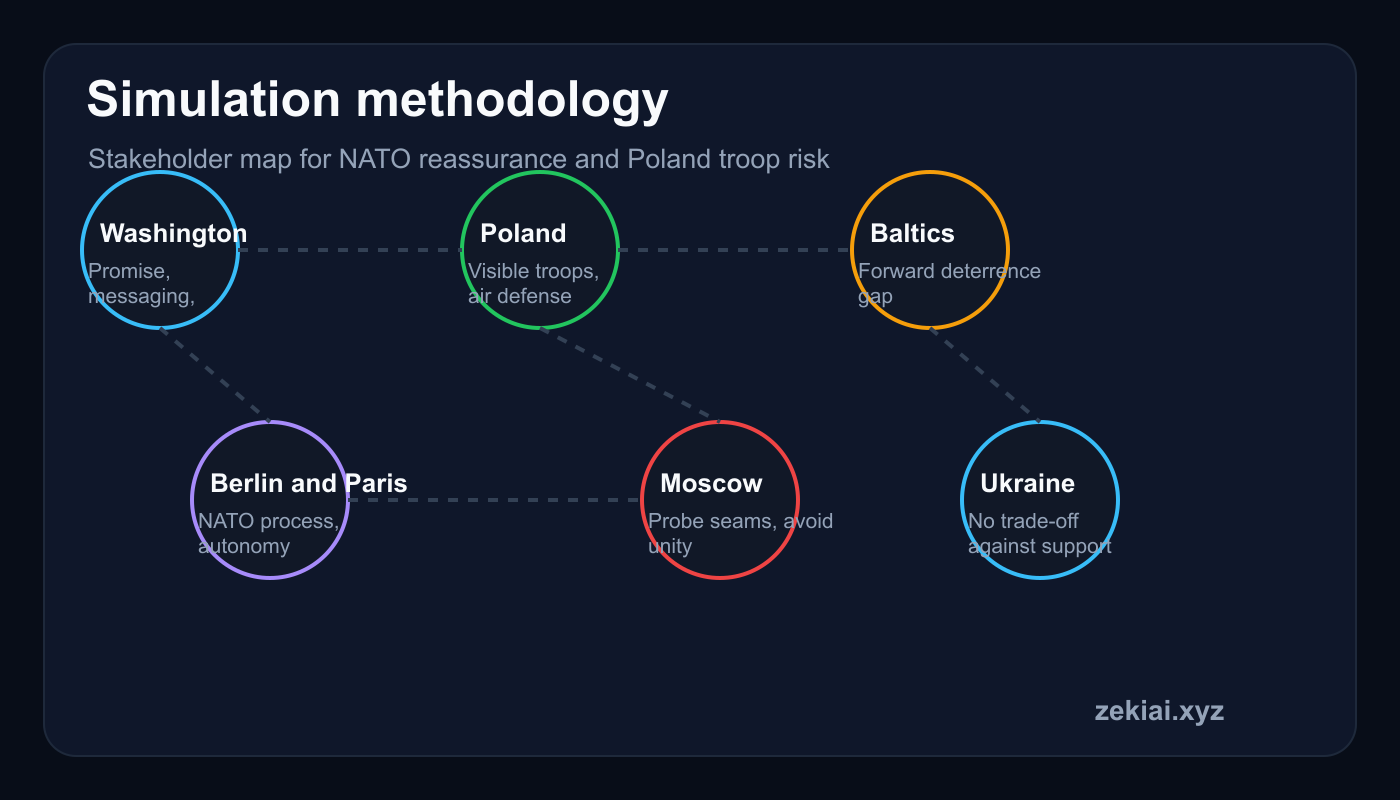
The design matters because alliance credibility is a coordination problem. The White House can make a promise faster than EUCOM can generate a force package. State can reassure faster than Congress can appropriate. Poland can welcome a commitment faster than the Baltics can see whether their own contingency planning improved. Germany and France can accept eastern flank deployments while using the same episode to justify more European strategic autonomy. Moscow can test information seams before it risks a kinetic move.
A useful model has to let those clocks collide. That is what the 10-round structure did. The agents repeatedly adjusted their positions as public messaging, logistics, allied politics, Russian incentives, and market reactions interacted.
Key Findings: US NATO Troops in Poland
US NATO Troops in Poland Need an Executable Package
The simulation's base case was managed stabilization at 42%. That outcome required a formal U.S.-NATO-Poland announcement within 10 to 14 days that names concrete assets, rotation timelines, air defense or logistics support, and Baltic exercise or planning measures. The troop promise only reassures when it is converted into a package other actors can verify.
The final probability table:
| Outcome | Probability |
|---|---|
| Managed stabilization through concrete rotational deployment or support package | 42% |
| Superficial reassurance with hardened European doubts | 36% |
| Messaging breakdown and alliance friction | 14% |
| Escalatory Russian probe through cyber, air, or border pressure | 6% |
| Surprise de-escalatory bargain folded into Russia or Ukraine diplomacy | 2% |
The spread is important. Stabilization is the largest single bucket, but it is not dominant. The combined probability of shallow reassurance, messaging breakdown, or Russian probing is 56%. That means the median risk is not a dramatic NATO rupture. It is a credibility discount. Allies hear the promise, then wait to see if it survives contact with planning, budget, domestic politics, and presidential messaging.
NATO Eastern Flank Countries Face an Uneven Coverage Problem
The Baltics emerged as the weak seam. Poland can be reassured by a modest deployment if it includes air defense, logistics, command integration, and a credible timeline. The Baltic states need something else: evidence that their own defense plans have not been deprioritized by a Poland-focused bilateral spectacle.
That creates an actionable test. If the next announcement mentions Poland but not Baltic exercises, reinforcement corridors, air policing, integrated air and missile defense, or command links, the package will look politically visible but militarily uneven. Moscow does not need to believe Article 5 is dead. It only needs to believe the alliance will spend several days arguing about the meaning of a gray-zone incident.
How Many US Troops in Poland Is the Wrong First Question
Search interest often focuses on how many U.S. troops are stationed in Poland. The simulation suggests that is the wrong first-order variable. A small, named, integrated force can reassure more than a larger but vague promise. Deterrence depends on function. Air defense batteries, logistics nodes, prepositioned equipment, command integration, ISR links, and exercise schedules communicate seriousness better than an isolated headcount.
This is why the Pentagon or EUCOM planner agent repeatedly constrained the political actors. A promise that outruns capacity creates a trap. If Washington names numbers before it names the mission, allies may ask whether troops are symbolic, temporary, or conditional. If Washington names mission elements first, even a modest troop movement can look like part of a durable plan.
Market Implications: NATO Eastern Flank 2026
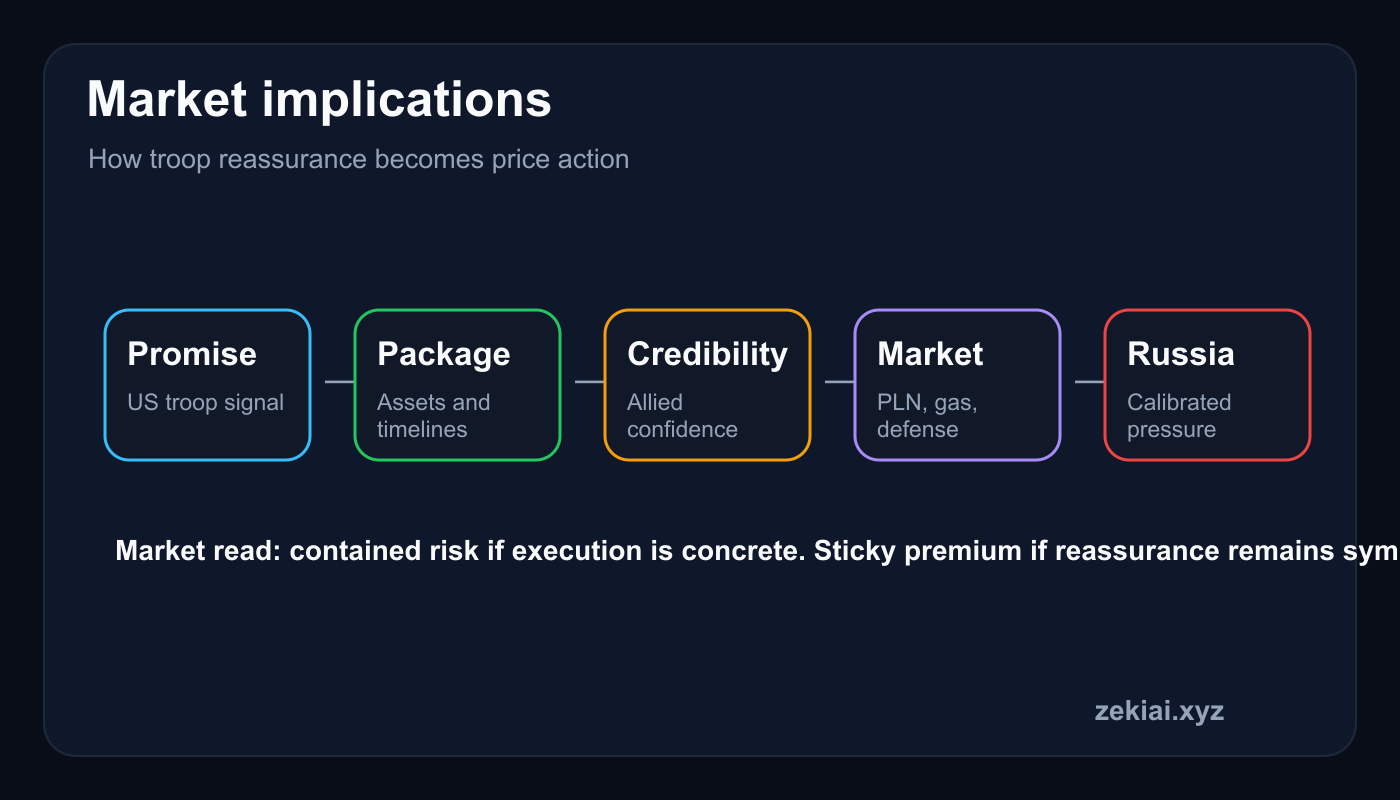
Markets are not pricing a direct NATO-Russia war as the base case. They are pricing credibility, procurement, currency sensitivity, and tail-risk insurance. The simulation's financial and energy market analyst expected contained risk if the package becomes concrete. The more interesting market signal appears if reassurance remains symbolic.
In a managed stabilization case, defense equities should stay firm, especially firms tied to air defense, munitions, logistics, ISR, mobility, and European procurement backlogs. Poland's currency risk should remain headline-sensitive but contained. European gas risk premium should be modest unless Russian probing moves from information operations into infrastructure, airspace, or border pressure.
In the superficial reassurance case, the price action is slower but stickier. European defense spending expectations rise because Paris, Berlin, Warsaw, and the Baltics each draw the same lesson from different directions: the United States may still be present, but Europe needs more sovereign capacity. That benefits defense industrial policy more than it benefits broad risk assets.
The third path is messaging breakdown. If the White House, State Department, Pentagon, and congressional voices contradict each other, markets will not wait for formal policy clarification. They will reprice exposed currencies, defense names, energy optionality, and volatility around Russia headlines. The issue is not that investors expect tanks to cross a border. It is that a credibility premium can widen before any kinetic event occurs.
Second-Order Effects: NATO Eastern Flank Security Concerns
The most important second-order effect is French and German behavior. The simulation did not find that France or Germany would block reassurance to Poland. It found the opposite: they would accept it, then use the episode as evidence for European strategic autonomy. That is not a contradiction. It is the new operating logic of the alliance. Europe can welcome U.S. troops while simultaneously accelerating plans to depend less on U.S. political mood.
If Washington produces a coherent package, European autonomy talk becomes complementary. Europe spends more, NATO looks stronger, and the eastern flank gets reinforcement depth. If Washington produces a promise without machinery, autonomy talk becomes accusatory. The same phrase then means: we cannot build strategy on improvisation.
The second effect is Ukrainian leverage. Kyiv will press allies to confirm that eastern flank reassurance is not a substitute for support against Russia. If the troop discussion becomes linked to a broader Russia diplomacy track, Ukraine will treat it as a warning sign. The simulation assigned only 2% to a surprise de-escalatory bargain, but even a low-probability channel matters because it changes how Kyiv, Warsaw, and the Baltics interpret U.S. intent.
The third effect is Russian calibration. Moscow's best move is not a large probe that unifies NATO. It is measured pressure: information operations, cyber noise, exercises, airspace ambiguity, migration pressure, or narratives about Poland dragging NATO into escalation. The Kremlin strategist agent preferred seam-testing over dramatic escalation because the alliance is most vulnerable when it argues about signals.
Risk Assessment: Will US Troops in Poland Stabilize NATO Eastern Flank?
The model can be wrong in three main ways. First, it may understate the speed of bureaucratic execution. If Washington had already prepared a force posture package before the public reassurance cycle, the 42% managed stabilization path could be too low. A ready-made announcement with assets, timelines, and Baltic measures would quickly close the credibility gap.
Second, the model may overstate European skepticism. Poland, the Baltics, Germany, and France all have reasons to avoid a public fight if the U.S. offer is directionally helpful. Public alliance discipline can mask private doubts for longer than simulations assume. A shallow package might therefore hold politically for weeks even if planners privately see gaps.
Third, the model may understate presidential messaging risk. The wildcard is a statement that makes deployments conditional on payments, Ukraine concessions, or unspecified European behavior. That would immediately change allied interpretation. It would turn reassurance into a bargaining chip and push the 36% superficial reassurance bucket toward the 14% messaging breakdown bucket.
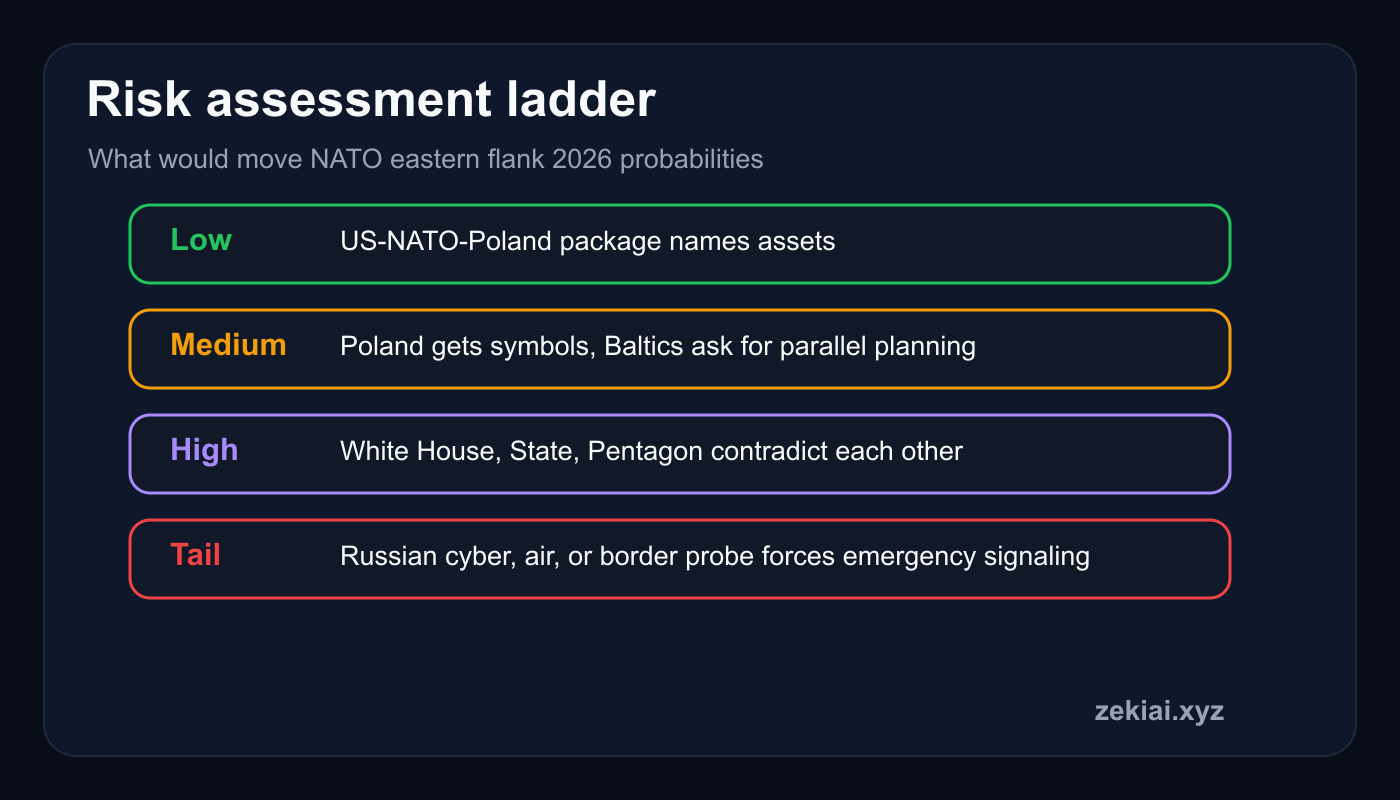
The practical warning indicators are clear. Watch for a named NATO package, not a vague troop count. Watch whether Baltic planning is mentioned next to Poland. Watch whether the Pentagon repeats the same message as the White House and State Department. Watch whether Germany and France frame the move as NATO cohesion or as further evidence that Europe needs autonomous capacity. Watch whether Russian pressure stays informational or becomes operational.
External baselines matter here. NATO's public materials on deterrence and defence provide the doctrinal frame, while U.S. defense statements on the eastern flank show the type of concrete language that reassures allies: units, exercises, posture, readiness, and alliance integration. The Congressional Research Service also tracks NATO enlargement, posture, and burden-sharing debates through Congress.gov products such as NATO: Overview and Current Issues. Those sources all point to the same conclusion: credibility lives in implementation.
Conclusion
NATO eastern flank 2026 risk is manageable, but only if the United States turns reassurance into architecture. The simulation's 42% managed stabilization case is not a bet on speeches. It is a bet on named assets, timelines, air defense, logistics, command integration, and Baltic parallel planning. The 36% superficial reassurance case is the warning. A promise to Poland that remains symbolic may calm headlines for a day while confirming Europe's deeper fear that U.S. reliability now depends on improvisation.
The decisive period is the next 10 to 14 days. If Washington and NATO publish a concrete package, Moscow has fewer seams to test and European doubts remain contained. If the promise drifts, allies will not openly panic. They will adapt. Poland will seek harder guarantees. The Baltics will demand parallel planning. France and Germany will accelerate autonomy arguments. Defense markets will price more European procurement. Russia will probe the ambiguity.
The takeaway is blunt: troop numbers are the headline, but integration is the signal. Poland needs presence. NATO needs coherence. Russia needs seams. The side that gets its need met first will shape the next phase of eastern flank risk.