Gaza Flotilla 2026: Sanctions Risk Model
Gaza flotilla 2026 simulation finds 38% odds of contained sanctions pressure, 18% maritime crisis risk, and a bank de-risking cascade.
Executive Summary
Gaza flotilla 2026 is now a sanctions, aid-access, and alliance-management problem before it is a naval problem. A 16-agent, 10-round MiroFish simulation of the May 19 US sanctions on Gaza-bound flotilla organizers assigns 38% probability to a contained sanctions and legal pressure campaign with humanitarian carveouts. The next most likely path is a 25% domestic political expansion inside the United States and Europe. A maritime confrontation that triggers an alliance-management crisis sits at 18%, high enough to matter, but not high enough to define the base case.
The central finding is simple: Washington can designate networks faster than it can control the downstream behavior of banks, insurers, ports, payment processors, activists, courts, and allies. The stated policy objective is narrow counterterror finance enforcement. The operational risk is broad financial over-compliance that disrupts legitimate aid activity and hands activists a cleaner narrative than the legal record allows.
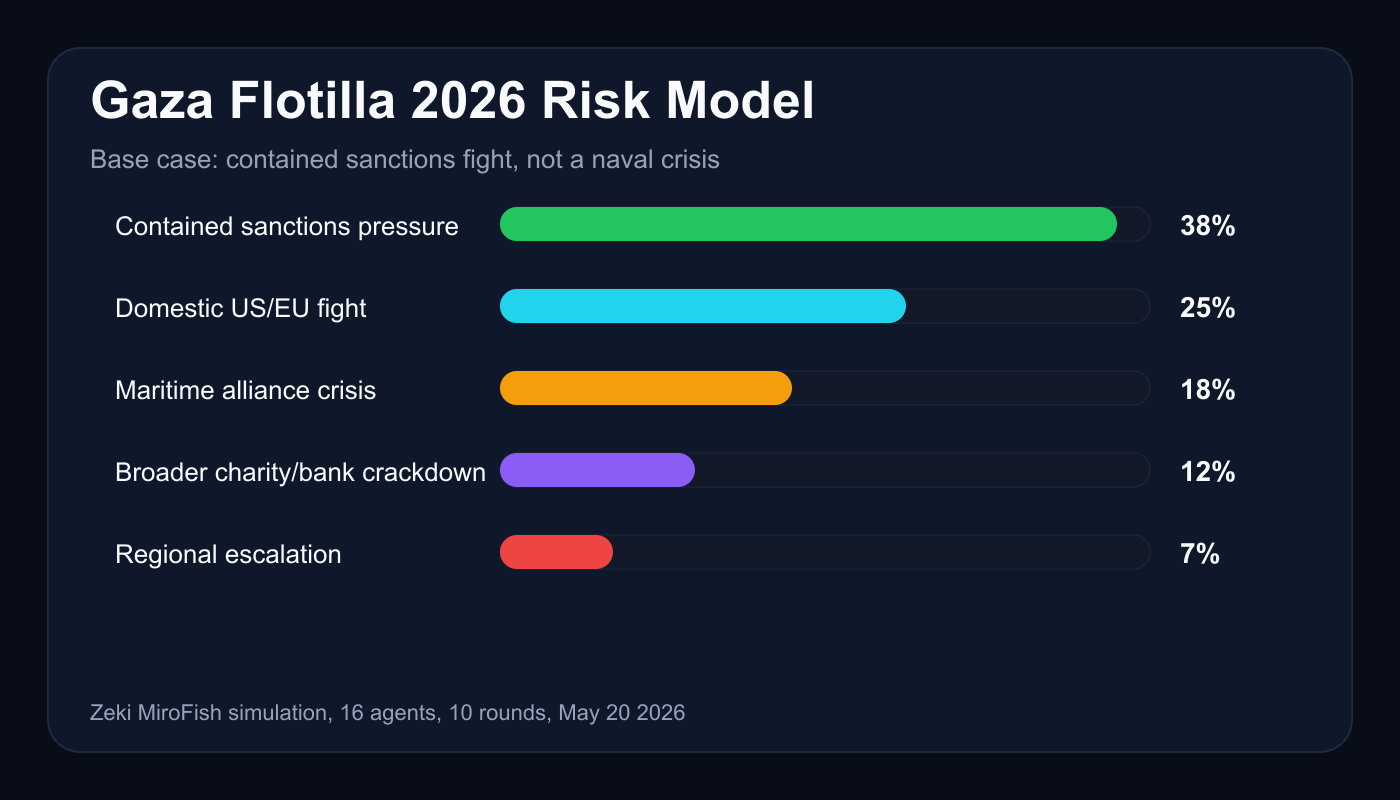
The model does not forecast a dramatic naval clash as the default outcome. It forecasts a grinding legitimacy contest. The most likely cascade is US designations, bank and insurer caution, NGO disruption, activist backlash, litigation and congressional pressure, Treasury clarifications, and humanitarian licenses. The danger is that a single maritime incident can compress that slow legal fight into a visual crisis.
Background and Context: Gaza Aid Flotilla Sanctions
On May 19, 2026, the US Treasury announced action against four individuals associated with a pro-Hamas flotilla organized by the US-designated Popular Conference for Palestinians Abroad, alongside actors operating within Hamas-aligned Muslim Brotherhood networks. Treasury framed the measure as counterterror finance enforcement against networks supporting Hamas, not as a general prohibition on humanitarian aid to Gaza. The official release is the anchor fact for this model and should be read directly at the US Department of the Treasury.
The distinction matters because sanctions law and aid politics operate on different clocks. OFAC designations can be announced in a day. Compliance departments then interpret exposure across correspondent banking, insurance, port services, payment processing, fiscal sponsorships, and donor flows. Civil society groups respond through litigation, media pressure, and coalition-building. Allies ask for evidence that can survive their own courts. Israel evaluates deterrence and operational risk. Flotilla organizers evaluate optics.
This is why Gaza aid flotilla politics can widen even when the formal sanctions package remains narrow. The Office of Foreign Assets Control maintains counterterrorism sanctions architecture, but the practical effect is mediated by private actors that often over-comply when reputational or correspondent-banking risk is ambiguous. In a humanitarian theater, that over-compliance can become the story.
The humanitarian backdrop is already severe. The United Nations Office for the Coordination of Humanitarian Affairs continues to track Gaza access constraints, civilian need, and the politics of aid delivery. That context makes any enforcement action vulnerable to a reframing campaign: sanctions against alleged extremist-linked support networks can be portrayed as sanctions against food, medicine, or civilian solidarity if implementation is sloppy.
This post should be read alongside Zeki's prior Gaza crisis model on the Gaza ceasefire 2026 hostage deal odds and the broader archive at zekiai.xyz/blog. The recurring pattern is that formal agreements, sanctions, and military deterrence only hold when the second-order incentives remain controlled.
Methodology: Humanitarian Aid Sanctions Simulation Design
MiroFish ran 16 agents for 10 rounds. The seed question was: after US sanctions on Gaza-bound flotilla organizers and Muslim Brotherhood-linked networks, does the dispute remain contained or widen into a maritime, alliance, or domestic crisis?
The agent set represented the enforcement and escalation chain: a Treasury sanctions official, a State Department diplomat, an Israel security official, a US congressional hawk, a progressive congressional critic, a flotilla organizer, an international humanitarian NGO lawyer, a civil-liberties litigator, a European legal official, a UK/EU bank compliance officer, a maritime insurer, a Turkish foreign policy adviser, a Qatari mediator, an Egyptian border official, a Hamas political operator, and a media narrative strategist.
The rounds moved from initial sanctions shock to legal framing, Israeli deterrence posture, regional mediator containment, US domestic polarization, European legal distance, the maritime approach window, activist counter-mobilization, containment bargaining, and end-state convergence. Each agent had to defend an institutional incentive rather than optimize for abstract peace.
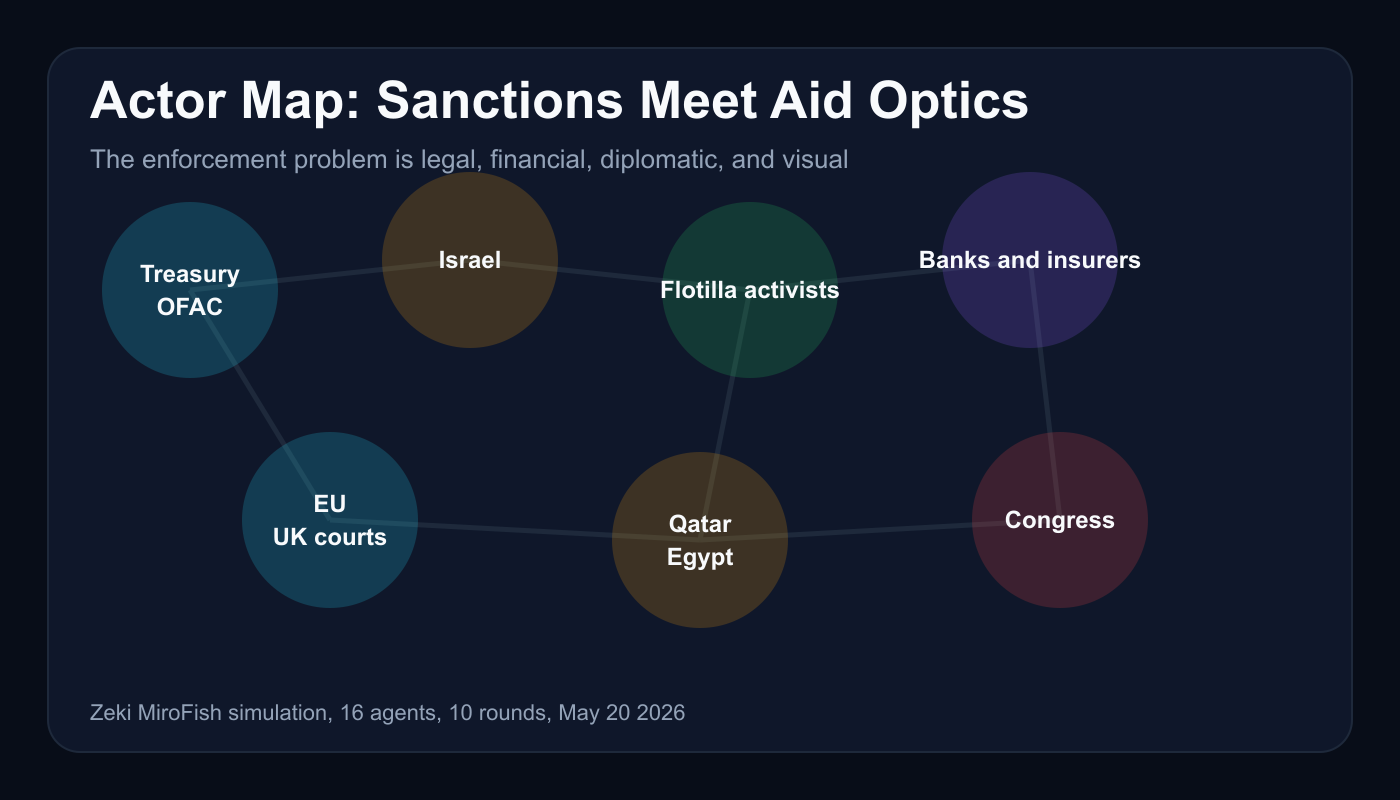
This matters because the question is not whether sanctions are legally justified in the abstract. The operational question is whether the United States and Israel can separate sanctioned extremist-linked networks from humanitarian aid activism in practice. Press language can make that distinction instantly. Banks, insurers, ports, donors, and journalists do not resolve it instantly.
The model used probability-weighted scenario convergence. Agents were allowed to disagree on motives, but had to identify the most likely path under political, legal, and operational constraints. The final distribution was:
| Outcome | Probability | Main trigger | Market or policy signal |
|---|---|---|---|
| Contained sanctions and legal pressure with humanitarian carveouts | 38% | Precise enforcement, Treasury guidance, no dramatic interdiction | NGO disruption limited, allies complain but coordinate |
| Contained but politically expanded domestic fight in the US and Europe | 25% | Progressive backlash, litigation, European evidence demands | Hearings, court filings, bank caution, aid-access pressure |
| Maritime confrontation triggers alliance-management crisis | 18% | Boarding, injury, detained journalist, seized footage, parliamentarian on vessel | Israel-US message discipline breaks, Turkey/EU pressure rises |
| Sanctions widen into broader crackdown on charities and banks | 12% | Hawks push expansion, compliance failures surface | Financial de-risking spreads beyond named targets |
| Regional escalation with Turkish, Qatari, Egyptian, or Hamas-linked countermoves | 7% | Mediation fails, Hamas-linked actors exploit sanctions frame | Rhetorical escalation, proxy signaling, border pressure |
Key Findings: US Sanctions Gaza Optics
Narrow designations can produce broad de-risking
The highest-probability path is contained, but not quiet. Treasury can issue clarifications and humanitarian licenses. That does not prevent compliance departments from acting conservatively before the guidance filters through the system. A bank does not need to believe every NGO is sanctioned to exit a relationship. It only needs enough uncertainty to decide the account is not worth the risk.
That is the first second-order effect. The sanctions may be narrow on paper while broad in financial practice. If legitimate aid groups lose payment access, fiscal sponsorship, insurance, or shipping services, activists gain a stronger argument than they had at the start: the enforcement system is chilling humanitarian work.
The Gaza aid flotilla becomes a visual referendum
The simulation's 18% maritime crisis probability is not driven by a planned war at sea. It is driven by visual asymmetry. A boarding, detention, injury, missing video feed, seized journalist, or European parliamentarian on board can become a cleaner public image than the underlying network evidence. Israel and the United States may have a stronger legal claim, but visual politics can still defeat legal complexity.
That is the maritime hinge. If Israel deters the flotilla through ports, flag states, insurers, warnings, and quiet pressure, the crisis remains mostly legal and diplomatic. If enforcement happens on camera with visible civilian hardship, the sanctions narrative merges with the blockade narrative.
Europe is the slow friction point
EU and UK actors are unlikely to simply import Washington's frame without evidence that can withstand court scrutiny. The model's European legal official and bank compliance agents repeatedly slowed the process. They did not defend Hamas-linked networks. They demanded records, evidentiary thresholds, proportionality, and humanitarian exemptions.
That creates a transatlantic drag effect. The United States can move fast through OFAC. European institutions move through legal review, reputational risk analysis, and domestic politics. The result is not open rupture. It is a slow alignment problem that activists can exploit.
Humanitarian aid sanctions create a narrative trap
Humanitarian aid sanctions is a bad phrase for policymakers because it collapses the distinction they need most. Washington wants to say it is targeting extremist-linked support infrastructure. Activists want to say Washington is criminalizing Gaza aid. The winner is not determined by the first press release. It is determined by implementation.
If aid still flows through credible channels and Treasury issues practical carveouts early, the policy remains defensible. If banks and insurers cut off broad categories of civil society activity, the activist frame becomes self-fulfilling.
Market Implications: Banking, Shipping, and NGO Risk
This simulation has limited direct oil-price relevance compared with Hormuz or Iran strike scenarios. The market impact is concentrated in compliance, insurance, shipping services, donor platforms, and NGO operations. The main risk premium is not crude supply disruption. It is legal and reputational exposure around Gaza-related aid, maritime activism, and cross-border civil society funding.
Banks and payment processors are the first pressure point. They will screen named parties, associated entities, donors, counterparties, fiscal sponsors, and transaction descriptions. Even when a transfer is lawful, a compliance officer may reject it if the relationship is too hard to explain to a regulator. That is how a targeted designation can produce generalized aid-access friction.
Maritime insurers and port services are the second pressure point. A flotilla does not need a naval escort to become operationally difficult. If insurers, flag states, port operators, fuel suppliers, and logistics contractors pull back, the deterrence effect can occur before Israeli forces act. That is the quiet containment path.
NGOs are the third pressure point. The groups most exposed are not necessarily the most ideological. They are the groups with messy counterparties, informal donor networks, weak documentation, or public association with sanctioned actors. The policy lesson is blunt: compliance infrastructure is now part of humanitarian capacity.
Second-Order Effects: Will Gaza Flotilla Sanctions Trigger a Maritime Crisis?
The long-tail question is whether Gaza flotilla sanctions trigger a maritime crisis. The model's answer is no as a base case, yes as a serious tail risk.
If the flotilla is deterred through non-kinetic channels, sanctions remain a legal and diplomatic pressure campaign. If a vessel reaches an interception window with high media visibility, the scenario changes. A single operational decision can override weeks of careful legal messaging.
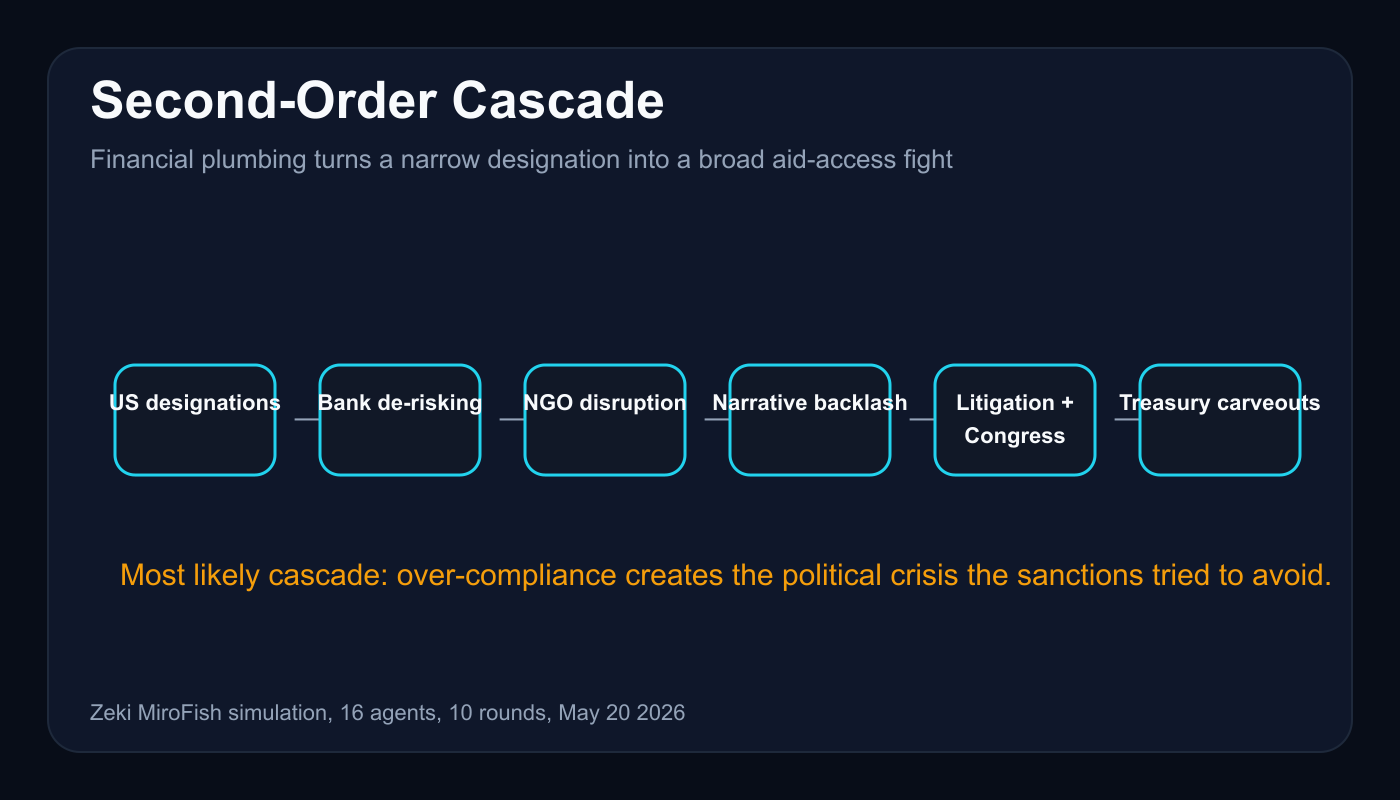
The most likely second-order cascade is financial. US designations cause private-sector caution. Caution disrupts NGOs and donors beyond the named targets. Disruption fuels activist claims that aid is being criminalized. Those claims generate litigation and congressional pressure. Treasury responds with clarifications and humanitarian licenses. Israel grows frustrated that legal containment is slowing deterrence. The flotilla cycle continues through non-military channels.
The underpriced effect is activist selection. Sanctions may discourage some participants, but they also select for organizers who are more ideologically committed, more media-savvy, and less deterred by legal risk. That can make the next flotilla smaller but more politically explosive.
The mediator effect is also important. Qatar and Egypt prefer controlled aid routes because uncontrolled maritime activism weakens their role. Turkey has incentives to escalate rhetorically while avoiding a direct naval commitment. This produces loud diplomacy without automatic regional war.
Risk Assessment: What Could Break the Model
The model could be wrong in three ways.
First, it may understate evidentiary strength. If the US releases detailed, court-resilient evidence tying named organizers to Hamas support structures, allied hesitation and civil-liberties litigation lose force. In that case, the contained sanctions path rises above 38% and the domestic backlash path falls.
Second, it may understate humanitarian optics. If Gaza aid conditions deteriorate further during the enforcement window, any sanctions action becomes harder to distinguish from collective punishment in public debate. In that case, the 25% domestic and European political expansion path rises.
Third, it may understate operational accident risk. Maritime confrontations are low-frequency and high-impact. Poor weather, unclear commands, livestream failure, activist injury, warning-shot confusion, or a detention involving a recognizable foreign figure can reprice the entire scenario in hours.
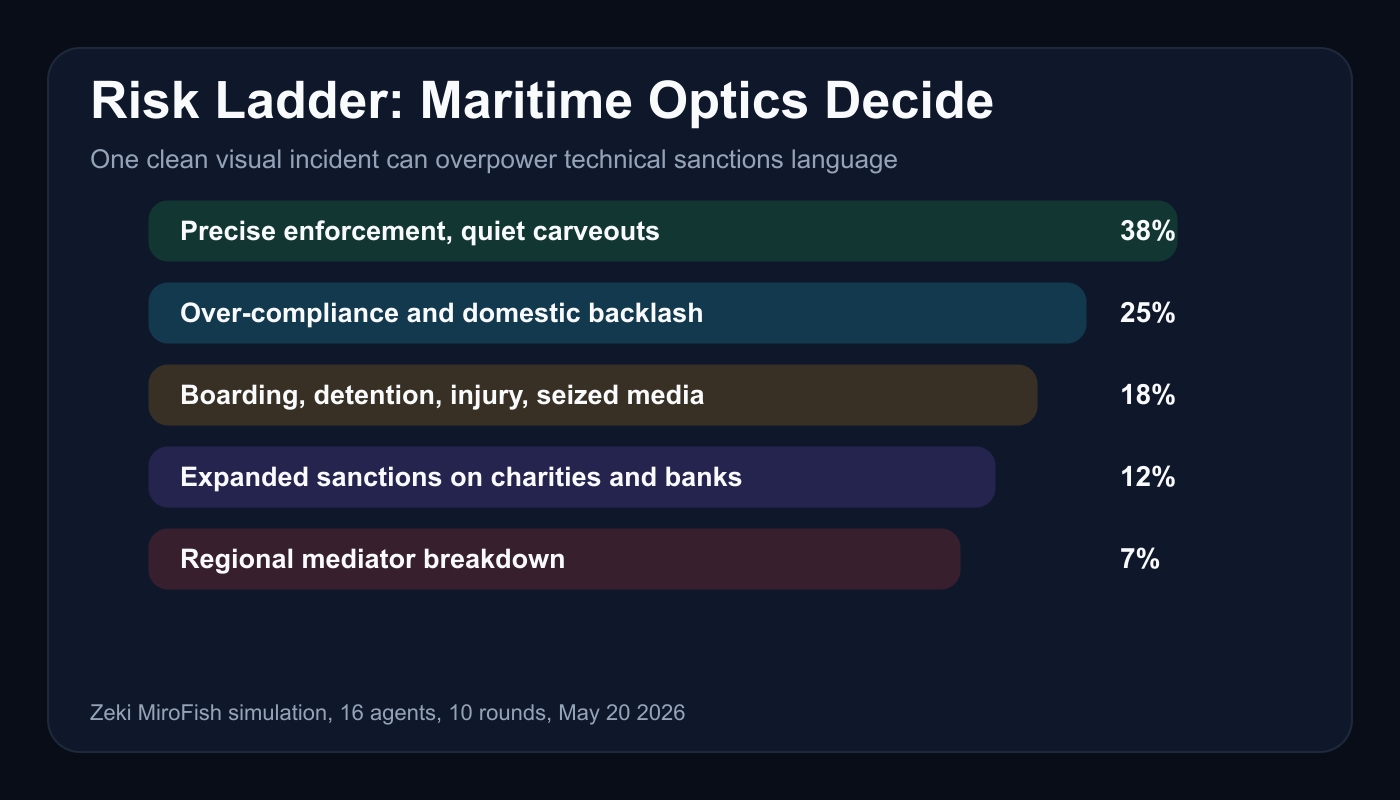
A practical uncertainty band is plus or minus 8 points around the top three outcomes. The 38% contained sanctions scenario could plausibly sit near 30% or 46%. The 25% political expansion path could sit near 17% or 33%. The 18% maritime crisis path could sit near 10% or 26%. The tail risk is not dominant, but it is large enough that policymakers should treat visual incident prevention as a primary objective, not an afterthought.
Conclusion
The Gaza flotilla 2026 sanctions fight is a precision-enforcement test. The United States can win the legal argument and still lose the implementation argument if private-sector over-compliance disrupts legitimate aid and activists capture the humanitarian frame.
The best policy path is boring by design: publish clear evidence, issue early humanitarian guidance, keep banks and insurers from over-correcting, use regional mediators to preserve controlled aid routes, and avoid a visible maritime confrontation unless the legal and operational case is overwhelming.
The simulation's base case is contained pressure with carveouts. The warning is that containment is fragile. In this theater, the decisive event may not be a new sanctions package. It may be one camera angle at sea.