Trump Pauses Iran Strike: Gulf Risk Model
Trump pauses Iran strike as Gulf states request restraint. A 16-agent simulation maps diplomacy, coercion, war risk, oil, and Israel escalation.
Executive Summary
Trump pauses Iran strike is the primary signal in this 14-day Gulf crisis model. The pause did not remove war risk. It converted immediate force into bargaining leverage, and it gave Gulf states a short window to turn restraint into a diplomatic mechanism. A 16-agent, 10-round MiroFish simulation assigns 38% probability to diplomacy gaining traction through interim framework language, 42% probability to contained coercion with talks under military pressure, and 20% probability to renewed war or major escalation within two weeks.
The central finding is stark: Gulf states can delay escalation, but they cannot dictate the settlement. Saudi Arabia, the UAE, Qatar, and Oman have enough access to slow the strike clock because they own the infrastructure risk, host critical channels, and can sell restraint as regional stability. They do not control Israel's patience, the US domestic need for visible coercion, or Iran's refusal to accept public humiliation.
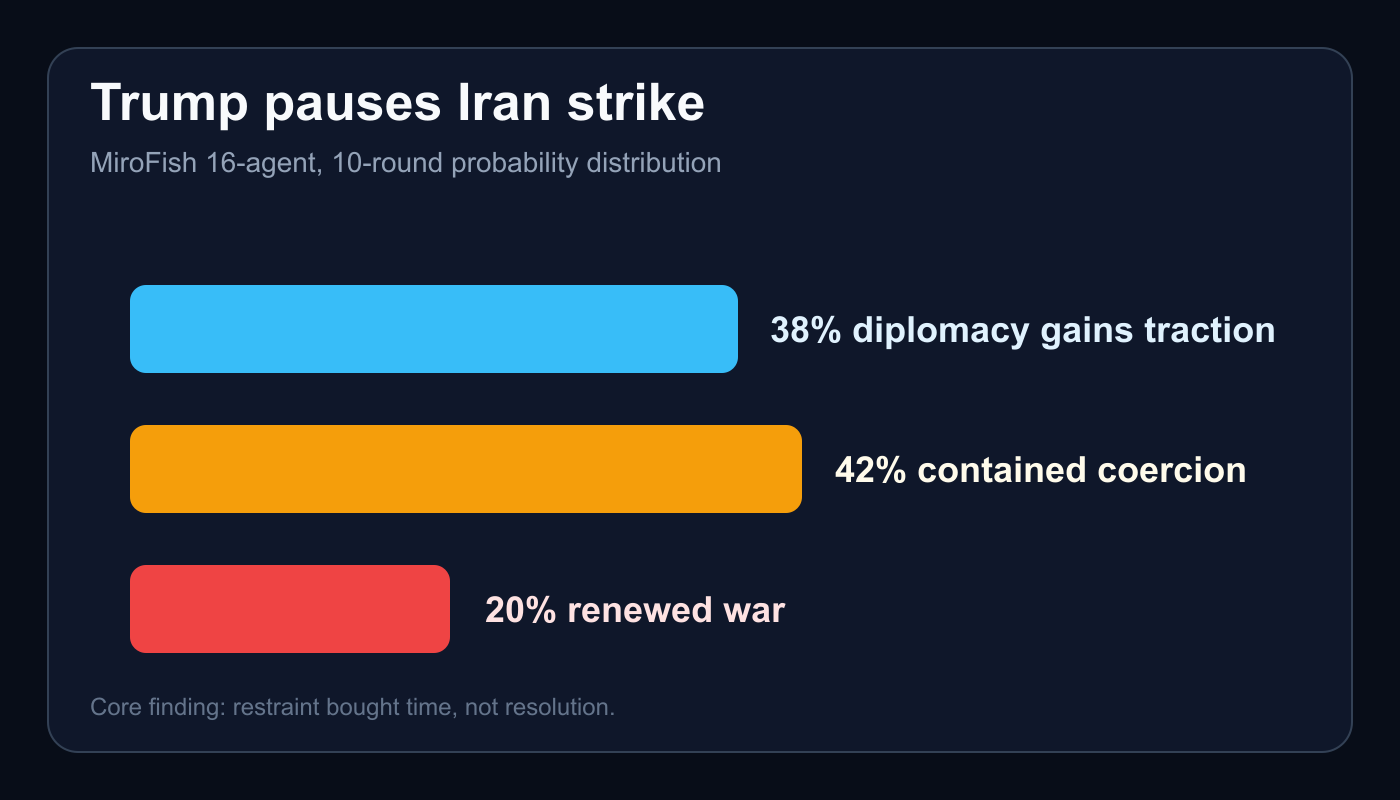
This is not a clean peace scenario. It is a coercive bargaining scenario where every side needs the same pause to mean something different. Trump needs to say pressure worked. Iran needs to say it did not surrender. Gulf mediators need to say infrastructure was protected. Israel needs to say the window did not let Iran recover. The entire two-week outlook depends on whether negotiators can produce a face-saving interim step before a spoiler incident closes the space.
Background and Context: US Iran War Gulf States
The seed event was a reported statement that President Trump called off a planned Tuesday attack on Iran after Gulf states asked for restraint, while also warning that the clock was ticking for Tehran. The sequence matters. A strike was prepared, regional partners intervened, military readiness remained visible, and markets treated the pause as a reduction in immediate conflict probability.
That combination creates a narrow but real bargaining window. Gulf states are not neutral bystanders in a US-Iran crisis. They are exposed infrastructure owners. Their ports, refineries, desalination plants, air bases, and shipping lanes sit inside the retaliation geography. They need US protection, but they also need Washington not to turn their territory into the launchpad for a war that makes them targets.
The US Energy Information Administration has repeatedly identified the Strait of Hormuz as one of the world's most important oil chokepoints. That is why even a temporary reduction in strike risk can soften oil prices. It is also why the relief can reverse quickly. A tanker incident, militia attack, drone strike, or misattributed explosion can move the market faster than diplomats can clarify intent.
Iran's incentives are equally constrained. Tehran wants sanctions relief, regime survival, deterrence credibility, and no public surrender under threat. The International Atomic Energy Agency remains central to any verification pathway, but inspection language only works if it lets Iran avoid the optics of capitulation. An interim freeze can be sold domestically. A televised concession cannot.
This model should be read alongside prior Zeki simulations on Iran bargaining and Hormuz risk, including the US-Iran nuclear deal simulation, the Congress and IRGC peace deal simulation, and the Strait of Hormuz crisis simulation. The recurring pattern is consistent: diplomacy is possible, but only when each actor can preserve a victory narrative.
Methodology: Iran Diplomacy 2026 Simulation Design
MiroFish ran 16 agents for 10 rounds. The simulation question was: after Trump says he paused a planned Iran strike at Gulf states' request, what happens over the next 14 days, diplomacy, contained coercion, or renewed war?
The agent set represented the key pressure centers: Donald Trump, a US national security hawk, a US military planner, the Gulf monarchies bloc, an Oman/Qatar mediator, the Iranian Supreme Leader circle, an IRGC commander, an Iranian diplomat, the Israel security cabinet, a European E3 diplomat, a China energy strategist, a Russia opportunist, an oil market trader, the Iraqi government, a Hezbollah and Axis proxy liaison, and a US domestic antiwar Republican.
The rounds were designed to force convergence and disagreement. Early rounds hardened public positions. Middle rounds tested whether Gulf mediation could convert the pause into credible sequencing. Later rounds stressed spoiler risk, Israeli impatience, market reaction, and domestic political incentives.
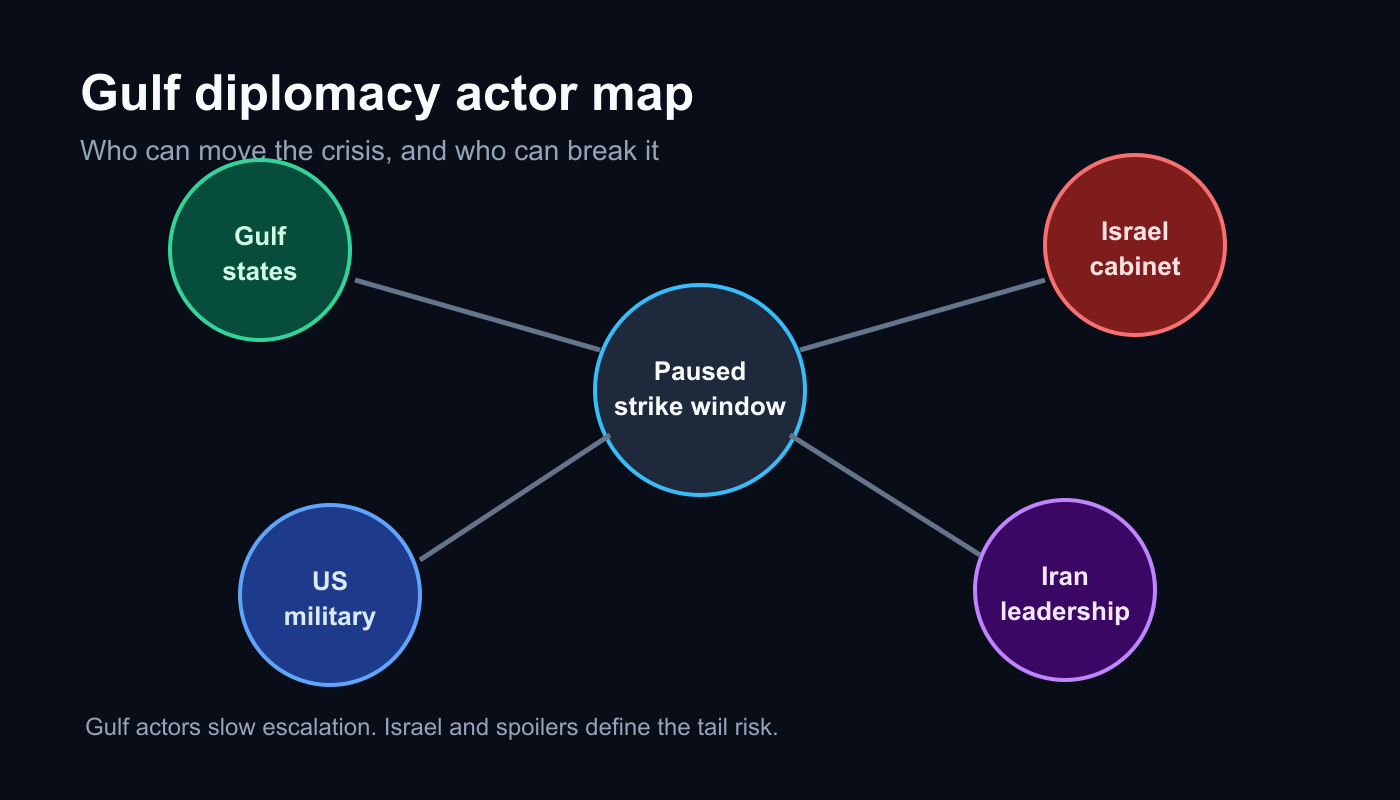
The model did not assume goodwill. It assumed each actor maximized survival, leverage, optics, and downside control. That matters because the most likely outcome was not a formal deal. The strongest convergence was contained coercion: negotiations continue, strike threats remain visible, sanctions pressure persists, maritime alerts stay elevated, proxies calibrate pressure, and Gulf mediators keep shuttling messages.
Key Findings: Israel Iran Escalation Risk
Gulf mediation delays escalation, not final terms
The Gulf bloc has leverage because it can credibly say that escalation threatens shared infrastructure, shipping, energy pricing, and US basing. That leverage is tactical. It can slow the strike clock and open backchannels. It cannot force Iran to concede, force Israel to trust a pause, or force Trump to accept a quiet technical compromise if he needs public proof that pressure worked.
The Gulf role is therefore best understood as time-buying. The first week is decisive. If mediators can produce a freeze, inspection gesture, prisoner channel, sanctions carveout, or de-escalatory statement that each side can rebrand, diplomacy moves from performative restraint to usable process. If they cannot, the pause becomes evidence that pressure failed.
Trump converts the aborted strike into leverage
The simulation did not treat the cancelled strike as weakness. Agents converged on the opposite interpretation. A prepared strike that is paused at allied request gives Trump two messages at once: force was ready, and restraint was chosen because serious negotiations were possible. That duality is politically valuable.
The risk is that duality has a short half-life. If Iran appears to stall, the same pause can be reframed by hawks as a mistake. If talks produce only vague language, Trump may need new coercive proof. That is why contained coercion outranked clean diplomacy by four points in the final distribution.
| Outcome | Probability | Market signal | Political signal |
|---|---|---|---|
| Diplomacy gains traction through interim framework or freeze language | 38% | Oil softens, gold risk premium fades | Trump claims pressure worked, Iran claims non-capitulation |
| Contained coercion with talks and military pressure | 42% | Oil oscillates, shipping insurance stays elevated | Every side preserves leverage, no side closes the file |
| Renewed war or major escalation within 14 days | 20% | Oil spikes, Hormuz risk reprices | Spoiler or Israeli impatience overwhelms backchannels |
Iran's concession space is indirect and reversible
Iran can move if the movement is framed as sequencing, technical inspection, temporary freeze, humanitarian exchange, or regional de-escalation. Iran cannot easily move if the ask is public surrender to US threats. The IRGC commander agent consistently resisted steps that degraded deterrence. The Iranian diplomat agent consistently searched for language that could preserve dignity while reducing strike probability.
That split is important. The path to diplomacy runs through ambiguity. The path to collapse runs through maximalist public demands.
Israel is the key impatient actor
Israel does not need to oppose every diplomatic channel to become the main escalation variable. It only needs to believe the channel is buying Iran time. If Israeli intelligence or political leadership decides the pause allows recovery, dispersal, or nuclear progress, unilateral or covert action becomes the primary spoiler path.
That is why the Israel Iran escalation risk remains high even in the base case. The model's 20% renewed war probability is not driven by a simple US decision to attack. It is driven by the possibility that attribution pressure, proxy action, or Israeli impatience turns a bargaining pause into a credibility crisis.
Market Implications: Oil, Shipping, Gold, and Defense
The immediate market implication is relief with a trapdoor. Oil can soften when the strike clock pauses, because traders remove part of the imminent attack premium. The relief is rational, but it is not durable until there is a mechanism. A reported channel is not the same as a verified freeze.
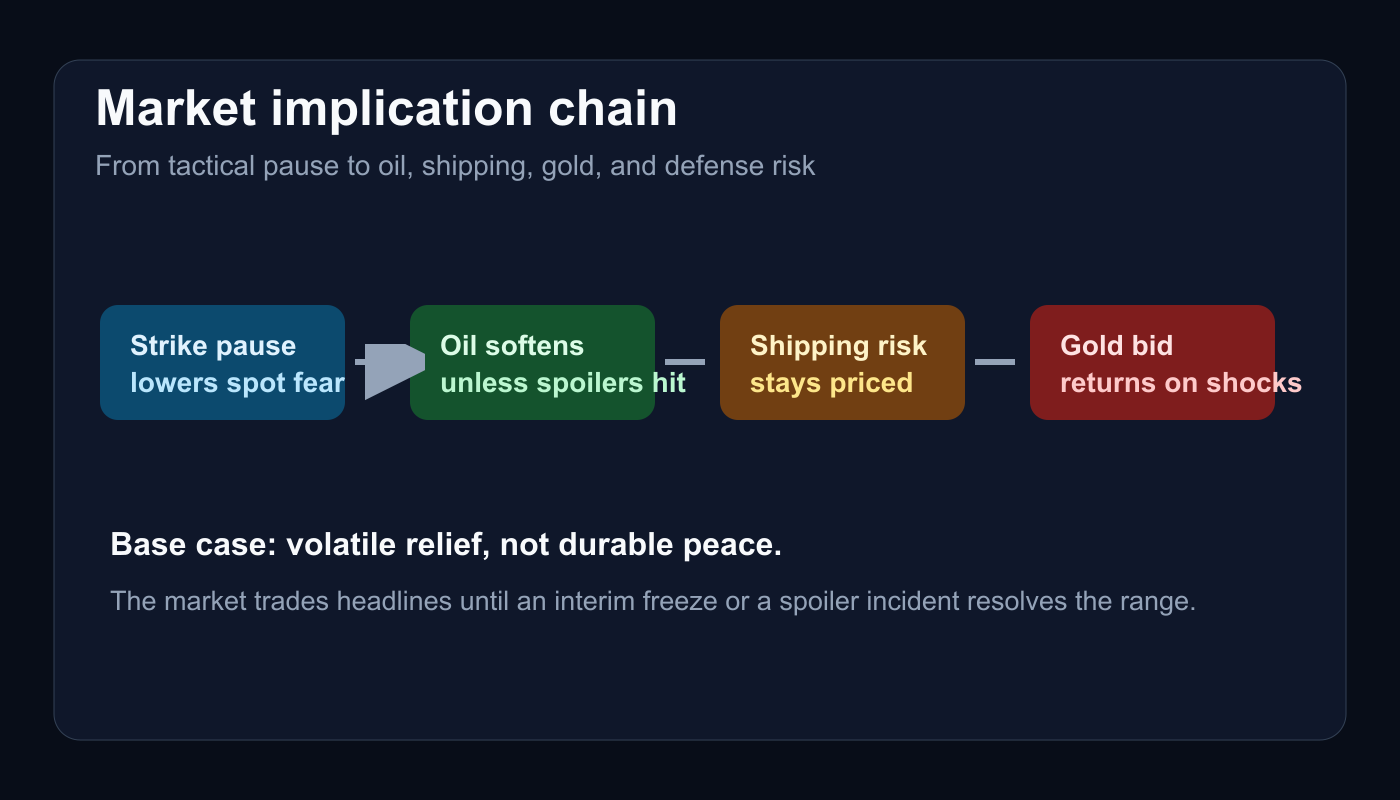
For oil, the base case is choppy range trading. Headlines about talks push prices lower. Military deployments, militia claims, tanker reports, or Israeli briefings push prices higher. Shipping insurance and Gulf infrastructure risk should remain elevated because the physical geography has not changed. The assets at risk are fixed, even if the diplomatic mood improves.
Gold behaves differently. It is less sensitive to the first pause headline and more sensitive to credibility loss. If the market starts to believe the pause was only a delay before force, gold regains the geopolitical bid. Defense equities benefit from sustained posture rather than immediate war, because contained coercion means munitions demand, air defense attention, and regional readiness without the full uncertainty of a major conflict.
The second market point is China. A China energy strategist agent opposed uncontrolled escalation because a Hormuz shock damages import stability and global demand. China benefits from US distraction in some scenarios, but not from an oil shock that creates inflation pressure and supply uncertainty. That makes Beijing a quiet de-escalation stakeholder, even when it publicly blames Washington.
Second-Order Effects: Will Gulf States Prevent a US Iran War?
The long-tail question is whether Gulf states can prevent a US Iran war. The simulation answer is precise: they can prevent a war this week more easily than they can prevent a war this month.
If Gulf mediators produce a credible interim step, then the pause becomes a precedent. Washington can say allied restraint created results. Tehran can say it resisted force and extracted process. Gulf states can say they protected infrastructure. Israel can be offered verification language, timelines, and intelligence coordination.
If mediators fail to produce a step, the pause becomes unstable. Hawks argue restraint invited delay. Iran argues threats were bluffs. Israel argues the window is dangerous. Markets stop pricing diplomacy and start pricing the next catalyst.
Iraq is the underpriced second-order theater. The Iraqi government agent repeatedly pushed to avoid becoming either a launchpad or battleground. That is rational. US forces, Iran-aligned militias, and political pressure all intersect there. A militia incident in Iraq or Syria can collapse the Gulf channel without any Gulf state choosing escalation.
Russia is the other underpriced actor. Russia benefits from US attention being absorbed and from higher energy prices, but not from complete regional chaos that damages diplomatic positioning. Its incentive is opportunistic friction, not necessarily maximum fire.
Risk Assessment: What Could Break the Model
The model can be wrong in four ways.
First, it may underweight private diplomacy already underway. If Gulf and Omani channels have more concrete Iranian commitments than public reporting suggests, the 38% diplomacy case is too low.
Second, it may overweight rational calibration by proxies. The Hezbollah and Axis proxy liaison agent tried to preserve pressure without triggering full war. Real proxy ecosystems are messier. Local commanders, communications failures, or false attribution can create escalation that no capital wanted.
Third, it may underweight Israeli unilateral action. The model captured Israeli impatience, but it may still understate the probability that Israel acts before a diplomatic window matures.
Fourth, it may overread market relief. Oil price softness after a pause can reflect short-term positioning rather than durable belief in de-escalation. Traders can remove imminent strike premium while still expecting volatility.
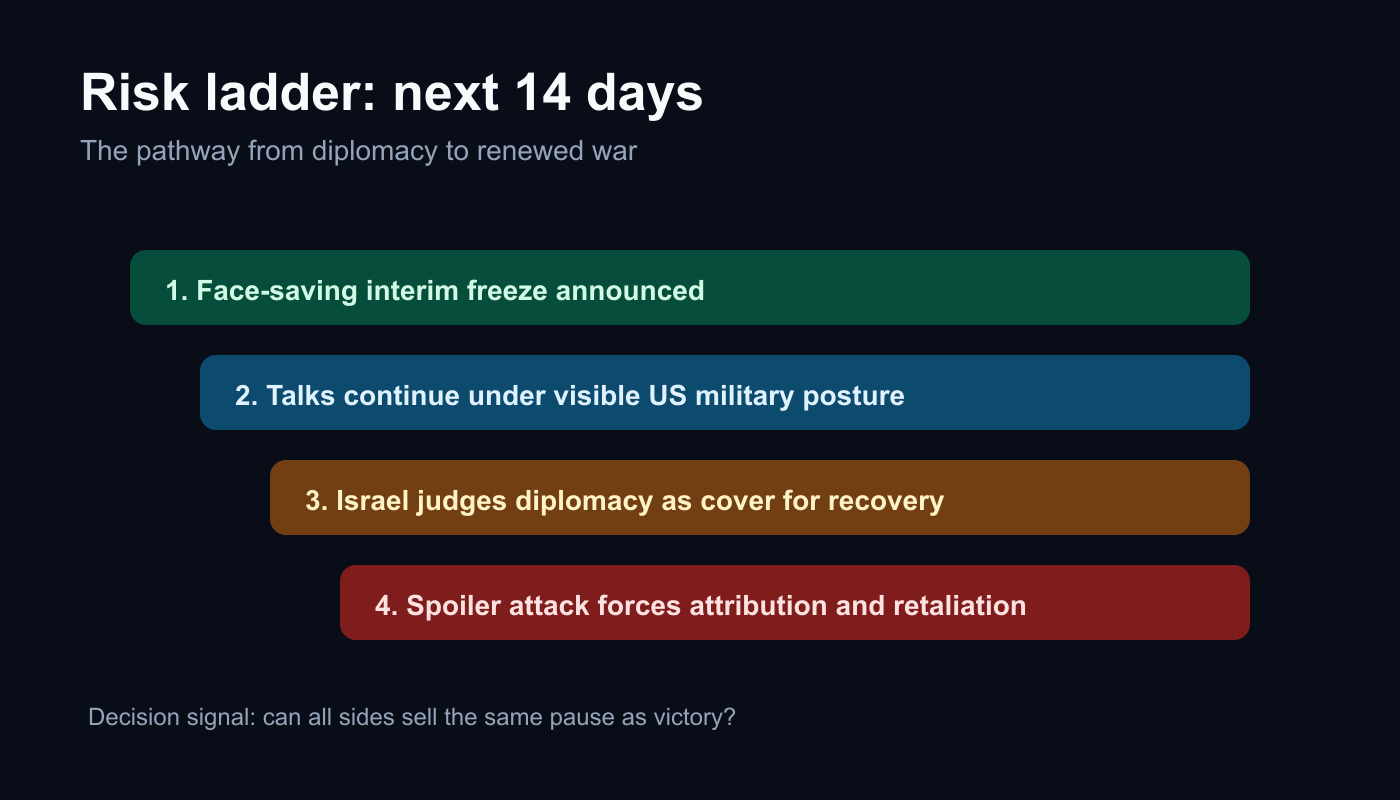
The uncertainty band around renewed war should be treated as wide. The point estimate is 20%, but the live range is closer to 15% to 30% depending on three signals: whether an interim step appears within a week, whether Israel publicly accepts verification language, and whether Gulf energy infrastructure or US forces face a deniable attack.
Conclusion
The Gulf request for restraint changed the tempo, not the structure. The most likely 14-day outcome is contained coercion: talks continue, military pressure remains visible, oil trades headlines, and every actor tries to preserve the ability to claim victory.
The actionable takeaway is simple. Watch for a face-saving interim step within one week. Not a grand bargain. Not public surrender. A freeze, inspection pathway, humanitarian channel, sanctions carveout, or sequencing statement that lets Trump claim pressure worked and lets Iran claim it did not capitulate.
If that step appears, diplomacy can gain traction. If it does not, the paused strike becomes a countdown again.