Gaza Ceasefire 2026: Hostage Deal Odds After Strike
Gaza ceasefire 2026 simulation finds a 34% phased hostage deal path, but Hamas fragmentation keeps deadlock risk at 27%.
Executive Summary
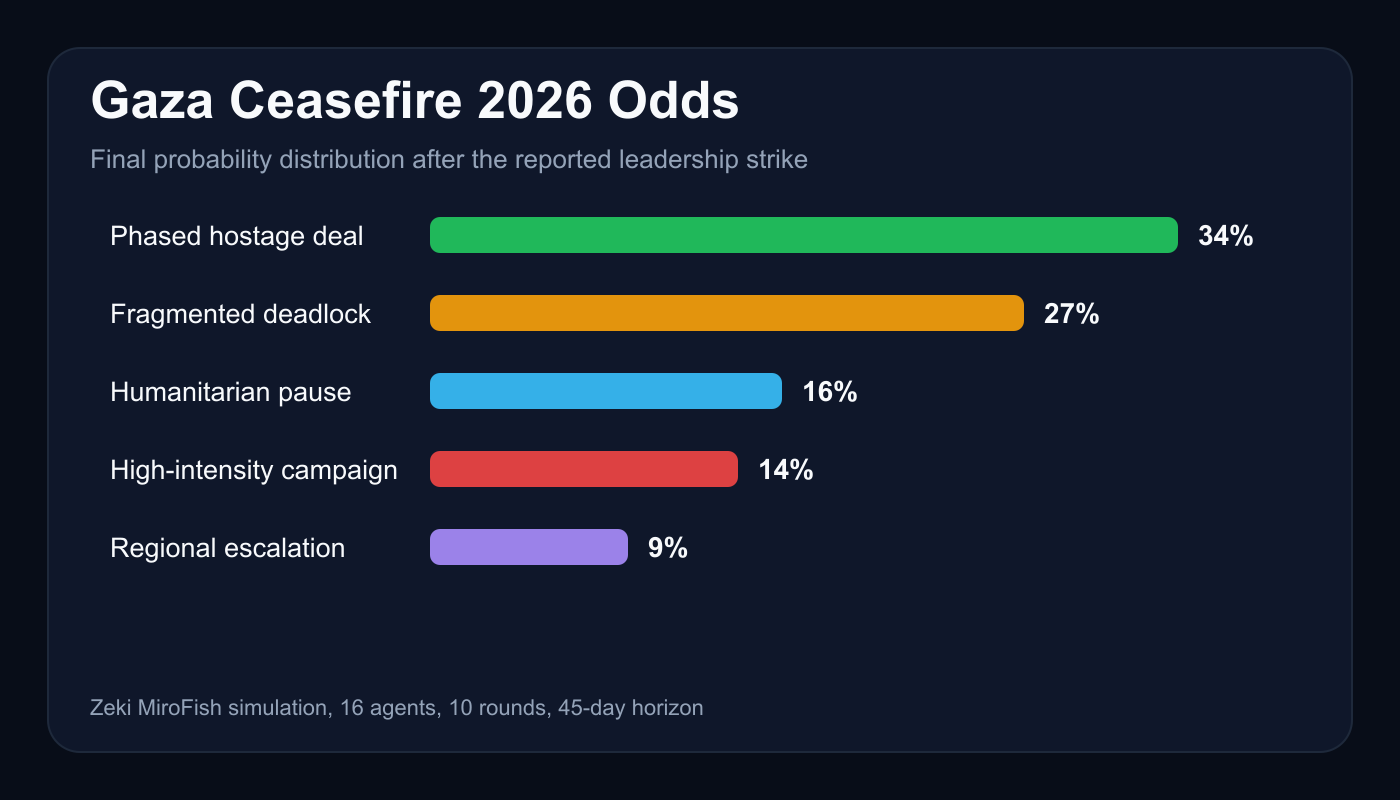
Gaza ceasefire 2026 now has a narrow but real negotiating window. A 16-agent MiroFish simulation assigns a 34% probability to a limited phased ceasefire and hostage deal over the next 45 days, compared with a 27% probability of fragmented insurgency and hostage deadlock. The central finding is not that killing a senior Hamas figure automatically ends the war. It is that tactical success can give Israel a victory narrative, while simultaneously weakening the command structure needed to deliver hostages. The deal exists only if Hamas external leaders can bind Gaza field commanders and hostage-holder cells.
Background and Context: Gaza Ceasefire 2026
The simulation stress-tested the 45 days after reports that Israel killed Hamas's top leader in Gaza. The event falls into a conflict architecture already shaped by hostage diplomacy, humanitarian pressure, Israeli coalition politics, Egyptian border concerns, Qatari mediation, United States regional management, and the risk that Iran-linked fronts exploit a vacuum.
Leader decapitation is often described as a clean inflection point. In practice it is a bargaining shock. It can make compromise easier because one side can claim victory. It can also make compromise harder because surviving commanders fear liquidation, local cells hide hostages, and external leaders lose the ability to enforce terms. That contradiction is the core of this forecast.
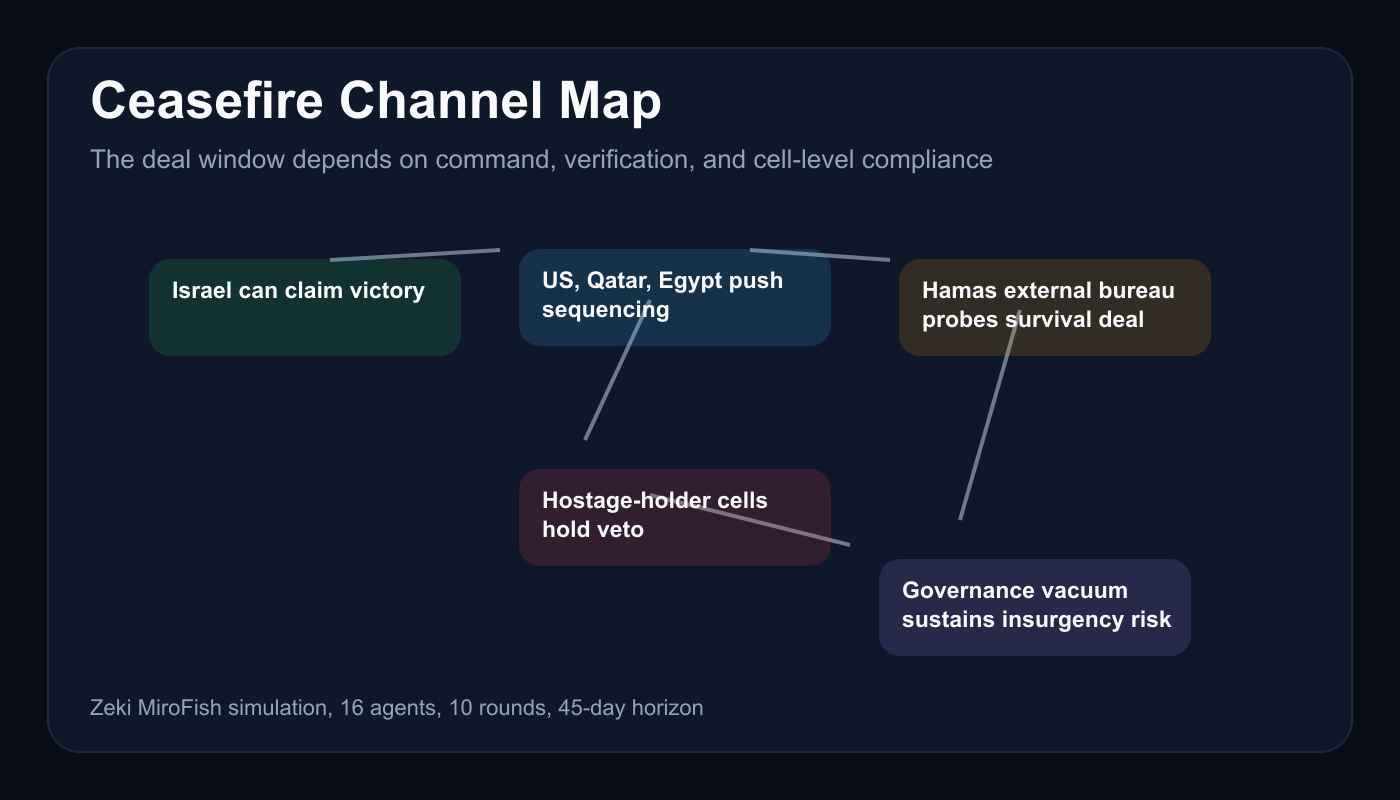
The relevant question is not whether Hamas has been weakened. It has. The relevant question is whether the weakening produces negotiable hierarchy or fragmented veto power. The simulation treated Hamas as a network of external political leaders, Gaza field commanders, and hostage-holder cells rather than a single actor. That distinction changes the forecast. A political bureau can accept a sequence. A cell holding captives can refuse to move.
For internal comparison, Zeki's prior regional simulations have repeatedly found that tactical shocks matter most when they change sequencing. The Strait of Hormuz crisis simulation found that diplomatic off-ramps survived when actors could claim partial success. The US-Iran peace deal simulation found the same pattern around political cover. Gaza is more fragile because the hostage channel requires physical custody, communication, and compliance under battlefield pressure.
Authoritative humanitarian and legal context matters. The UN Office for the Coordination of Humanitarian Affairs tracks Gaza access and civilian conditions at OCHA oPt. The International Committee of the Red Cross outlines the legal prohibition and humanitarian stakes of hostage-taking at ICRC hostages and protected persons. These sources do not answer the forecast, but they define the pressure environment mediators operate inside.
Methodology: Israel Hamas Ceasefire Simulation
The MiroFish run used 16 agents across 10 rounds. The horizon was 45 days. Agents represented the Israeli prime minister, Israeli defense establishment, hostage families and opposition, Hamas external political bureau, Hamas Gaza field commanders, hostage-holder cells, Palestinian civilians and local notables, the Palestinian Authority, Qatar, Egypt, the US White House, the US national security bureaucracy, Iran, Hezbollah, Gulf states, and the EU/UN humanitarian bloc.
The model asked one question: does the leadership strike push the Gaza war toward a negotiated ceasefire and hostage deal, a fragmented insurgency, or wider regional escalation?
Each round forced the agents to react to a changing bargaining environment. The sequence began with Israeli victory claims and hostage-family pressure, moved into Qatari and Egyptian mediation probes, then tested Hamas command cohesion, Israeli coalition constraints, humanitarian pressure, spoiler violence, and implementation. The simulation did not assume that a signed framework equals success. It separated agreement from delivery.
That distinction is essential. Hostage diplomacy fails when the political center signs what the armed periphery cannot or will not execute. The MiroFish agents therefore treated proof-of-life, cell communication, local security guarantees, Israeli repositioning, prisoner-release sequencing, and verification as first-order variables rather than implementation details.
Key Findings
Gaza Hostage Deal Probability
The final probability assessment was:
| Outcome | Probability |
|---|---|
| Limited phased ceasefire and hostage deal, followed by unstable follow-on talks | 34% |
| Fragmented insurgency and hostage deadlock | 27% |
| Partial humanitarian pause without durable hostage breakthrough | 16% |
| Renewed high-intensity Israeli campaign after failed talks | 14% |
| Wider regional escalation involving Hezbollah or Iran-linked fronts | 9% |
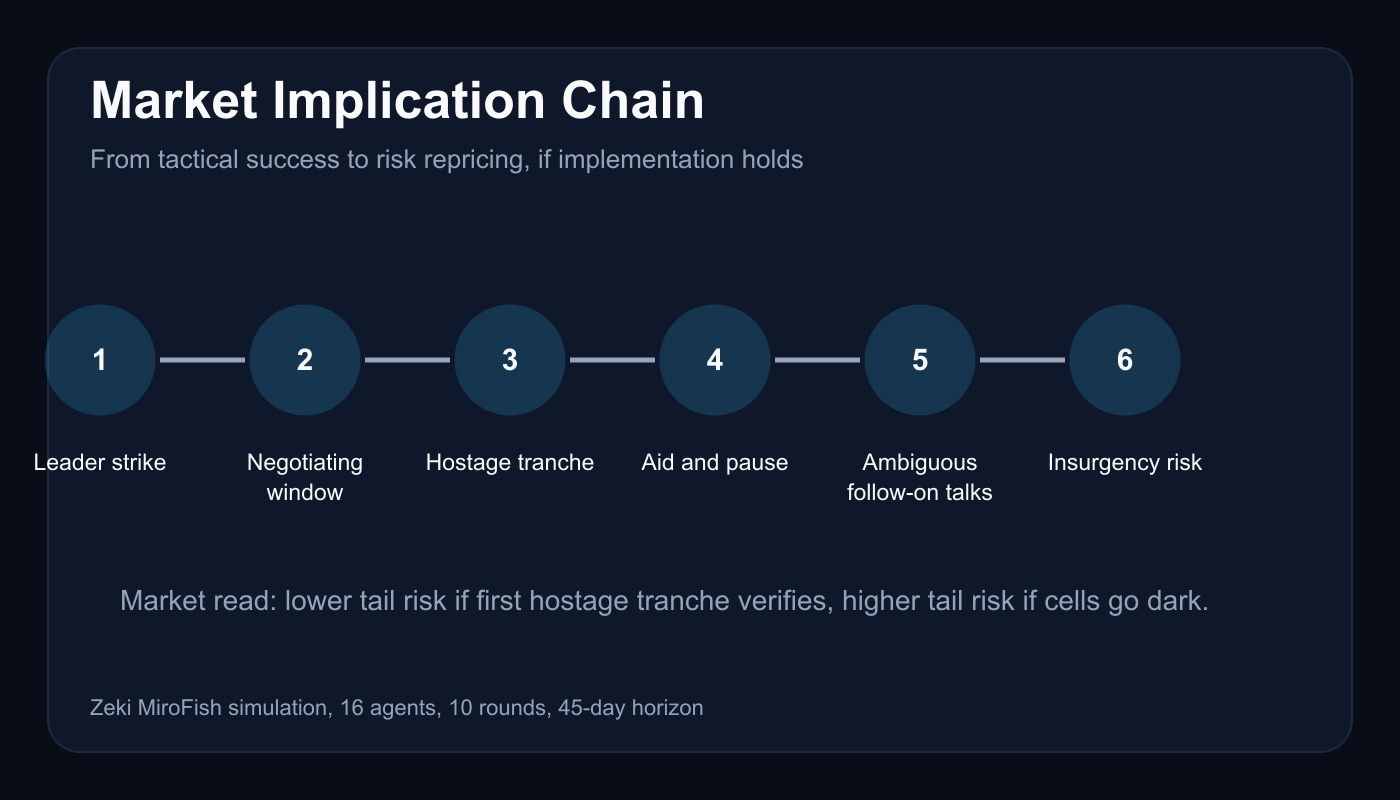
The highest-probability outcome is a limited package, not a comprehensive settlement. That package would likely include a pause, first hostage tranche, prisoner releases, aid surge, partial Israeli repositioning, and follow-on talks. It would avoid final language on Hamas disarmament, Gaza governance, and permanent war termination.
Ambiguity is not a bug in this forecast. It is the mechanism. Israel needs language that preserves the right to resume operations. Hamas needs language that can be framed as survival rather than surrender. Mediators need enough vagueness to get the first tranche moving. The problem is that the same ambiguity that permits signature makes implementation brittle.
Hamas Leader Killed: Why the Strike Opens a Window
The strike creates political cover for Israel. If Israeli leaders can tell the public that a major target was removed, then a hostage deal can be framed as consolidation of success rather than concession. That is why the simulation raised the probability of a phased deal above the probability of immediate escalation.
Hostage families and opposition forces matter here. Their argument becomes sharper after a tactical victory: if Hamas leadership has been degraded, why not use the moment to bring hostages home? Israeli defense officials also have an incentive to convert battlefield leverage into a sequenced arrangement before captives are moved, communications degrade further, or local cells improvise.
The US, Qatar, and Egypt have a similar incentive. A leadership shock gives mediators a reason to test whether remaining Hamas structures still have enough coherence to bargain. The diplomatic pitch is simple: exchange tactical Israeli success for hostages, aid access, and a temporary reduction in violence.
Israel Hamas Ceasefire Talks Face a Command Problem
The same strike that improves Israeli political cover can damage Hamas's ability to deliver. This is the simulation's most important tension. External leaders may prefer survival, prisoner releases, and relevance. Gaza field commanders may prioritize revenge credibility or local security. Hostage-holder cells may become independent bargaining actors.
That makes the decisive actor smaller than most public analysis assumes. The veto may not sit with a named political leader. It may sit with a cell that controls captives, fears being targeted, and does not trust guarantees from either Hamas external leaders or Israel. If those cells go dark, move hostages, raise demands, or split, the deal path collapses into deadlock.
The 27% fragmented insurgency outcome is therefore not a residual category. It is a serious competing path. In that scenario, formal channels continue, public statements alternate between threats and conditional openness, and mediators keep working, but no actor can credibly deliver the hostage mechanism.
Market Implications
Markets should treat the first verified hostage tranche as the key signal, not the first optimistic briefing. A temporary decline in regional risk premia is rational if mediators secure proof-of-life, a named release sequence, and observable movement toward aid access. The strongest near-term effects would be in energy tail-risk pricing, Israeli domestic risk assets, regional shipping insurance, and gold volatility.
The simulation does not produce an oil shock base case. Wider escalation involving Hezbollah or Iran-linked fronts received 9%. That is low enough to reject panic pricing, but high enough to keep tail hedges alive. The risk is asymmetric. A functioning first-stage deal compresses risk gradually. A failed implementation, especially one tied to a dead hostage, a spoiler attack, or a northern-front incident, reprices risk quickly.
For energy markets, the relevant path runs through regional linkage rather than Gaza alone. Iran and Hezbollah agents preferred credibility without uncontrollable war. Gulf states preferred stabilization and reconstruction leverage, but not financing chaos without governance. Egypt prioritized border stability and no refugee spillover. Qatar prioritized diplomatic relevance and a viable channel. Those preferences reduce the odds of deliberate regional expansion, but they do not eliminate accidental escalation.
For political markets, watch three indicators. First, whether Israeli coalition hardliners accept a limited first phase or force maximal terms. Second, whether Hamas external leaders can provide verifiable signs of control over Gaza cells. Third, whether mediators can separate humanitarian access from final-status arguments long enough to build momentum.
Second-Order Effects
The first second-order effect is that victory rhetoric may become pro-deal rather than anti-deal. In many conflicts, claiming success hardens maximalism. Here it can also create permission to pause. If Israeli leaders can declare that a senior Hamas figure was removed, a hostage deal becomes easier to sell domestically.
The second effect is that Hamas fragmentation can increase both deal urgency and deal fragility. Mediators may rush because they fear hostages will scatter. Field units may resist because they fear exposure. The same fact supports opposite strategies.
The third effect is that Gaza governance becomes the post-deal failure point. A first-stage package can move hostages and aid without solving who governs Gaza. That is why the simulation did not treat a 34% phased deal as peace. It treated it as a temporary equilibrium. The Palestinian Authority wants a pathway back but fears being seen as arriving under Israeli cover. Gulf states may fund reconstruction only if governance is credible. Israel wants security control. Hamas remnants want survival. These preferences do not align.
The fourth effect is that humanitarian pressure changes the negotiating clock. Civilian conditions give the EU/UN bloc, Washington, and Arab mediators stronger arguments for aid access and pause sequencing. They also increase reputational cost for delay. OCHA's reporting environment gives this pressure a public measurement system, which makes private diplomacy harder to ignore.
Risk Assessment
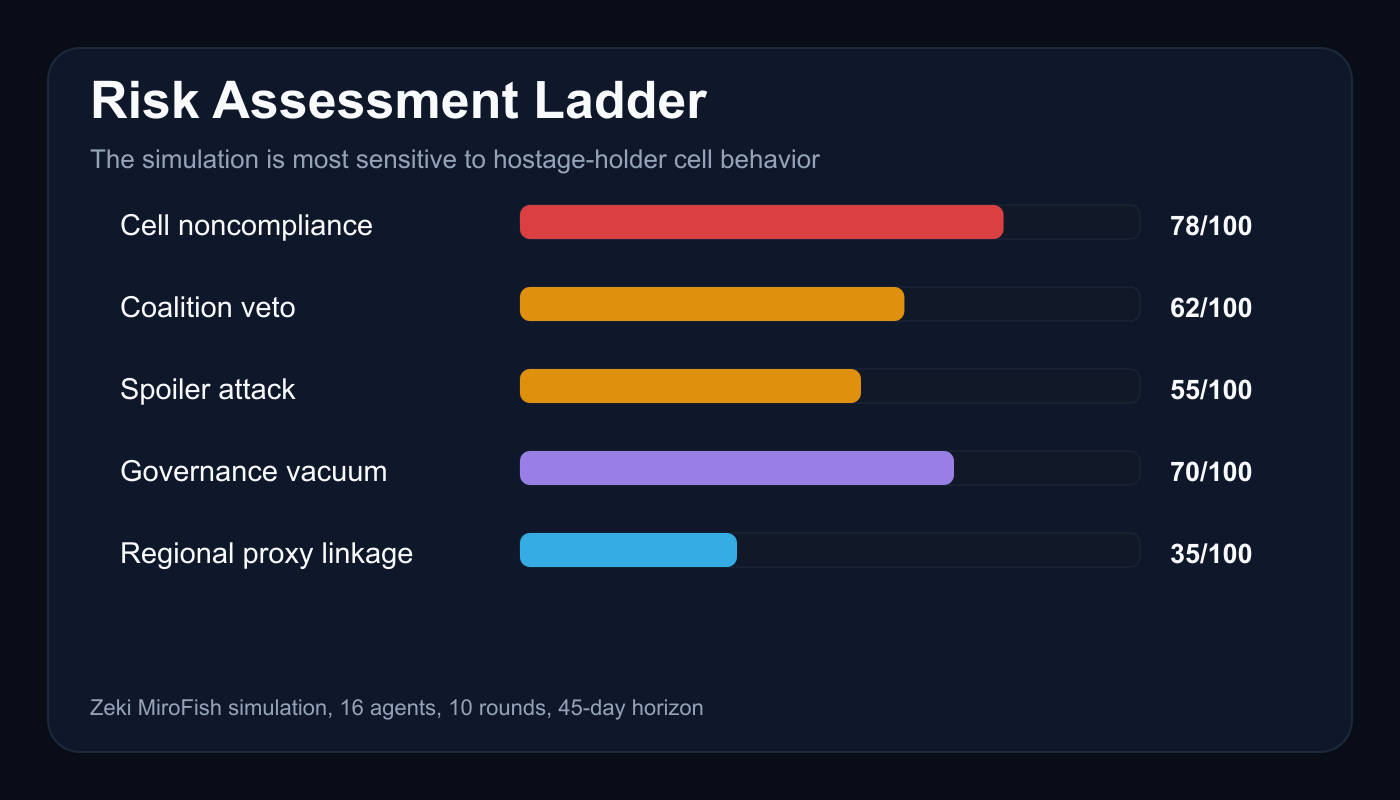
The simulation is most sensitive to one variable: whether Hamas external leaders can credibly locate, command, and deliver hostage-holder cells inside Gaza. If they can, the 34% phased deal path is underpriced by public pessimism. If they cannot, the 27% deadlock path becomes the base case.
The main model risk is information opacity. Outside observers rarely know which cells hold which captives, who can communicate with them, or what security guarantees they require. A model can represent incentives, but it cannot see tunnel-level command links. That uncertainty should widen the probability bands around both the deal and deadlock outcomes.
A second risk is Israeli domestic politics. The prime minister can frame a deal as victory consolidation, but coalition hardliners can frame the same deal as surrender. If the government requires maximal language on disarmament or permanent security control before a first hostage tranche, the deal path narrows.
A third risk is spoiler violence. Palestinian Islamic Jihad, local cells, rogue actors, or regional proxies can create events that make ambiguity politically impossible. In the simulation, spoiler violence did not automatically cause regional war. It did give hawks leverage and made implementation verification harder.
A fourth risk is over-reading mediation momentum. Qatar and Egypt can test channels, but they cannot manufacture command cohesion. The US can pressure allies, but it cannot personally deliver hostages from a fragmented battlefield. Diplomatic intensity is necessary, not sufficient.
Conclusion
The forecast is clear: the most likely constructive path is a limited phased Gaza hostage deal, not a comprehensive ceasefire settlement. The leadership strike improves the odds of a first-stage package because it gives Israel a victory narrative and gives mediators urgency. It also raises the odds of deadlock because it can fracture the command chain needed to deliver captives.
The next 45 days should be judged by implementation signals, not statements. Proof-of-life, named release sequencing, aid access, prisoner lists, Israeli repositioning, and evidence that hostage-holder cells obey instructions matter more than public optimism. If those indicators appear together, the 34% phased-deal path strengthens. If cells go dark or coalition vetoes dominate, Gaza moves toward fragmented insurgency and renewed operations.
The tactical center of the conflict has shifted. The decisive question is no longer only what Israel, Hamas's political bureau, or Washington wants. It is whether the smallest armed actors with the highest leverage can be brought inside a sequence before the window closes.