Hormuz Crisis 2026: Gulf of Oman Seizure Risk
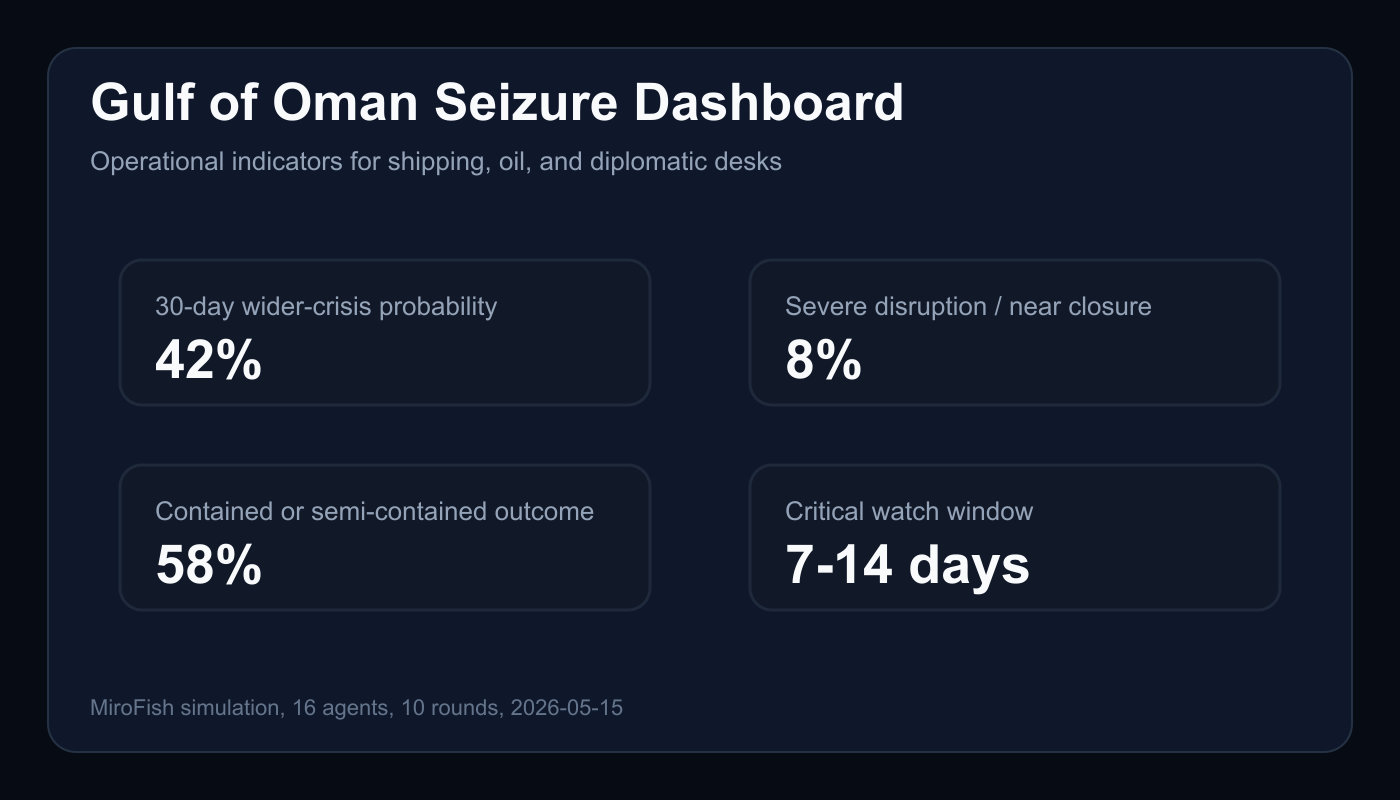
Hormuz crisis 2026 simulation finds 58% containment odds, 42% wider-crisis risk, and a 7-14 day trigger window after Hui Chuan.
Executive Summary
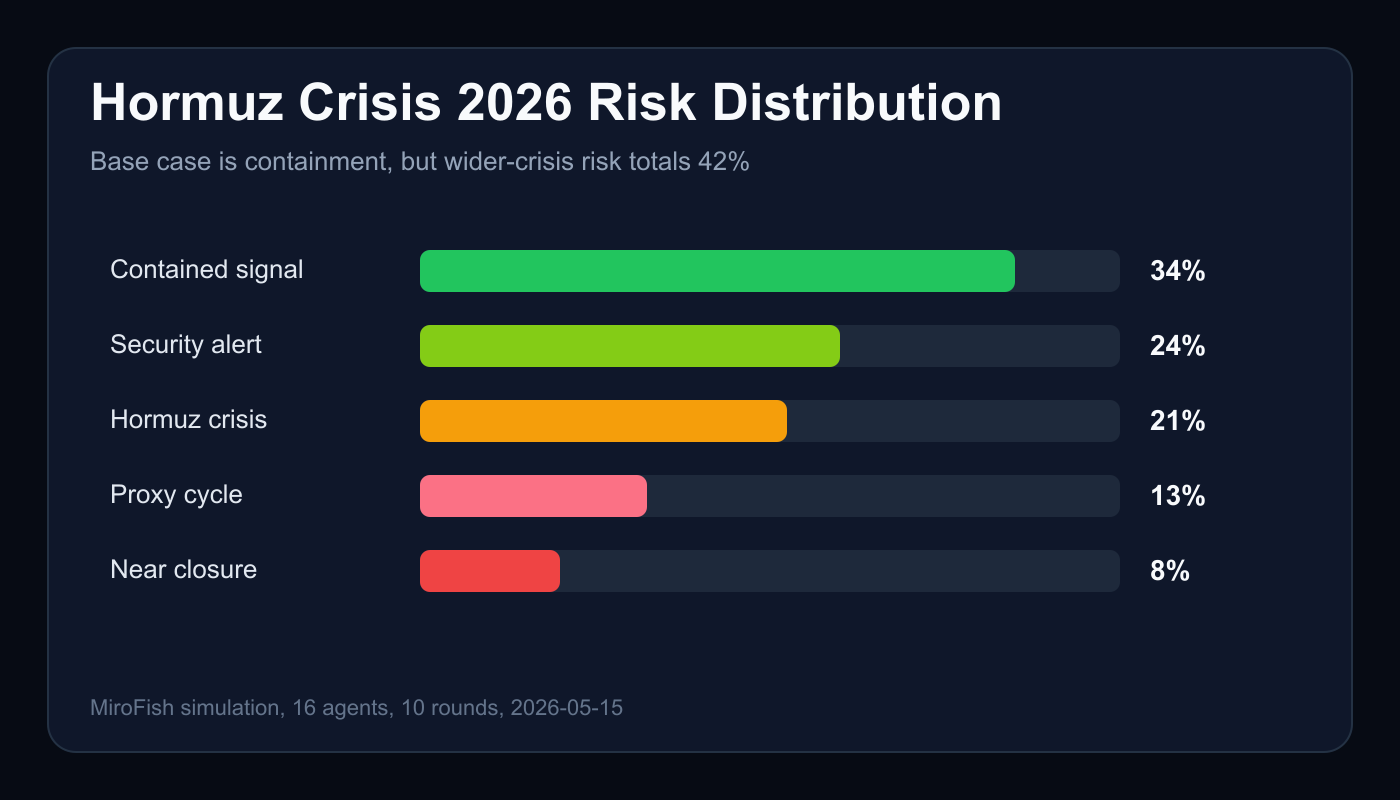
Hormuz crisis 2026 risk is not a binary question of war or calm. The MiroFish simulation of Iran's reported seizure of the Honduras-flagged Hui Chuan, described by maritime risk firm Vanguard as a floating armoury, produced a narrower result: 58% probability of containment or semi-containment, 42% probability of wider crisis dynamics, and only 8% probability of severe disruption or near-closure of the Strait of Hormuz within 30 days.
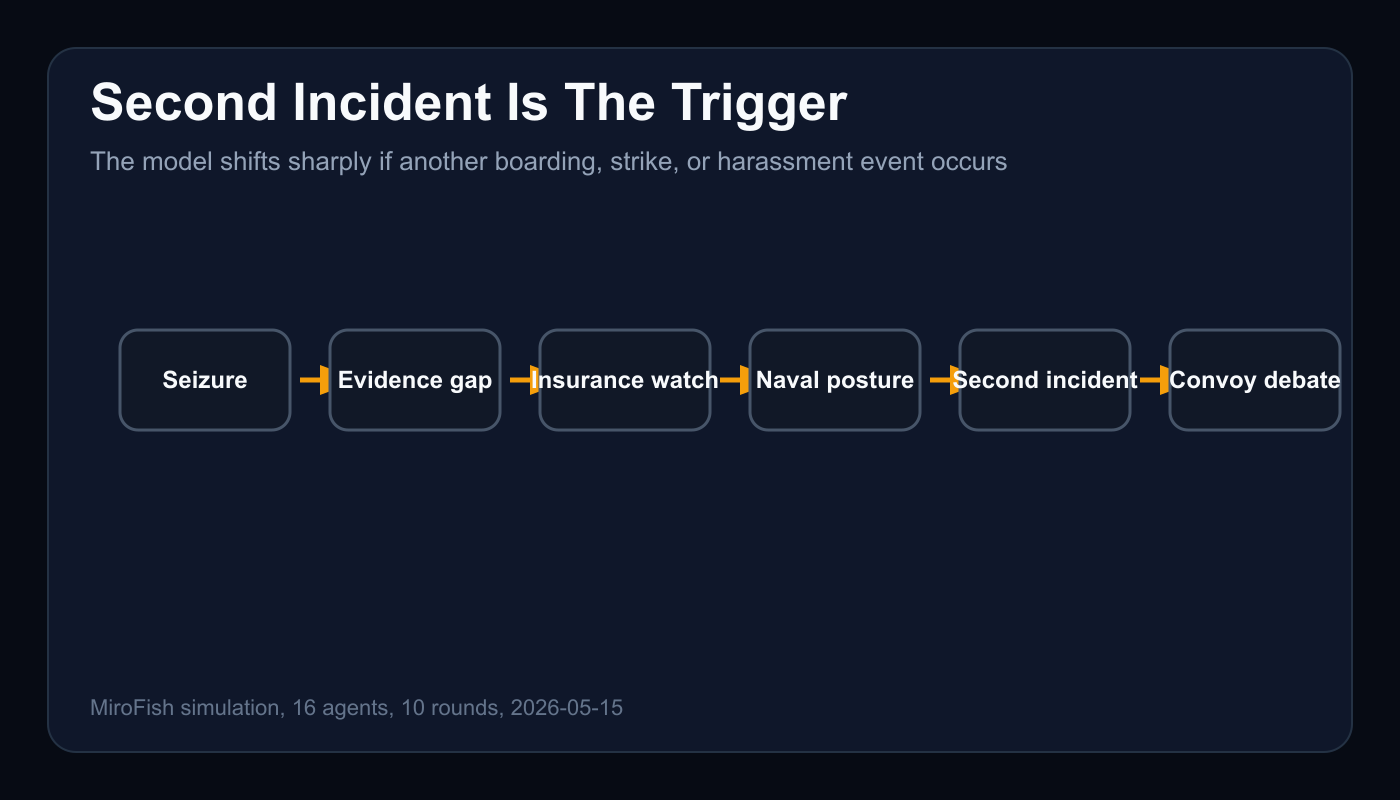
The most important finding is that the seizure itself is not the decisive event. The decisive event is whether a second credible maritime incident occurs within 7 to 14 days and becomes narratively linked to Hui Chuan, floating armouries, private maritime security, or Western naval presence. Without that second incident, the model converges on legal-diplomatic containment. With it, the event shifts from an isolated boarding into a pattern of maritime coercion.
The simulation used 16 agents over 10 rounds. The agent set included Iranian military and diplomatic actors, US naval planners, Chinese energy security officials, Oman and UAE crisis managers, India, insurers, shipping firms, private maritime security operators, European diplomats, proxy opportunists, oil traders, and open-source verification analysts. The result is a crisis map, not a prediction headline. It identifies where the risk lives: evidence gaps, insurance repricing, naval posture, and the politics of ambiguous weapons custody.
Background and Context: Gulf of Oman Seizure
The Gulf of Oman matters because it is the maritime approach to the Strait of Hormuz, the chokepoint connecting Gulf energy exports to the Indian Ocean. The US Energy Information Administration describes the Strait of Hormuz as one of the world's most important oil transit chokepoints, with a large share of seaborne crude and liquefied natural gas moving through it. That makes even a limited seizure economically relevant if insurers, shippers, or naval forces infer a broader pattern.
According to the simulation seed document, BBC reporting on 2026-05-14 said a vessel identified by BBC Verify as the Honduras-flagged Hui Chuan had been seized by Iranian military personnel after last broadcasting roughly 70 km northeast of Fujairah, UAE. UKMTO said the ship was bound for Iranian territorial waters. The public evidence left critical questions unresolved: what was onboard, who used the vessel, what custody chain existed, and whether the ship's role as a floating armoury was routine anti-piracy infrastructure or something politically more sensitive.
Floating armouries are not ordinary cargo ships. They can store weapons used by private maritime security firms that protect commercial vessels from piracy or armed robbery. That makes them legally and politically ambiguous. Iran can frame the seizure as action against militarization near its waters. Shipping interests can frame the same event as interference with legitimate security infrastructure. This ambiguity is the center of the simulation.
The seizure also appeared beside a separate reported attack on the Indian-flagged Haji Ali off Oman, after a suspected drone or missile incident. Oman rescued the crew. India called the attack unacceptable. At the same time, the seed document noted Trump-Xi discussion of keeping the Strait of Hormuz open and avoiding militarization. Those facts created the simulation's central tension: Iran has incentive to signal strength, but the major energy importers and Gulf intermediaries have incentive to localize the dispute.
For comparison, previous Zeki simulations on the region found similar containment logic under stress. See the earlier analysis of a US-Iran talks and Hormuz escalation simulation and the Hormuz ship seizure escalation simulation. The recurring pattern is clear: Hormuz crises rarely require deliberate closure to move markets. They need ambiguity, repeated incidents, and credible signs that risk is becoming systemic.
Authoritative background sources for this risk frame include the EIA analysis of world oil transit chokepoints, the United Kingdom Maritime Trade Operations incident reporting channel, and the International Maritime Organization framework for maritime safety and security.
Methodology: Iran Ship Seizure Simulation
MiroFish is a multi-agent simulation method for stress-testing political and market scenarios. Instead of asking one model for one forecast, the framework assigns competing incentives to specialized agents and forces those agents through multiple rounds of interaction. In this run, the simulation tested the question: after Iran reportedly seized Hui Chuan, does the event remain a contained maritime signal or escalate into a broader Strait of Hormuz security crisis over the next 30 days?
The run used 16 agents and 10 rounds. The agents were:
- IRGC Maritime Commander, focused on deterrence and leverage.
- Iranian Foreign Ministry Pragmatist, focused on bargaining room and sanctions relief.
- US National Security Council Gulf Lead, focused on open Hormuz without a new war.
- US Navy Fifth Fleet Planner, focused on readiness and rules of engagement.
- Chinese Energy Security Official, focused on oil flow and stable US-China optics.
- Oman Mediation Cell, focused on crew welfare and de-escalation.
- UAE Port and Security Adviser, focused on Fujairah credibility and insurance stability.
- Indian MEA Crisis Desk, focused on Haji Ali accountability and crew safety.
- Maritime Insurer, focused on hidden contagion and correlated ship attacks.
- Private Maritime Security Operator, focused on weapons custody and operational access.
- European Diplomat, focused on legal clarity and coalition restraint.
- Israeli Security Hawk, focused on pressure against Iran.
- Houthi or Proxy Opportunist, focused on ambiguity and cost imposition.
- Oil Trader, focused on premium changes and sudden unwind risk.
- Shipping CEO, focused on predictable routes and crew safety.
- BBC Verify or Open Source Analyst, focused on evidence quality and narrative discipline.
The model did not assume that Iran wants to close Hormuz. It tested pathways where actors with different incentives react to uncertainty. That distinction matters. The most plausible escalation path was not an announced blockade. It was a chain reaction: unresolved custody dispute, insurer repricing, naval posturing, proxy incident or misattributed attack, convoy debate, then Iranian counter-signaling.
Key Findings: Strait of Hormuz News Signals
Hormuz Crisis 2026 Probability Table
| Outcome | Probability | Interpretation |
|---|---|---|
| Contained maritime signal, no broader crisis | 34% | Legal and diplomatic handling contains the event. |
| Semi-contained security alert | 24% | Patrols and insurance costs rise, but Hormuz stays functional. |
| Broader Strait of Hormuz crisis without closure | 21% | Shipping, naval, and diplomatic behavior shifts into crisis mode. |
| Proxy-linked escalation cycle | 13% | A linked or misattributed incident drives retaliation logic. |
| Severe disruption or near-closure | 8% | High-impact tail scenario, not the base case. |
The headline number is 58% containment or semi-containment against 42% wider-crisis risk. That 42% is too high to ignore, but it is not a direct forecast of closure. It is the probability that commercial, military, and diplomatic actors start behaving as if the Gulf of Oman has become a regional security problem rather than a single ship dispute.
Iran Ship Seizure Risk Depends On Evidence
The biggest wildcard is the actual cargo, ownership chain, and user network of Hui Chuan. If the weapons inventory looks routine for private maritime security, the legal path is clearer. Oman or another intermediary can broker consular access, cargo inventory, crew welfare steps, and a quiet release or regularization process. If the cargo or user network looks irregular, sanctioned, or intelligence-linked, Tehran gains leverage and Western governments face a harder public response problem.
Evidence gaps are not neutral. They are fuel. Governments, proxies, shipping actors, and traders can all use uncertainty to support their preferred narrative. The simulation's open-source analyst repeatedly constrained the model by asking what could actually be verified. That reduced the probability of instant escalation, but it increased the importance of the next verified fact.
Strait of Hormuz News Can Move Before Governments Move
Insurance repricing was the most important market transmission channel. Underwriters do not need a formal blockade to raise war-risk premiums or tighten coverage terms. A localized seizure can become a regional premium event if insurers link Hui Chuan, Haji Ali, and a follow-on incident into one pattern.
That is why the simulation treated shipping behavior as an early-warning system. If shipowners delay calls, reroute, demand naval reassurance, or change private security protocols, market stress can appear before foreign ministries acknowledge crisis conditions. In other words, the commercial layer can escalate faster than the diplomatic layer.
Market Implications: Gulf of Oman And Oil Risk
The market implication is not simply higher oil. It is higher optionality around disruption. Oil traders in the simulation cared less about the first seizure than about whether the story became a repeatable risk pattern. A single ambiguous boarding can be discounted. A second incident inside two weeks forces desks to price a regime change in maritime risk.
The most likely market path under the 58% containment case is a temporary risk premium, localized insurance caution, and greater attention to UKMTO advisories and AIS gaps near Fujairah, Oman, and the Strait approaches. The 24% semi-contained outcome implies more patrols, more client calls between shipowners and insurers, and more expensive coverage for exposed voyages. It does not require a spike that breaks global energy markets.
The 21% broader-crisis outcome is different. In that scenario, Hormuz remains open but market behavior starts to resemble a crisis. Shipping firms delay decisions. Naval planners debate convoy readiness. Iran frames foreign security activity as militarization. China and India press for calm while quietly planning supply resilience. Oil prices can rise on risk premium even if barrels still move.
The 8% severe disruption scenario is the tail risk. It requires more than Hui Chuan. It likely requires a second or third incident, poor attribution, public humiliation of one actor, and a military posture that leaves little room for quiet exit. That is why the simulation's risk window is 7 to 14 days. The next incident matters more than the initial incident.
Second-Order Effects: Shipping, Insurance, And Diplomacy
The underreported effect is private maritime security repricing. Floating armouries sit in a grey zone between commercial protection and political vulnerability. If operators conclude that weapon-storage vessels are now exposed to seizure, they may change how armed-guard logistics work across the region. That would affect shipping operations even without a formal Hormuz crisis.
The second effect is diplomatic burden-shifting to Oman. Oman has the cleanest off-ramp because it can focus on crew welfare, consular access, cargo inventory, and face-saving legal process. This avoids forcing Iran into a public climbdown while giving India, the UAE, European actors, and shipping firms a procedure to point to.
The third effect is China as stabilizer. The simulation repeatedly found that Beijing has strong incentive to keep energy flows uninterrupted and to avoid a price shock. China does not need to publicly pressure Iran to be relevant. Quiet alignment with Oman, UAE, and India can raise the cost of Iranian escalation while preserving diplomatic flexibility.
The fourth effect is proxy opportunism. Ambiguous maritime space is attractive to actors that benefit from confusion. A proxy-linked incident does not need to be strategically brilliant. It only needs to be confusing enough to trigger insurer, naval, and media reaction at the same time.
Risk Assessment: What Could Be Wrong
The simulation could be wrong in three main ways.
First, the model may understate Iranian willingness to exploit a floating-armoury narrative. If Tehran believes the ship offers unusually strong evidence of hostile activity, the seizure could become a public political case rather than a bargaining chip. That would reduce Oman's ability to mediate quietly.
Second, the model may understate market fragility. Insurers can move faster than diplomats. If coverage changes sharply or if shipping clients interpret advisories as a regional pattern, the semi-contained outcome can feel economically closer to a crisis than the probability table suggests.
Third, the model may overstate great-power restraint. China, India, Oman, and the UAE all prefer stability, but preference is not control. A misattributed strike, a drone incident, or an armed boarding could compress decision time and make public signaling outrun private diplomacy.
The uncertainty band is therefore asymmetric. Severe near-closure remains only 8%, but the path from isolated incident to broader crisis is wide enough at 42% to justify active monitoring. The watch indicators are clear: another incident within 7 to 14 days, public display of seized weapons, unclear crew status, insurer repricing, convoy language from naval actors, or official rhetoric linking Hui Chuan to wider militarization.
Conclusion
The Hui Chuan seizure is most likely to remain contained, but it is not harmless. The MiroFish result says the base case is a localized maritime signal with elevated alert levels, not a Strait of Hormuz closure. It also says the risk is already large enough for shipping, energy, and policy desks to treat the next two weeks as a decision window.
The practical takeaway is simple: do not watch for a formal blockade first. Watch for repetition. A second credible maritime incident, especially one tied to floating armouries, private security, Haji Ali, or Western naval presence, would shift the Gulf of Oman from ambiguous seizure into Hormuz crisis 2026 territory.
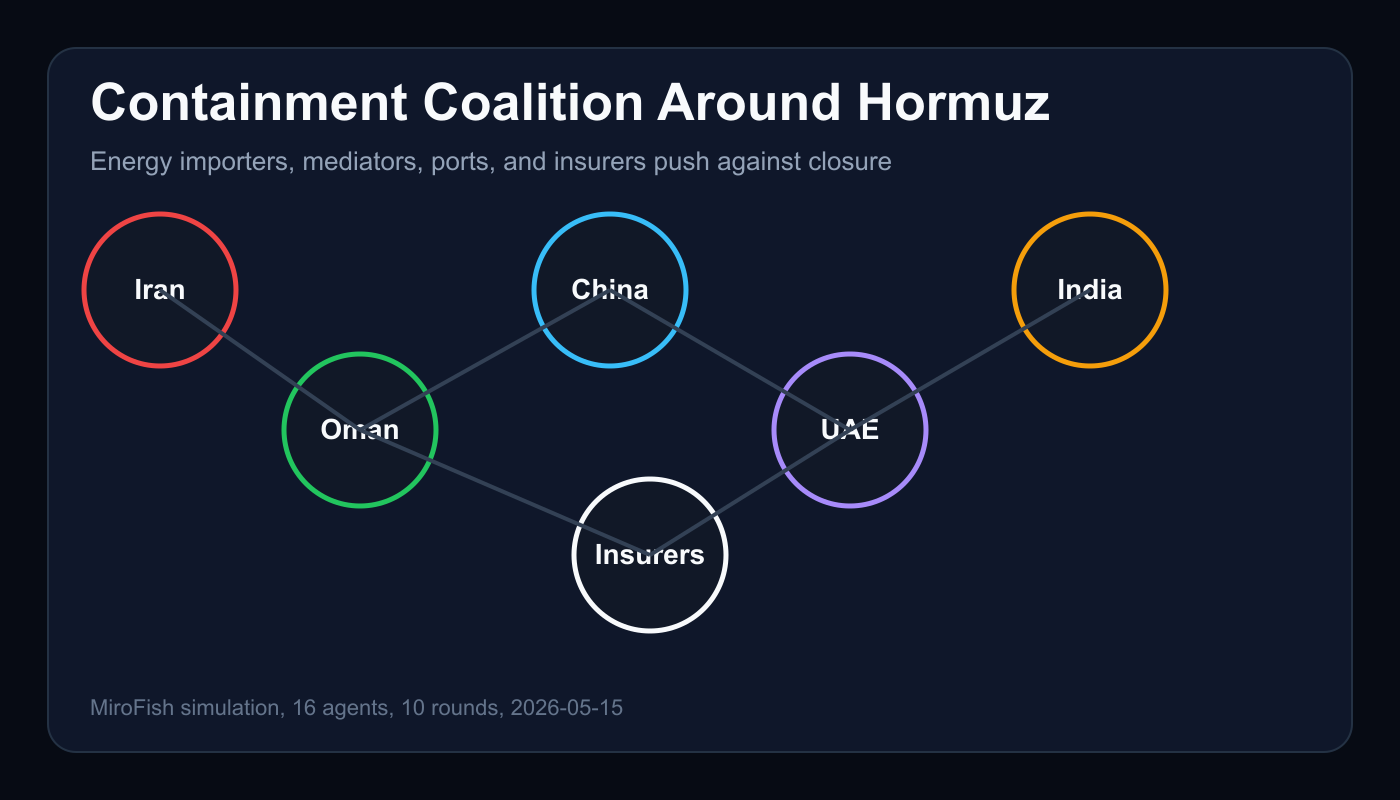
Until then, the strongest forces are containment forces: Oman mediating, China protecting energy flow, UAE protecting port credibility, India balancing outrage with Gulf interests, and insurers waiting for more evidence. The story ends quietly if those actors keep the dispute procedural. It becomes a crisis if ambiguity gets another incident to attach itself to.