Russia Ukraine Ceasefire 2026: 34% Talks Path
Russia Ukraine ceasefire 2026 forecast: 16-agent simulation finds a 34% path to credible talks, with violations still likely.
Executive Summary
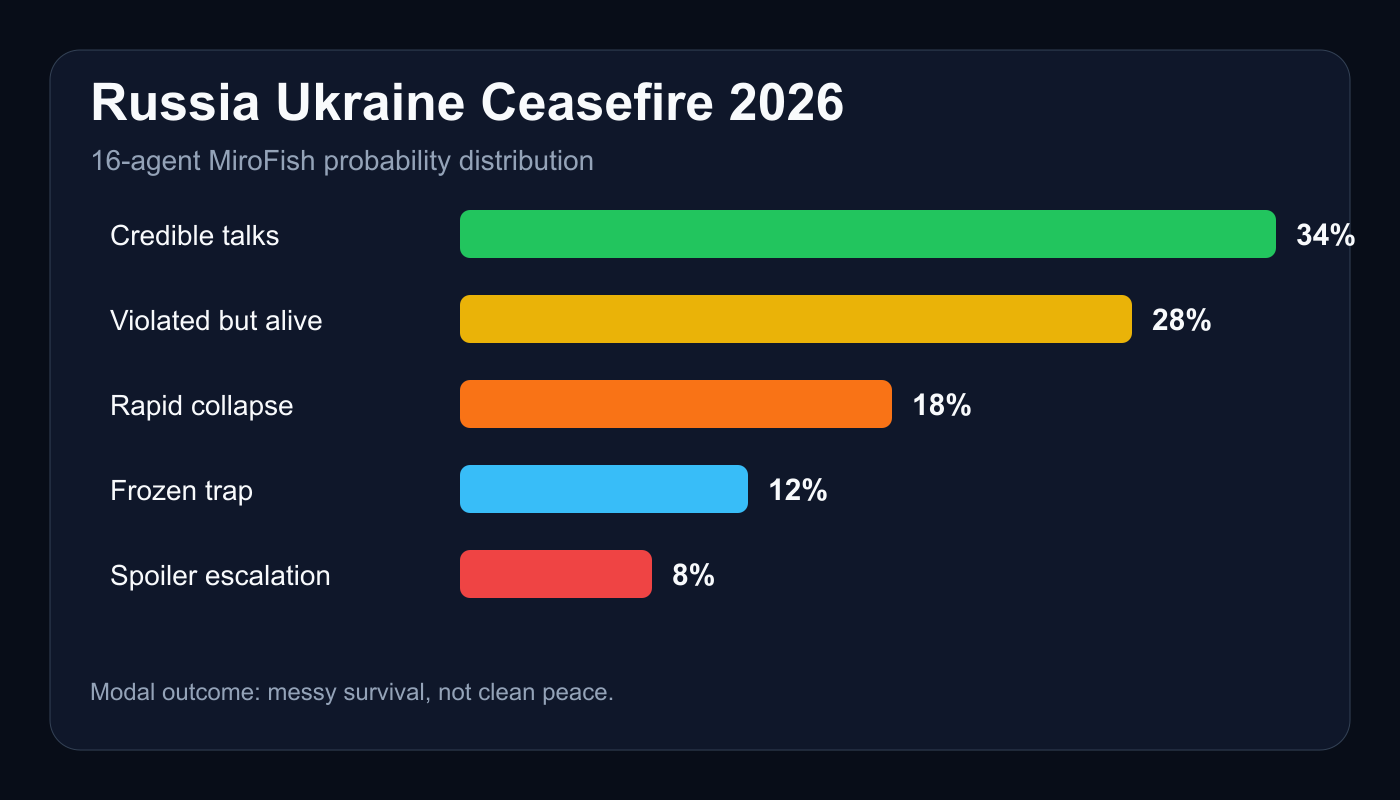
Russia Ukraine ceasefire 2026 risk is not a binary question of silence or war. A 16-agent, 10-round MiroFish simulation found that the most likely path is a messy pause that survives long enough to create a credible initial talks track, with a 34% probability. A second 28% outcome puts the ceasefire in an even stranger category: militarily violated but diplomatically kept alive through ambiguity. Combined, the model assigns 62% probability to a ceasefire that is imperfect, contested, and still politically usable.
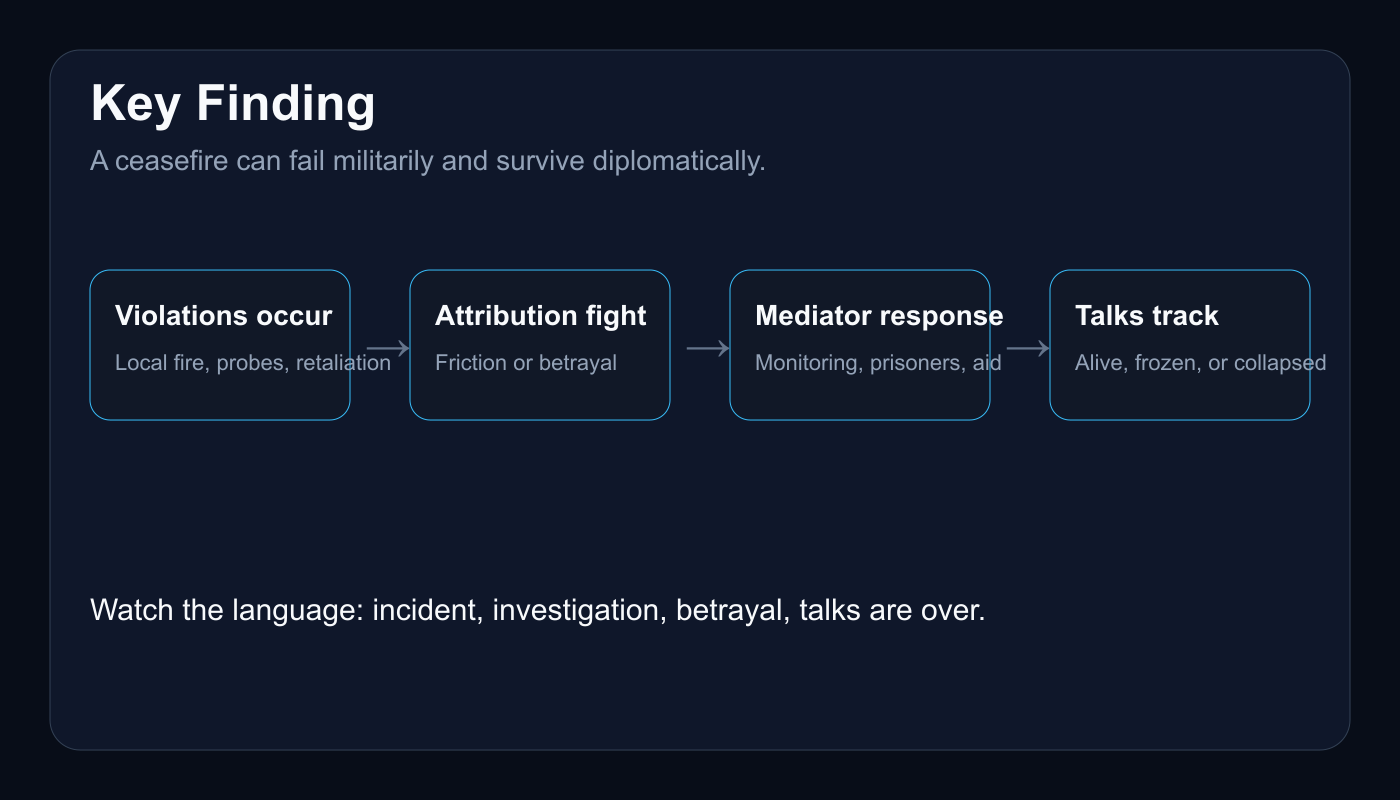
The central finding is direct: attribution control matters more than perfect compliance. If battlefield violations are framed as local friction, retaliation, fog of war, or command failure, diplomacy can continue. If one spectacular strike becomes impossible to excuse, the talks track collapses.
The simulation does not forecast peace. It forecasts a narrow bargaining window. Both armies retain incentives to hedge, probe, rotate, resupply, and accuse the other side of bad faith. Moscow can use the pause as leverage. Kyiv can enter exploratory talks only if aid, monitoring, prisoner issues, and security guarantees remain visible. Washington can create the opening, but Trump mediation also becomes fragile if either side believes the United States needs a visible deal more than the belligerents do.
Background and Context: Russia Ukraine Ceasefire Talks
Russia Ukraine ceasefire talks sit inside a war where tactical pauses and political messaging have repeatedly diverged. The simulation seed used a May 8 news hook: President Trump said Russia and Ukraine would observe a three-day ceasefire, while contemporary reporting described continuing fire and mutual accusations around the same Victory Day ceasefire environment. The relevant question is not whether this pause begins under clean conditions. It does not. The question is whether the political system around the ceasefire can absorb early violations without immediately declaring failure.
That distinction is why search demand around this topic is unusually practical. Google Suggest queries around "russia ukraine ceasefire" surface "russia ukraine ceasefire news," "russia ukraine ceasefire talks," "russia ukraine ceasefire deal," "russia ukraine ceasefire negotiations," "russia ukraine ceasefire 2026," and "russia ukraine ceasefire violations." Queries around "trump ukraine ceasefire" surface "trump ukraine ceasefire proposal," "trump ukraine ceasefire talks," "trump ukraine ceasefire deal," and "trump ukraine ceasefire prospects." The public is not only asking what was announced. It is asking whether a ceasefire can hold when both sides distrust the premise.
The institutional context matters. The OSCE Special Monitoring Mission legacy archive shows how difficult ceasefire verification became even before the full-scale invasion. The United Nations Ukraine pages document the humanitarian frame that any pause would immediately activate: civilian protection, displacement, prisoners, energy infrastructure, and access. The NATO Ukraine relationship page captures the security guarantee problem Kyiv cannot ignore. A ceasefire that reduces fire but freezes vulnerability is not automatically a political win for Ukraine.
This article extends Zeki's simulation research series at zekiai.xyz/blog, including the Ukraine drone exports simulation, the Taiwan Strait crisis simulation, and the Trump EU trade deal tariff escalation simulation. The common thread is not prediction theater. It is stress testing how political incentives interact with markets, escalation ladders, and institutional constraints.
Methodology: Trump Ukraine Ceasefire Simulation
The MiroFish simulation used 16 agents over 10 rounds. It is an analytic stress test, not a poll, market price, or deterministic forecast. Each agent represented a strategic actor with incentives, fears, constraints, and escalation options. The simulation question was: will the newly announced Russia-Ukraine three-day ceasefire hold long enough to create a credible talks track, or collapse into renewed escalation?
The agent set was deliberately adversarial. It included a Trump envoy, Kremlin strategist, Ukrainian presidential adviser, Russian general staff officer, Ukrainian front commander, EU Commission security official, Polish or Baltic hawk, German industrial and policy voice, Chinese foreign ministry strategist, Turkish mediator, UN or OSCE monitor, Russian hardline blogger, Ukrainian civil society voice, energy and grain market analyst, US Congress Ukraine skeptic, and US defense planner.
The model concentrated on eight variables:
| Variable | Why it matters |
|---|---|
| Battlefield control | Local commanders may continue fire even if leaders endorse restraint |
| Attribution politics | Violations can be framed as friction or betrayal |
| Trump leverage | Washington can create talks, but visible deal pressure creates mediator risk |
| European unity | Western and eastern Europe value de-escalation and deterrence differently |
| Russian incentive balance | Moscow may want leverage without losing operational freedom |
| Ukrainian domestic tolerance | Kyiv needs aid, prisoners, monitoring, and security guarantees visible |
| Spoiler events | A drone, missile, or false flag can collapse ambiguity |
| External mediators | Turkey, China, UN, and OSCE roles can convert pause into process |
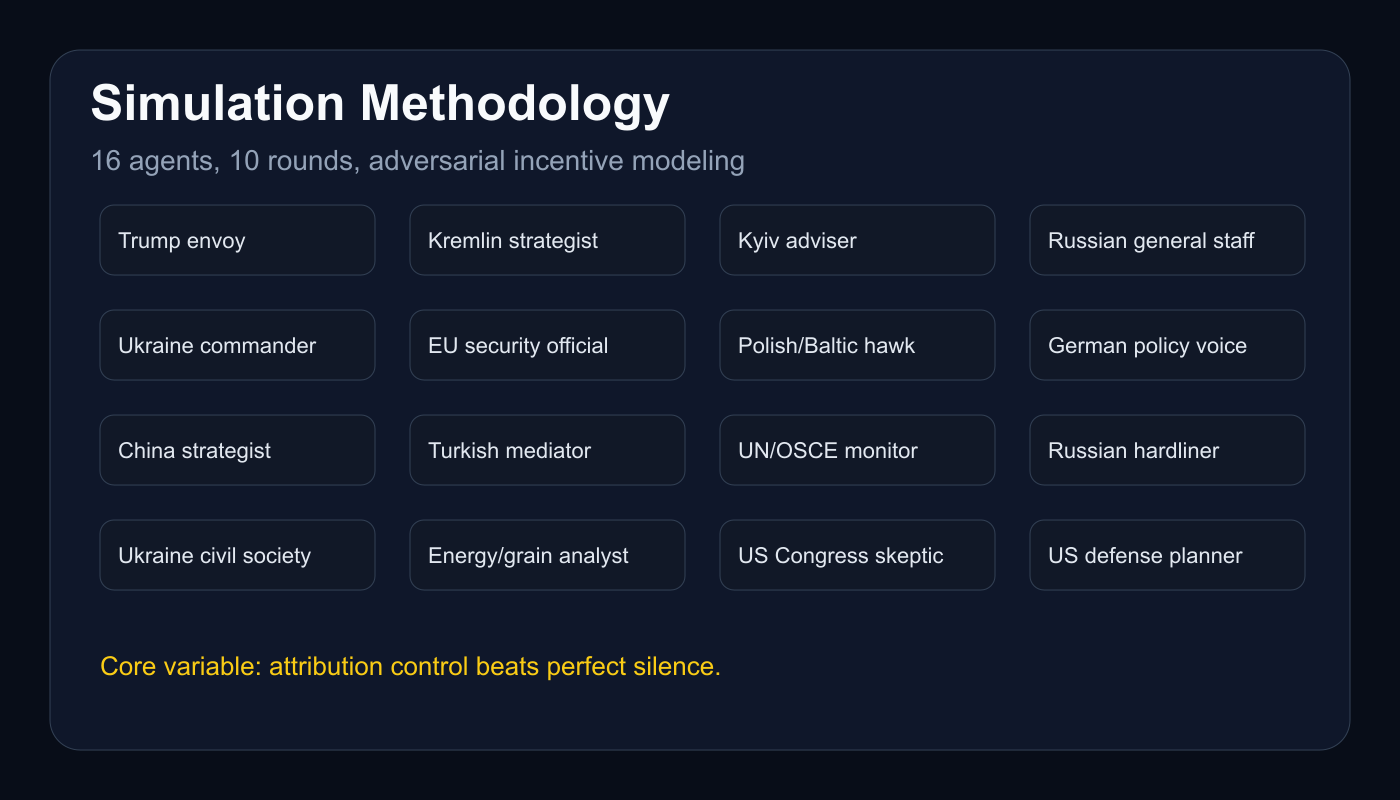
Rounds 1 and 2 separated the agents into deal-seekers, military skeptics, and frozen-conflict hawks. Rounds 3 and 4 produced the key analytic turn: diplomats and mediators reframed the test from "full silence" to "containable violations." Rounds 5 through 8 clarified the bargaining constraints around Kyiv, Moscow, Europe, and Washington. Rounds 9 and 10 converged on the modal outcome: not a clean ceasefire, but a messy three-day pause with violations, blame, and enough ambiguity to launch a fragile talks track.
Key Findings: Russia Ukraine Peace Talks Probability
The final probability distribution is concentrated in the middle. Clean success is not the forecast. Immediate collapse is also not the modal outcome.
| Outcome | Probability |
|---|---|
| Messy ceasefire survives long enough for credible initial talks | 34% |
| Militarily violated but diplomatically kept alive through ambiguity | 28% |
| Rapid collapse into renewed escalation and mutual blame | 18% |
| Talks begin but harden into a frozen-conflict trap | 12% |
| Spoiler strike or false flag triggers major escalation | 8% |
Russia Ukraine Ceasefire Talks Depend on Attribution Control
The single most important variable is attribution control. A ceasefire can be broken militarily and still survive diplomatically if violations are treated as isolated battlefield friction. That is the core paradox of this simulation. A perfect ceasefire is unlikely because both armies have reasons to hedge. A politically survivable ceasefire is more plausible because outside sponsors, mediators, and exhausted domestic audiences may accept ambiguity if the alternative is immediate renewed escalation.
This creates a practical watchlist. The ceasefire is more likely to survive if official statements use language like "incident," "under investigation," "local commander," "unverified," or "monitoring needed." It is more likely to fail if leaders use language like "deliberate attack," "strategic betrayal," "proof of bad faith," or "the talks are over." In this model, rhetoric is not noise. It is the operating system of the ceasefire.
Trump Ukraine Ceasefire Leverage Opens and Weakens the Door
Trump leverage helps create the initial opening because both sides must account for US pressure, US aid decisions, sanctions posture, and the political value of appearing responsive to Washington. The problem is that leverage can invert. If Moscow or Kyiv believes the White House needs a fast win, each can test the mediator instead of the opposing army.
For Moscow, the temptation is to preserve enough violence to keep bargaining pressure alive while blaming Kyiv for every violation. For Kyiv, the danger is being pushed toward talks without sufficient air defense, prisoner movement, monitoring access, or future security guarantees. For Washington, the task is to keep the talks track visible without making the United States look more desperate for the deal than the parties fighting the war.
Russia Ukraine Peace Talks Face a Frozen-Conflict Trap
The 12% frozen-conflict trap outcome matters because it can look like success in the first week. Talks begin. Fire declines. Markets breathe. European capitals welcome diplomatic movement. Then the process hardens around an unstable line, unresolved security guarantees, weak monitoring, sanctions ambiguity, and domestic anger in Ukraine.
That is why Kyiv-side agents resisted any pause that normalizes occupation without credible guarantees. Ukrainian civil society and front-line military voices treated prisoners, abductees, monitoring, air defense, and future aid as preconditions for political tolerance. A ceasefire that saves lives now but locks in strategic vulnerability later is not durable peace. It is deferred escalation.
Market Implications: Ukraine Ceasefire News and Pricing
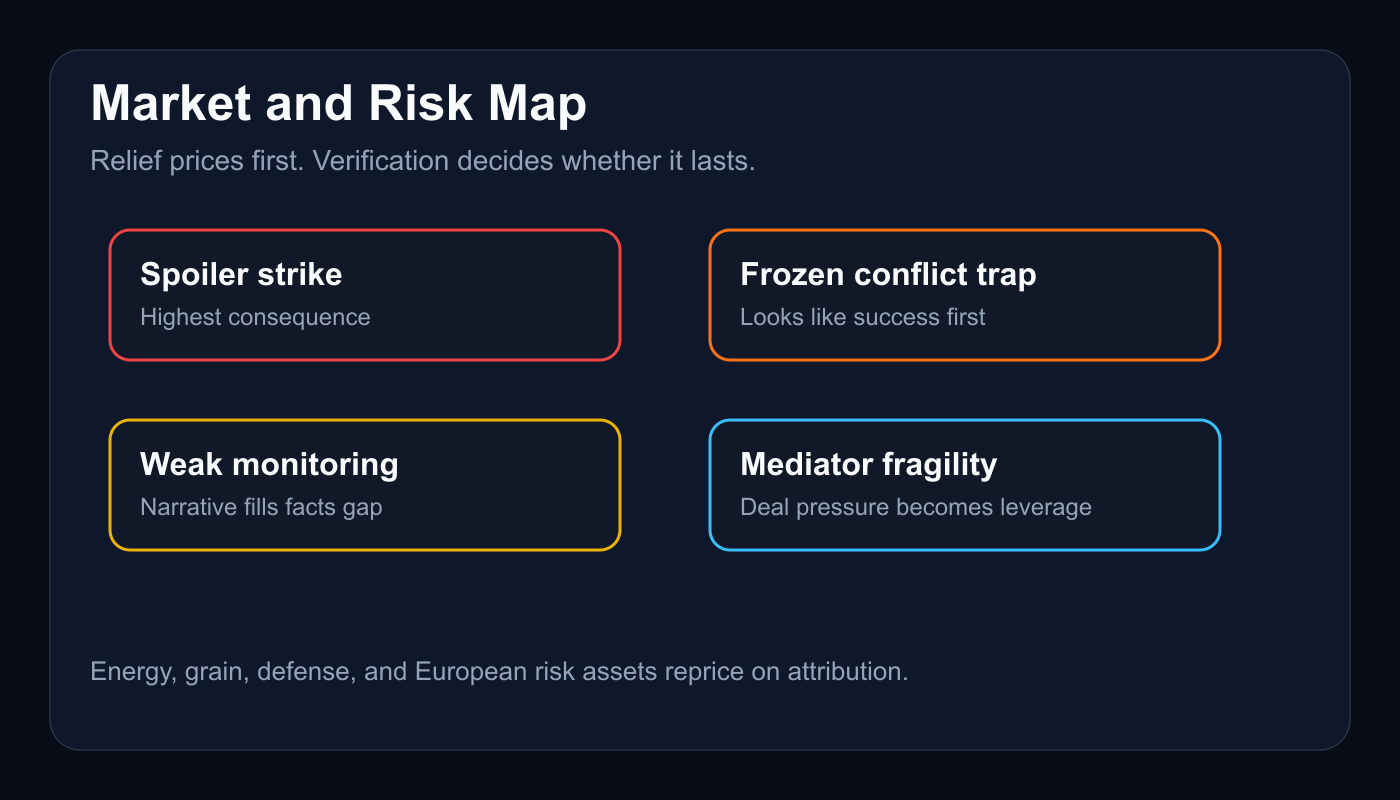
Markets are likely to price relief first and verification second. That sequence creates reversal risk. If the ceasefire appears to hold through the first news cycle, energy, grain, and European risk assets can respond positively. If violations intensify or a spectacular strike occurs, the same positions can unwind quickly.
The energy channel is indirect but important. Russia-Ukraine escalation affects European gas sentiment, sanctions expectations, shipping risk, and infrastructure security. A credible talks track lowers tail-risk premium. A collapse raises it again, especially if energy infrastructure becomes part of the blame cycle.
The grain and Black Sea channel is more immediate. Turkey, UN-linked humanitarian actors, shippers, insurers, and agricultural traders all have reasons to convert a ceasefire into practical arrangements around ports, corridors, prisoners, and inspections. Even limited humanitarian access can become a constituency for extension. The United Nations Black Sea Grain Initiative archive remains relevant because it shows how narrow wartime deals can reduce global pressure even without resolving the war.
Defense equities and aid politics move differently. A ceasefire that survives ambiguously does not eliminate demand for air defense, drones, artillery, electronic warfare, and munitions. It may increase demand for systems that support monitoring, hardening, and deterrence during talks. The US Congress Ukraine skeptic in the simulation saw a pause as evidence for burden reduction. The US defense planner saw it as a moment to preserve deterrence without letting the alliance signal abandonment.
Second-Order Effects
First, the ceasefire can create a monitoring race. Whoever defines the facts of violations first gains diplomatic advantage. If OSCE-style access, satellite evidence, third-party statements, and humanitarian reporting are delayed, each side fills the gap with narrative.
Second, prisoner exchanges become more than humanitarian gestures. They become proof that talks produce concrete outcomes. If prisoners move, domestic audiences can tolerate ambiguity longer. If prisoner talks stall, the ceasefire looks like theater.
Third, Turkey benefits if the process survives even imperfectly. Ankara has a plausible role in Black Sea stability, prisoner issues, grain arrangements, and follow-on talks. China also benefits from a lower-escalation track that preserves Russia without uncontrolled disruption to trade. Neither actor needs a final settlement to extract diplomatic value.
Fourth, Europe divides by geography and threat perception. Germany and other pressure-sensitive economies may favor keeping the track alive. Poland and Baltic states will test every concession against the risk of rewarding aggression. This split does not kill diplomacy by itself, but it shapes the security guarantee package Kyiv can accept.
Fifth, Russian hardliners become a spoiler constituency. The simulation's Russian hardline blogger treated any pause as weakness. That matters because domestic nationalist pressure can narrow the Kremlin's room to frame ambiguity as strength. If the internal story becomes "Russia is being restrained while Ukraine rearms," Moscow's diplomats lose space.
Risk Assessment: Will the Russia Ukraine Ceasefire Hold?
The model's biggest uncertainty is the spoiler strike. A high-casualty drone or missile attack during the three-day window, especially against civilians, energy infrastructure, command sites, or symbolic Victory Day-related targets, can convert ambiguity into betrayal. The simulation assigns 8% probability to a spoiler strike or false flag triggering major escalation beyond the ceasefire frame. That number is low relative to the modal outcomes, but it carries the highest consequence.
The second risk is overestimating command control. Leaders can announce restraint faster than they can impose it along a long, heavily armed line of contact. Local commanders may retaliate, probe, or hedge because the cost of being surprised is higher than the cost of being accused.
The third risk is underestimating domestic politics in Kyiv. External mediators may treat a ceasefire as progress. Ukrainian society may treat it as pressure unless aid continuity, security guarantees, abductees, prisoners, and monitoring are visible. A talks track that ignores domestic legitimacy will not hold.
The fourth risk is mediator fragility. Trump can pressure the parties into a pause, but pressure is not the same as enforcement. If the White House prioritizes a visible announcement over verification architecture, both sides can exploit the gap.
Conclusion
The Russia Ukraine ceasefire 2026 simulation points to a narrow, unstable, and real diplomatic opening. The most likely outcome is not peace and not immediate failure. It is a contested pause that survives because enough actors prefer ambiguity to collapse.
The operational test is simple. Ignore declarations of perfect compliance. Watch attribution language, monitoring access, prisoner movement, air defense commitments, Black Sea arrangements, and whether Washington can stay firm without looking desperate for a deal. If violations remain narratively contained, the talks track survives. If a spectacular strike turns ambiguity into betrayal, it fails fast.
The strongest forecast from the 16 agents is that ceasefire survival depends less on silence than on political management. In this war, a broken ceasefire can still become a negotiation. A single unmanageable incident can still destroy it.