Trump EU Trade Deal: Tariff Escalation Odds
Trump EU trade deal odds: a 16-agent simulation finds 40% chance of an interim framework and 62% odds of avoiding full tariff escalation.
Executive Summary
Trump EU trade deal negotiations are more likely to produce a face-saving interim framework than a fully approved legal agreement by the deadline. A 16-agent, 10-round MiroFish simulation assigns a 40% probability to the central outcome: Brussels delivers enough political movement for Washington to pause or delay tariffs, but not enough institutional finality to make the deal durable. The second most important result is the combined 62% probability that full tariff escalation is avoided through either an interim framework or narrow approval.
The simulation does not treat the ultimatum as empty theater. Trump's threat is credible because a missed deadline would create political pressure to prove that the White House was not bluffing. Yet the same simulation finds that market stress, inflation risk, Germany's export exposure, Italy's exporter politics, Poland's security concerns, and US Treasury caution all constrain maximal escalation. The median path is deliberately ambiguous: Trump says the EU agreed to a deal, while Brussels says it approved a lawful phased process.
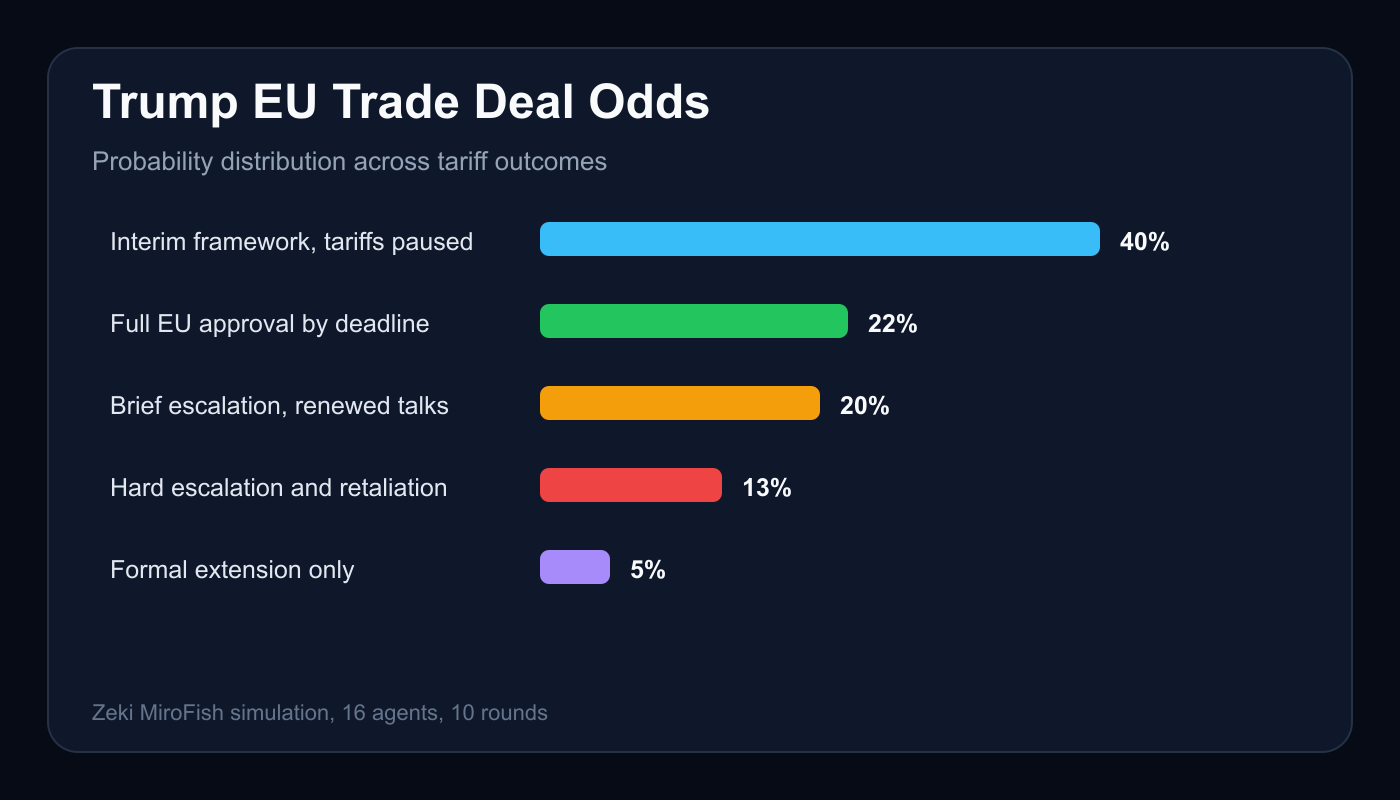
The key forecast: a clean EU approval before the deadline is only a 22% outcome. The system can produce movement faster than it can produce legal durability.
Background and Context: US EU Trade Deal Tariffs
The US and European Union have one of the world's largest economic relationships. The European Commission's United States trade page frames the relationship as a core pillar of global trade. The Office of the United States Trade Representative similarly treats the EU as a major counterpart across goods, services, investment, standards, and regulatory issues. That scale is why a deadline-driven tariff fight between allies matters beyond a single negotiation cycle.
The simulation seed used a May 7 news hook: President Trump gave the EU a deadline to approve a trade deal with the United States. The political context is unusually loaded. Europe is dealing with weak growth, defense spending pressure, Ukraine financing needs, energy insecurity, China competition, and domestic election stress. Washington wants visible concessions fast. Brussels needs unity across member states, a legally defensible process, and a package that does not look like capitulation to an ultimatum.
This is not a normal technocratic tariff negotiation. It is coercive bargaining inside an alliance. That distinction changes the incentives. If the EU moves too slowly, Trump has reason to impose tariffs to preserve credibility. If the EU moves too visibly under pressure, France, farmers, legal actors, and WTO defenders have reason to resist. The institutional center of gravity is therefore not a grand bargain. It is a narrow political framework that can be sold differently to each audience.
Keyword data from Google Suggest supports the public demand profile. Searches around "Trump EU trade deal" cluster around tariffs, talks, stock market impact, details, and energy. Searches around "US EU trade deal tariffs" cluster around tariff rates, car tariffs, pharma tariffs, reciprocal tariffs, exemptions, and negotiations. The high-value searcher is not merely asking whether a deal exists. They are asking which sectors get hit, whether escalation is delayed, and whether the deadline produces an enforceable outcome.
This post extends Zeki's simulation research series at zekiai.xyz/blog, including prior work on trade brinkmanship and geopolitical escalation such as the US China trade truce simulation and the US Brazil critical minerals simulation. The question here is narrower: will an ally under tariff pressure approve a deal, delay a rupture, or force a visible confrontation?
Methodology: EU Tariff Escalation Simulation Design
The MiroFish simulation used 16 agents and 10 rounds. It is an analytic simulation, not a poll or market price. Each agent represented an actor with incentives, constraints, fears, and plausible reaction functions. The question was: will the EU approve a US trade deal by Trump's stated deadline, or will the confrontation slide into tariff escalation?
The agent set included Donald Trump, the US Trade Representative, a US Treasury and markets adviser, the European Commission President, the German Chancellor, the French President, the Italian Prime Minister, the Polish Prime Minister, the EU Trade Commissioner, the US auto and industrial lobby, the European auto and industrial lobby, European farmers, China's Ministry of Commerce, a Russia strategic observer, a market bond and equity desk, and a WTO legal order advocate.
The simulation modeled seven variables:
| Variable | Why it matters |
|---|---|
| Trump deadline credibility | Determines whether the EU can dismiss the ultimatum as theater |
| EU unity | Determines whether France, Germany, Italy, Poland, and smaller exporters can hold a common line |
| Economic pain threshold | Determines how much manufacturers, farmers, consumers, and markets can absorb |
| Legal and institutional timing | Determines whether the Commission can convert political promises into an approvable package |
| China and Russia linkage | Determines whether strategic rivals gain from transatlantic friction |
| Domestic politics | Determines whether leaders fear looking weak more than they fear market disruption |
| Retaliation ladder | Determines whether counter-tariffs become automatic after a missed deadline |
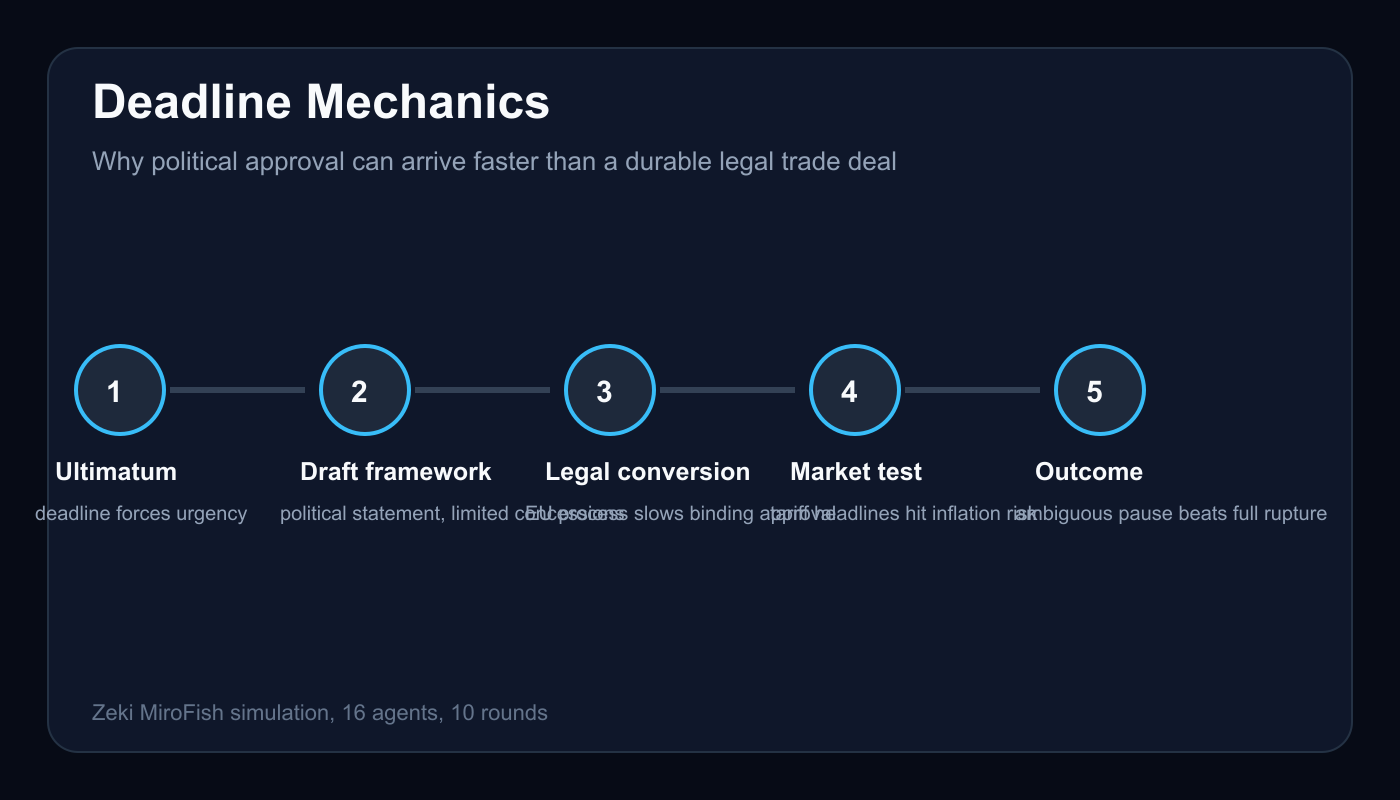
The output was a probability distribution across five outcomes, plus round-by-round convergence, deal-killers, tipping points, and cascade effects. The model's central constraint was timing. A political statement can move quickly. A legally durable EU trade package must survive process, member-state politics, sectoral protection, and institutional review.
Key Findings: Transatlantic Trade War Probability
The final distribution is concentrated around partial compromise rather than clean agreement or hard rupture.
| Outcome by deadline | Probability |
|---|---|
| Interim political framework before deadline, tariffs paused or delayed | 40% |
| Full EU approval of a narrow US trade deal by deadline | 22% |
| Deadline missed, brief tariff escalation, then renewed negotiations | 20% |
| Hard tariff escalation with EU retaliation and prolonged standoff | 13% |
| Deadline formally extended with no substantive deal but no tariffs | 5% |
US EU Trade Deal Tariffs Are Credible but Bounded
The tariff threat is credible because Trump has an anti-bluff incentive. If he sets a deadline and Brussels ignores it, domestic political pressure pushes him toward action. The US industrial lobby also rewards visible confrontation when import competition is framed as a jobs issue. USTR agents in the simulation pressed for measurable concessions rather than vague language.
But credibility is not the same as unlimited escalation. US Treasury and market agents warned that tariff headlines can hit equities, inflation expectations, and bond yields. That matters because tariff policy is never only about trade balances. It is also about consumer prices, manufacturer inputs, and financial conditions. The most likely White House preference becomes a headline win that avoids the market cost of a full rupture.
EU Tariff Escalation Is Limited by Internal Politics
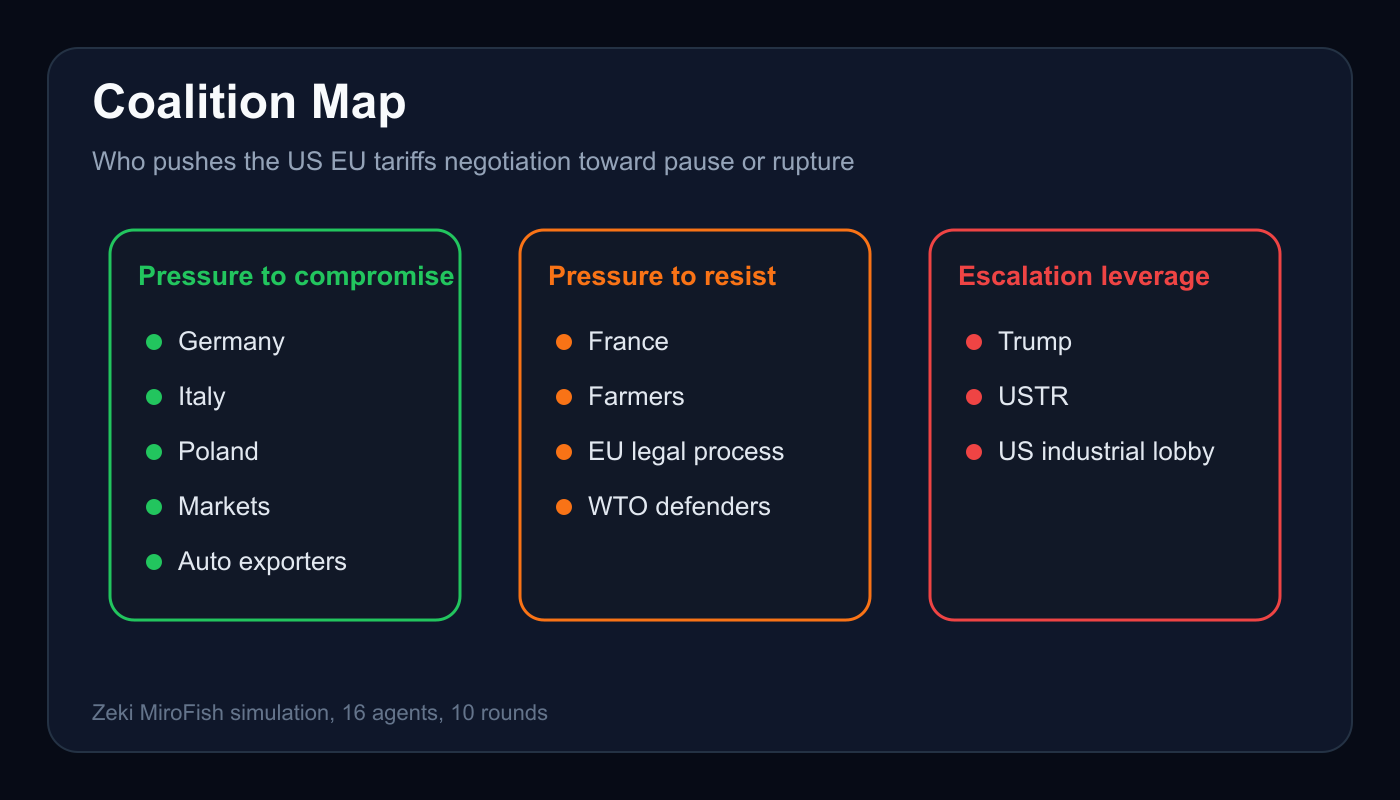
EU unity is fragile, but not absent. Germany wants auto and industrial stability. Italy wants exporter relief. Poland wants to protect the US security relationship because Ukraine and NATO cohesion matter more than tariff symbolism. These actors push Brussels toward a framework that avoids an immediate trade war.
The resistance coalition is different. France does not want US coercion normalized as the template for allied negotiations. European farmers resist any hidden agricultural concession. EU legal actors distinguish political statements from legally approvable trade arrangements. WTO defenders object to coercive bilateralism replacing process. The WTO tariff resources matter here because the legal architecture is part of the political fight, not an afterthought.
The Modal Outcome Is Deadline Theater With Substance
The most likely package is not pure theater. It includes enough substance to pause escalation: political approval of a negotiation framework, limited purchase commitments, sectoral talks on autos or industrial goods, no broad agricultural opening, and a timeline for legal conversion. Trump gets a deal agreed in principle. Brussels says it preserved process. Both claims can be true enough to buy time.
This is why the simulation assigns only 22% to full approval by the deadline. The EU can create political movement quickly. It cannot easily compress member-state politics, legal review, farmer constraints, sectoral bargaining, and WTO concerns into a single deadline without producing backlash.
Market Implications: Autos, Inflation, and EU Export Risk
The market implication is a skewed risk profile. The central 40% outcome stabilizes near-term sentiment because it delays or pauses tariffs, but it does not remove the risk premium. Investors should treat an interim framework as a volatility suppressant, not as a final settlement.
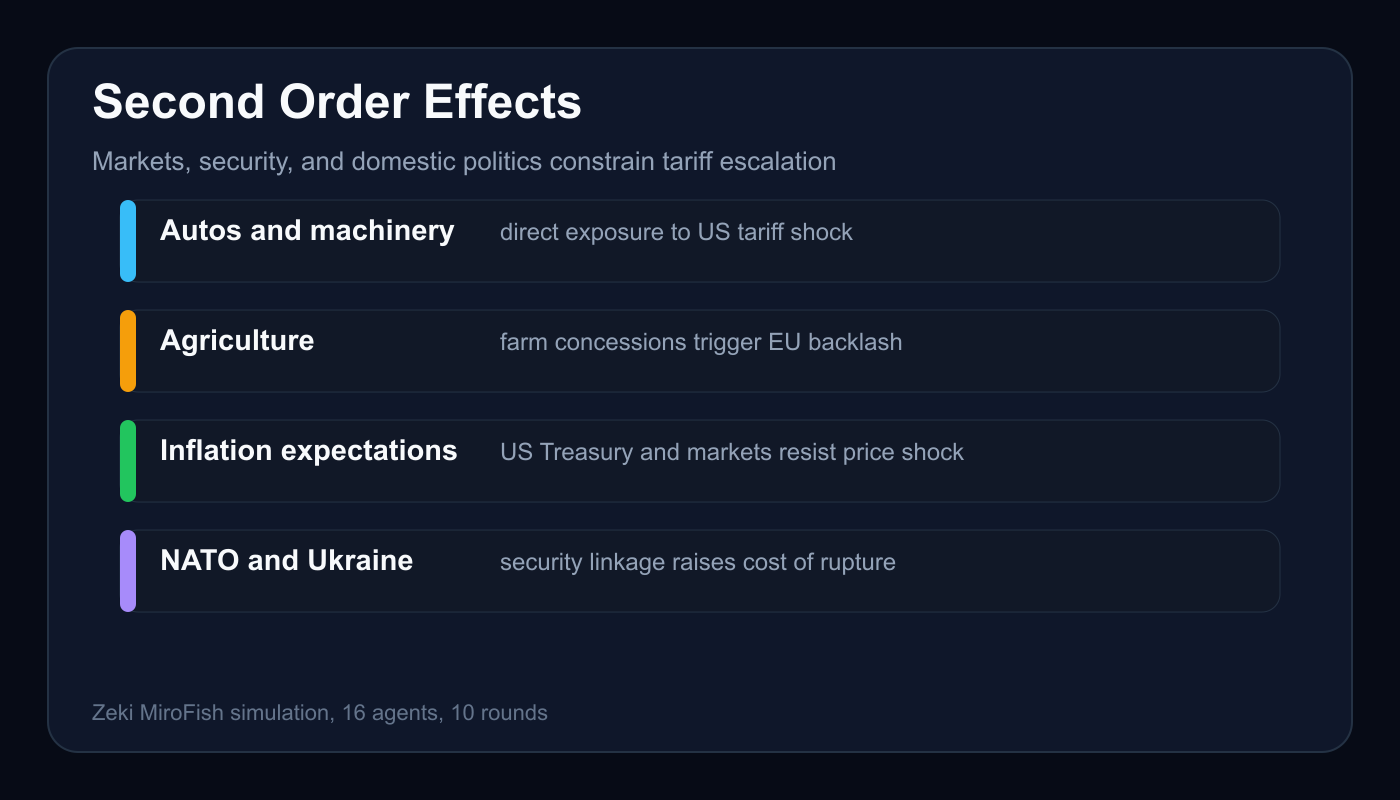
Autos and machinery are the most obvious exposure points. Germany and European industrial lobbies were among the strongest anti-escalation agents because a sudden US tariff shock would hit export expectations, factory sentiment, and supply-chain planning. A narrow framework that protects sectoral talks without final concessions is enough to calm markets in the short term.
Agriculture is the political landmine. US demands that imply agricultural access can trigger European farmer resistance, especially if leaders appear to trade rural protection for tariff relief in industrial sectors. That asymmetry matters. Industrial exporters may want speed. Farmers and France can slow the process by making the deal look like a sovereignty loss.
Inflation risk is the American constraint. Tariffs can be popular as leverage, but they are harder to sustain if consumer prices, input costs, or market volatility move against the administration. The European Central Bank's economic bulletin archive is useful context because monetary authorities watch trade shocks through prices, growth, and financial conditions. In the simulation, markets and Treasury did not eliminate escalation risk. They capped it.
The cleanest market read is this: 62% odds of avoiding full escalation by deadline, 33% odds of at least some tariff conflict if the deadline is missed or hard escalation begins, and 5% odds of a pure extension with no substance. That distribution favors short-term relief rallies on framework headlines, followed by renewed scrutiny of legal text, sectoral exclusions, and retaliation schedules.
Second-Order Effects: Will the EU Approve a US Trade Deal?
The long-tail question, "will the EU approve a US trade deal," has a split answer. Politically, probably enough to avoid rupture. Legally, probably not in the full durable sense by the deadline.
The first second-order effect is precedent damage. If an interim framework succeeds, Trump can claim tariffs forced allied concessions. That creates an incentive to repeat deadline diplomacy. Brussels can say process survived, but the precedent still weakens the norm that allied trade negotiations happen through slow institutional channels.
The second effect is strategic linkage. China and Russia benefit from transatlantic friction, but their role is indirect. The China agent preferred EU-US division because it weakens coordinated industrial policy and sanctions pressure. The Russia strategic observer preferred any dispute that distracts from Ukraine financing and NATO unity. Poland's agent reacted strongly to this: trade irritation should not fracture security alignment. That reaction helped the pro-pause coalition.
The third effect is retaliation machinery. Once tariffs are imposed, EU countermeasures become politically difficult to avoid. They may start targeted rather than maximal, but the legal and political machinery creates momentum. A brief escalation followed by renewed talks has a 20% probability because both sides can stumble into retaliation before markets force a return to negotiation.
The fourth effect is narrative compatibility. The deal survives if Trump can say pressure worked and Brussels can say law survived. It fails if either side frames the other as humiliated. This is the most important communication constraint. The substance can be modest. The story cannot be reckless.
Risk Assessment: What Could Break the Forecast
The central 40% estimate should be read with an uncertainty band of roughly plus or minus 10 percentage points. Four risks dominate.
First, the deadline may become more rigid than the model assumes. If Trump decides that anything short of explicit EU approval is a loss, the interim framework path narrows and brief escalation rises.
Second, EU politics may harden faster than expected. France, farmers, WTO advocates, and legal actors can turn a technical trade package into a public fight over sovereignty. If that happens before negotiators draft face-saving language, the 13% hard escalation path becomes more plausible.
Third, markets may either overreact or underreact. If tariff headlines create a rapid risk-off move, the compromise coalition strengthens. If markets remain calm, the White House may feel it has more room to escalate.
Fourth, sectoral details can poison the headline. Autos, pharmaceuticals, agriculture, procurement, standards, energy purchases, and industrial quotas each have different domestic constituencies. A framework that avoids detail can pass politically but remain shallow. A framework that includes detail can become unapprovable.
The biggest risk to the forecast is not that the model misses a secret concession. It is that public messaging outruns private terms.
Conclusion
The Trump EU trade deal deadline is likely to produce movement, not finality. The simulation's 40% central path is an interim political framework before the deadline, with tariffs paused or delayed. A full EU-approved trade deal by the deadline is a 22% outcome because legal process, member-state politics, farmer resistance, and WTO concerns cannot be compressed cleanly into ultimatum timing.
The actionable takeaway is clear: watch the language, not only the announcement. If both sides use compatible ambiguity, the tariff fight pauses. If either side declares humiliation, retaliation risk rises fast. The market should treat any framework as a bridge, not an endpoint. The deal that survives is the one vague enough for Trump to call victory and lawful enough for Brussels to call process.