Taiwan Strait Crisis: Arms Deal Risks
Taiwan Strait crisis forecast: a 16-agent simulation finds 38% gray-zone coercion odds after Taiwan's $25B US arms deal.
Executive Summary
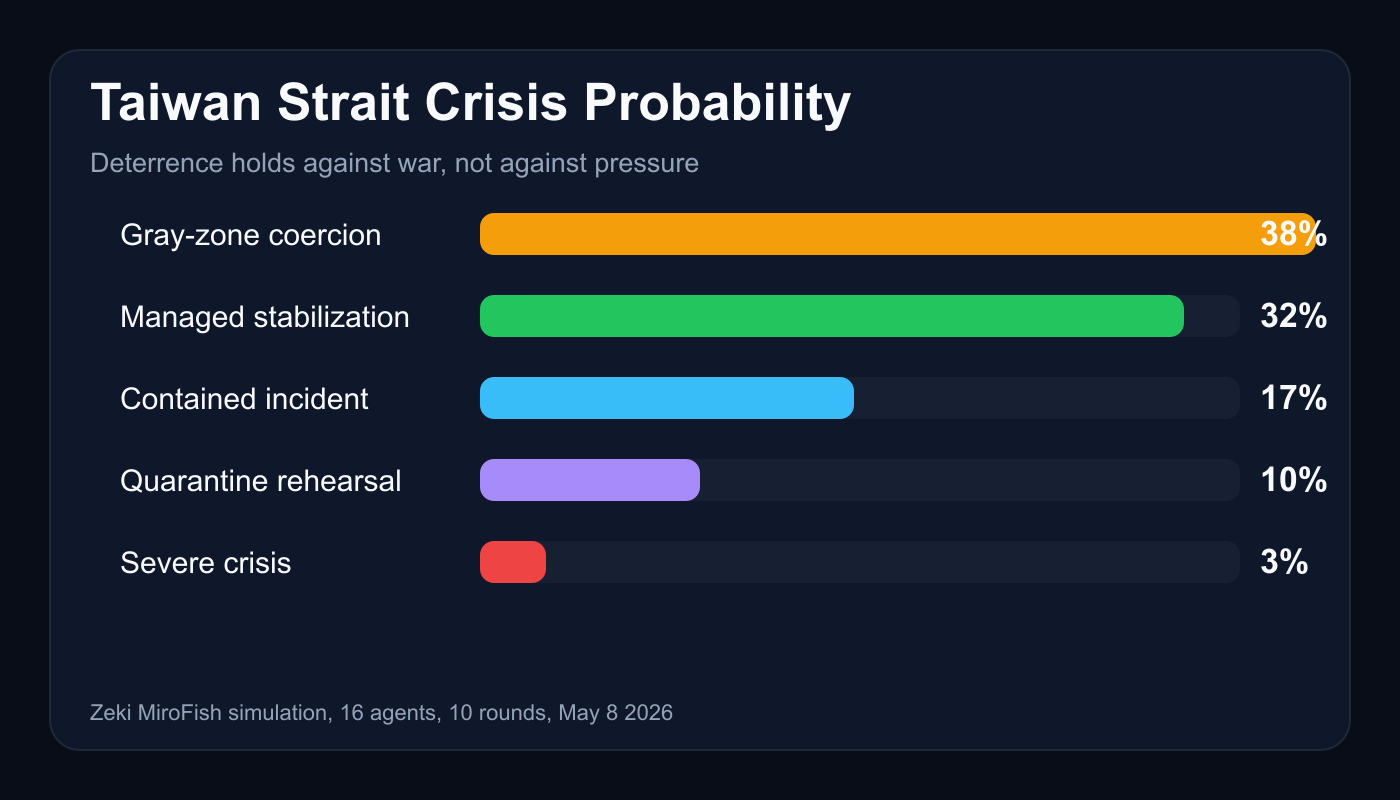
Taiwan Strait crisis risk rises after Taiwan's roughly $25 billion US arms purchase, but the danger concentrates below the threshold of major war. A 16-agent, 10-round MiroFish simulation assigns a 38% probability to intensified gray-zone coercion without an acute crisis, a 32% probability to managed deterrence and stabilization, a 17% probability to a limited contained incident, a 10% probability to coercive quarantine or blockade rehearsal, and only a 3% probability to severe US or Japan direct confrontation.
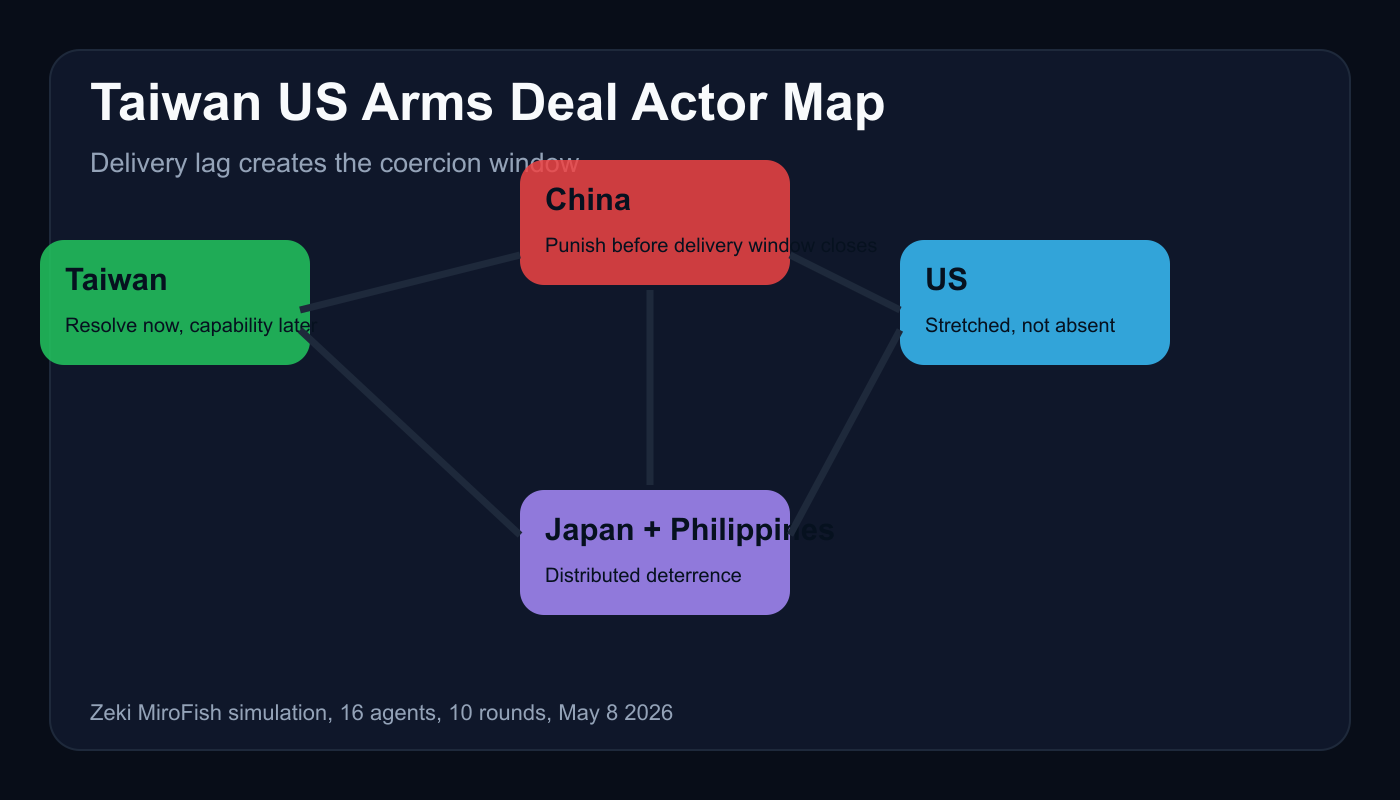
The core finding is simple: deterrence is likely to prevent war, not pressure. Taiwan gains political resolve immediately, but the military effect arrives later through delivery, training, basing, stockpiles, and integration. That lag creates the next 90-day danger window. Beijing has reason to punish Taiwan before the new capabilities are absorbed, but it also has reason to avoid a chip shock, allied military consolidation, and diplomatic backlash across Asia and Europe.
The modal path is not invasion. It is a hotter gray zone: more PLA air and naval activity, coast guard pressure, sanctions, cyber probes, disinformation, and legal language that tests the edge of quarantine without forcing a shooting war.
Background and Context: Taiwan US Arms Sales
Taiwan US arms sales sit at the center of the cross-Strait deterrence problem. The US State Department's Taiwan relations page states that the United States provides Taiwan with defensive articles and services under the Taiwan Relations Act framework. The Taiwan Relations Act text anchors the legal basis for supporting Taiwan's self-defense capacity. Beijing treats that support as a challenge to its sovereignty claims. Taipei treats it as proof that democratic survival depends on credible military preparedness.
The simulation seed used a May 8 news hook: Taiwan broke a political deadlock to approve roughly $25 billion in US arms purchases. The move matters because it is both a procurement decision and a political signal. It tells Washington that Taipei can still act despite internal legislative friction. It tells Beijing that Taiwan's political system can move toward harder defense even under pressure. It tells markets that the Strait remains a live geopolitical risk rather than a background assumption.
Keyword research from Google Suggest shows why this topic has broad search demand. Queries around "Taiwan arms purchase" surface "Taiwan arms procurement," "Taiwan US arms purchase," and "Taiwan US arms deal." Queries around "Taiwan Strait crisis" surface year-specific crisis searches including 2025 and 2026. Searches around "China Taiwan blockade" surface "China Taiwan blockade scenario," "China blockade Taiwan Strait," "China simulated Taiwan blockade," and "CSIS China Taiwan blockade." The public searcher is not only asking whether China invades. They are asking whether arms sales trigger coercion, whether a blockade is plausible, and how quickly deterrence becomes real.
This post extends Zeki's simulation research series at zekiai.xyz/blog, including prior work on Asian escalation and maritime coercion such as the South China Sea May 2026 simulation and the US China trade truce simulation. The Taiwan case is different because semiconductor concentration, alliance geography, and domestic legitimacy all compress decision time.
Methodology: Taiwan Gray Zone Coercion Simulation
The MiroFish simulation used 16 agents over 10 rounds. It is an analytic simulation, not a poll, market price, or deterministic prediction. Each agent represented an actor with incentives, constraints, fears, and escalation options. The question was: after Taiwan's arms approval, does deterrence stabilize the Strait over the next 90 days, or does China force a crisis?
The agent set included Lai Ching-te, a KMT legislative strategist, a Taiwan Defense Ministry planner, a TSMC supply-chain executive, Xi Jinping, a PLA Eastern Theater commander, a PRC Foreign Ministry spokesperson, President Trump, a US Indo-Pacific Command admiral, a US defense industrial base chief executive, a Japanese national security official, the Philippine defense secretary, an EU trade commissioner, an ASEAN neutral diplomat, a global macro fund manager, and a cybersecurity analyst.
The simulation modeled eight variables:
| Variable | Why it matters |
|---|---|
| Delivery lag | Purchased systems deter less before crews train and systems integrate |
| Taiwanese political unity | Determines whether procurement survives budget and implementation fights |
| US bandwidth | Iran and Gulf commitments can reduce visible Indo-Pacific attention |
| PLA risk appetite | Determines whether Beijing chooses patient pressure or near-term coercion |
| Semiconductor market sensitivity | Creates a rapid economic feedback loop against extreme escalation |
| Japan and Philippine posture | Converts US deterrence from bilateral to distributed regional signaling |
| Crisis-management channels | Determines whether an incident stays contained |
| Domestic nationalism | Raises the cost of appearing weak for Beijing, Taipei, and Washington |
The model's key structural assumption is that procurement has two clocks. The political clock moves now. The military clock moves later. A legislature can approve funds quickly. Missiles, air defense systems, training pipelines, logistics, hardened basing, and operational doctrine take longer. That separation is where the risk lives.
Key Findings: China Taiwan Blockade Probability
The final distribution clusters around coercion rather than clean stabilization or war.
| Outcome over next 90 days | Probability |
|---|---|
| Intensified gray-zone coercion, no acute crisis | 38% |
| Managed deterrence and stabilization | 32% |
| Limited acute incident, contained | 17% |
| Coercive quarantine or blockade rehearsal | 10% |
| Severe crisis with US or Japan direct confrontation | 3% |
Taiwan US Arms Sales Strengthen Resolve Before Capability
The arms package is immediately political. Taiwan demonstrates that internal deadlock can be broken when defense stakes are high. That matters because deterrence is partly about an adversary's belief that a society will resist, absorb costs, and keep institutions functioning under pressure.
But the package is only later operational. Capability requires delivery schedules, trained crews, interoperable command systems, munitions stockpiles, hardened facilities, and maintenance depth. A procurement announcement does not instantly change the military balance. The simulation agents repeatedly converged on this distinction. Taiwan's signal strengthens long-term deterrence while opening a short-term pressure window.
Taiwan Gray Zone Coercion Is the Modal Outcome
Beijing is more likely to punish than pounce. The reasons are strategic, economic, and diplomatic. A direct attack risks US and Japanese military involvement, semiconductor disruption, capital flight, European backlash, and domestic economic consequences inside China. A lower-level coercion campaign offers pressure with deniability and reversibility.
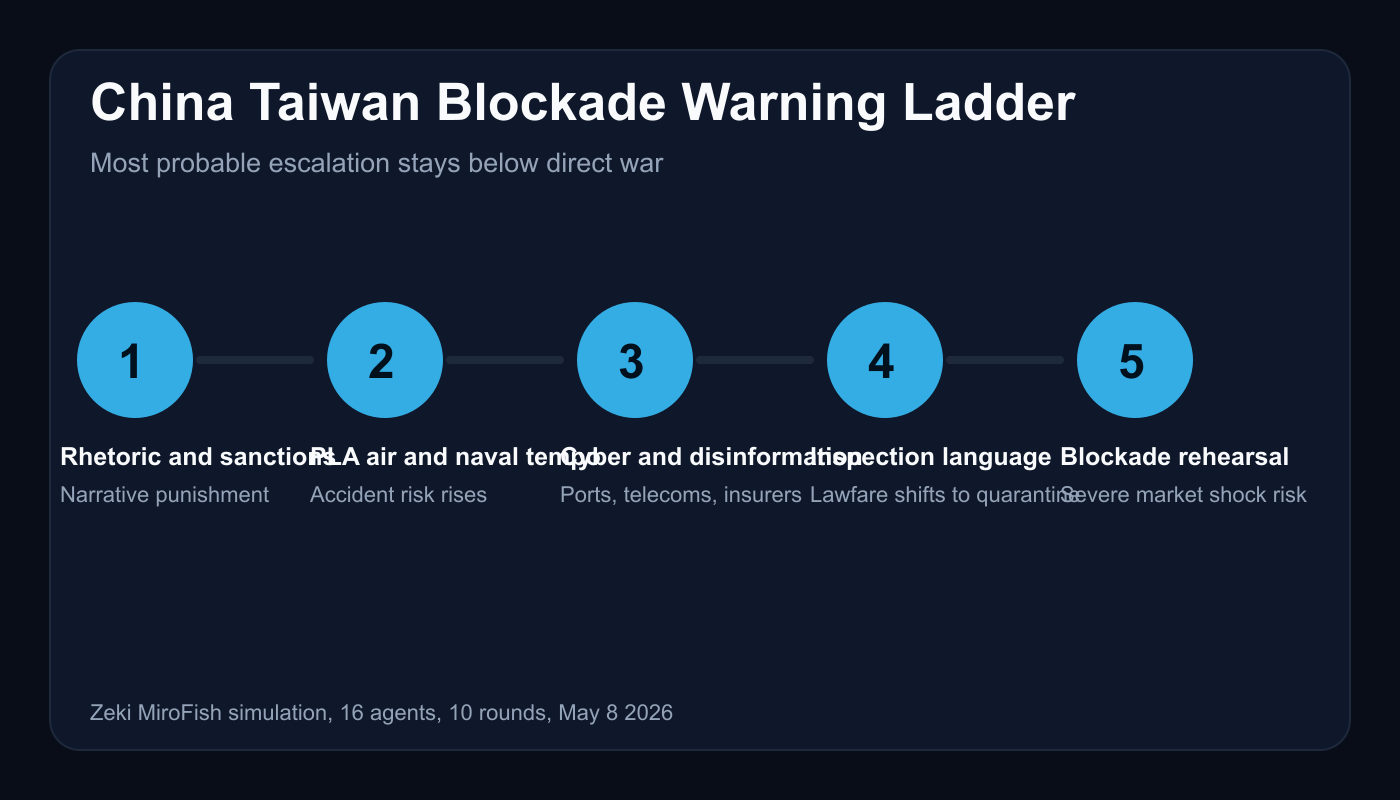
The likely menu includes PLA aircraft and naval tempo increases, coast guard activity near sensitive waters, sanctions against Taiwan-linked firms or political figures, cyber probes against logistics systems, disinformation aimed at political fracture, and exercises designed to show blockade capacity. The CSIS China Power Project has long tracked how military, economic, and political tools interact in Chinese statecraft. That toolkit is more relevant than a single invasion binary.
China Taiwan Blockade Risk Centers on Language Shift
The 10% quarantine or blockade rehearsal outcome is small but important. The tipping point is not necessarily a missile launch or amphibious movement. It is a legal and operational vocabulary shift. If PRC messaging moves from "exercise" to "inspection," "customs," "law enforcement," "anti-smuggling," or "quarantine," the risk profile changes. That language implies Beijing is testing a sovereignty enforcement frame rather than merely signaling displeasure.
The second indicator is cyber targeting. If cyber activity focuses on ports, shipping manifests, cable operators, telecoms, insurers, or logistics software, the coercion campaign is moving from symbolic military pressure toward economic control. The simulation treated that as the most important early-warning pattern.
Market Implications: Taiwan Strait Crisis Pricing
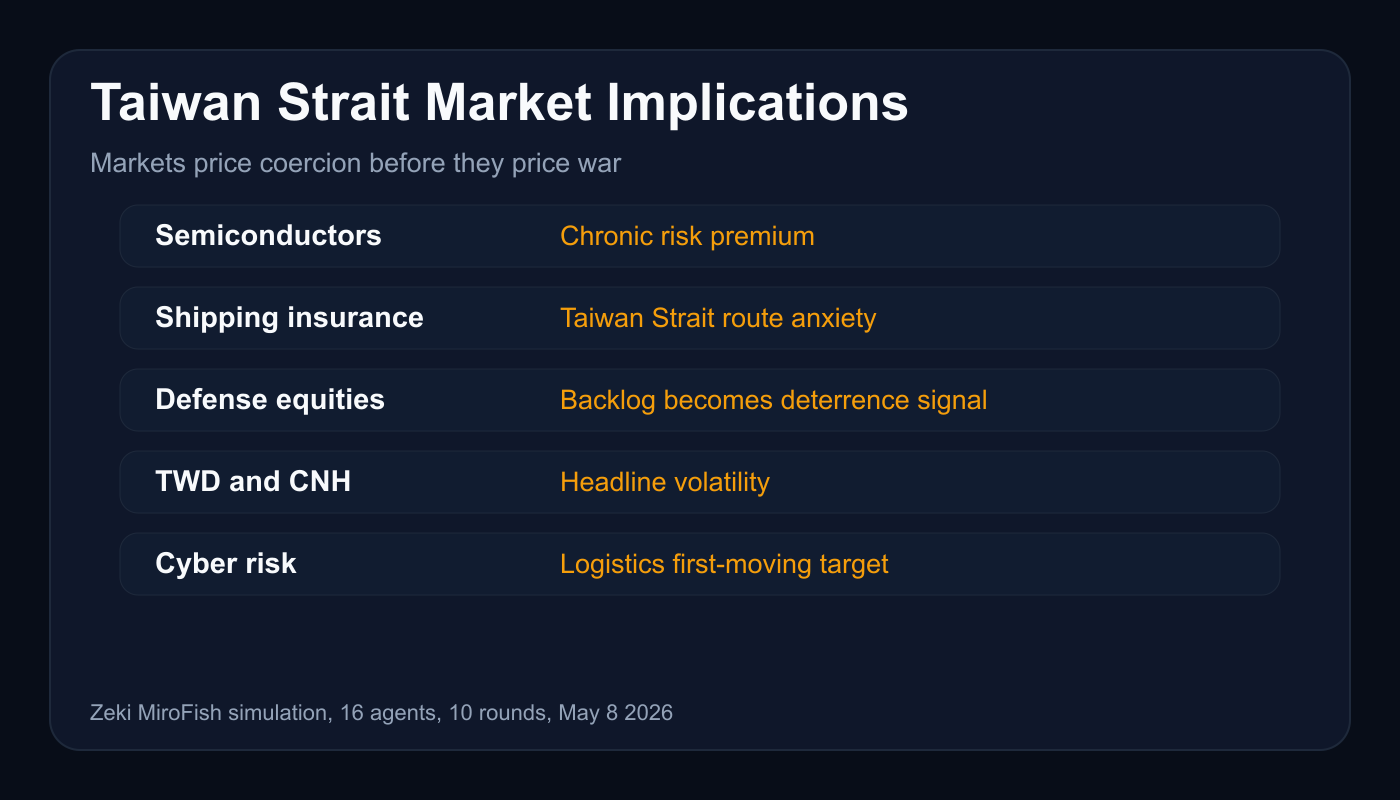
Markets are more likely to price chronic coercion than immediate war. The simulation's central market implication is recurring risk premium across semiconductors, shipping insurance, defense equities, currency volatility, and cyber insurance. That is different from a crash scenario. It means markets may absorb each incident until an operational threshold is crossed, then reprice suddenly.
Semiconductors remain the largest transmission channel. Taiwan's role in advanced chip production means even non-war coercion can raise inventory hoarding, supplier diversification, and insurance costs. A blockade rehearsal would not need to last long to affect expectations. If investors believe port access, shipping schedules, or power reliability could be threatened, risk premiums move before physical disruption appears.
Shipping and insurance are the second channel. The Taiwan Strait is not merely a local military space. It is an artery in Asian trade. Even a limited quarantine drill can force insurers, carriers, and port operators to revisit assumptions. A contained incident at sea or in the air would also raise questions about escalation control.
Defense equities are the third channel. The simulation found that backlog becomes part of deterrence credibility. If arms sales are approved but delivery timelines remain slow, markets may reward defense industrial capacity while also discounting the deterrence value of announcements. Production speed becomes geopolitical information.
Second-Order Effects
The first second-order effect is Taiwanese politics. The KMT can shift from obstruction to procurement scrutiny. That lets opposition actors argue they are fiscally responsible without appearing soft on defense. The result is more implementation friction, but less outright paralysis.
The second effect is PLA normalization. Higher air and naval tempo can become the new baseline. Once the baseline moves, future coercion requires even more pressure to be noticed. That ratchet effect is dangerous because accidents become statistically more likely even if no actor wants war.
The third effect is alliance distribution. Japan and the Philippines become more central as deterrence becomes less about a single US signal and more about regional posture. Visible coordination can lower severe-crisis odds, but theatrical coordination can also give Beijing a pretext for counter-escalation. The stabilizing point is credible, routine, and operational rather than performative.
The fourth effect is cyber first movement. Cyber operations give Beijing a way to test pressure on logistics, media, finance, telecoms, and ports without openly crossing a military threshold. If the first visible sign of escalation is not a ship but a logistics outage, the market will be slower to classify the event correctly.
Risk Assessment
This forecast can be wrong in three directions. First, it may understate stabilization if Beijing decides that China's economy, trade exposure, and diplomatic environment make even gray-zone escalation too costly. In that case, the 32% managed deterrence outcome becomes the actual path and the next 90 days look noisy but contained.
Second, it may understate incident risk. Dense aircraft and naval activity can produce accidents. A collision, radar lock, warning shot, or misread maneuver could push the 17% contained incident scenario higher. Crisis-management channels matter because intent is not the only driver of escalation. Friction can substitute for strategy.
Third, it may understate blockade rehearsal risk if Beijing concludes that US bandwidth is constrained by Middle East commitments and that a short, reversible quarantine frame would not trigger direct allied intervention. That is the most dangerous branch because it blends lawfare, cyber, coast guard operations, and military overwatch into one coercive package.
The uncertainty band is widest around timing. Ninety days is long enough for coercive pressure and short enough that new weapons do not materially transform Taiwan's military posture. The simulation is therefore more confident about the type of pressure than the exact day it appears.
Conclusion
The Taiwan Strait crisis forecast is not a war forecast. It is a coercion forecast. Taiwan's $25 billion arms approval strengthens long-term deterrence, but its near-term effect is political rather than operational. That gives Beijing an incentive to punish now while avoiding the costs of outright war.
The correct baseline for the next 90 days is a hotter gray zone: more PLA activity, more cyber probing, more legal rhetoric, more sanctions, and more market sensitivity. The key warning sign is a shift from exercise language to inspection or law-enforcement language, especially if paired with cyber pressure on ports, telecoms, insurers, or logistics.
Bottom line: deterrence probably holds against invasion. It does not hold against pressure. The Strait can become strategically more stable while tactically more coercive, and that is exactly the path markets and policymakers should prepare for.