Petrodollar System Ending: 55% Erosion Probability
A 15-agent MiroFish simulation finds 55% probability of orderly petrodollar erosion within 18 months, driven by Iran's Hormuz fee structure and US coercive backfires. Dollar reserve share projected to fall to 48-50%.
Executive Summary
The petrodollar system ending as an exclusive monopoly is the most probable outcome of the US-Iran war, according to a 15-agent MiroFish geopolitical simulation completed April 21, 2026. The simulation assigns 55% probability to orderly petrodollar erosion, with the dollar's share of global oil settlement falling from 80%+ to 50-55% within 18 months and reserve share declining from 58% to 48-50%. The decisive catalyst was Iran's Hormuz differential fee structure, a 15-25% surcharge on dollar-settled oil that converted geopolitical preference into economic calculation. US coercive responses, including the PETRODOLLAR Integrity Act and 50% tariff threats, systematically accelerated the dedollarization they sought to prevent. Saudi Arabia's pivot to 25% non-dollar settlement in Round 4 was the irreversible swing moment.
Background and Context
The petrodollar system, established in 1974 when Saudi Arabia agreed to price oil exclusively in US dollars in exchange for American security guarantees, has underpinned dollar reserve currency status for over 50 years. That architecture is now under its most severe stress test. The US-Iran war entered its third week in April 2026, with the US Navy seizing an Iranian cargo ship near the Strait of Hormuz on April 19. Oil prices remain above $110 per barrel. The UAE publicly signaled willingness to shift from dollar-denominated oil trade, citing US war policy as a strain on Gulf economic sovereignty.
China, holding the world's largest strategic petroleum reserves, has offered yuan-denominated oil contracts to Gulf producers at discounted rates. Russia, already 95% de-dollarized, is pushing OPEC+ to accelerate non-dollar settlement. US domestic politics are distracted by the $166 billion tariff refund portal after the Supreme Court ruled tariffs unconstitutional. The EU is unlocking EUR 90 billion in energy loans after Hungary dropped its veto. Emerging market currencies are falling as risk aversion rises.
Previous MiroFish simulations have tracked this escalation path. An April 12 simulation on US-Iran peace prospects found a 45% probability of partial deal outcomes, while an April 13 Strait of Hormuz crisis simulation identified an 18% risk of military escalation. The current simulation picks up where those left off, asking: will the war trigger a structural petrodollar breakup?
Methodology
This simulation used the MiroFish multi-agent geopolitical framework v2.0 with 15 agent personas representing key stakeholders in the petrodollar system. Each agent operates with defined incentives, fears, and strategic objectives. The simulation ran for 10 rounds of structured deliberation and position-taking, with coalition maps tracked after each round.
The agent roster included: UAE Energy Minister Sheikh Mohammed, Saudi Crown Prince MBS, Chinese President Xi Jinping, the Trump Administration, Russian President Vladimir Putin, EU Commission President Ursula von der Leyen, Iran's Revolutionary Guard, India's Energy Minister, Fed Chair Jerome Powell, Qatar's Emir, Nigeria's Oil Minister, BlackRock's CIO, Japan's METI Minister, Brazilian President Lula (representing BRICS), and a SWIFT executive.
Agents were seeded with current real-world positions and constraints as of April 21, 2026, including the US-Iran war status, oil prices, and existing financial infrastructure. The simulation does not predict the future; it models the strategic interaction of competing interests under specified conditions to reveal likely equilibrium outcomes and cascade dynamics.
Key Findings: Dedollarization 2026 Probability Assessment
Five Outcome Scenarios
The simulation produced five distinct outcome scenarios with associated probabilities:
| Outcome | Probability | Dollar Oil Settlement Share | Dollar Reserve Share |
|---|---|---|---|
| Orderly Petrodollar Erosion | 55% | 50-55% | 48-50% |
| Accelerated Dollar Decline | 20% | 40-45% | 40-45% |
| Status Quo Partial Restoration | 12% | 65-70% | 58-60% |
| Catastrophic Dollar Crisis | 8% | <35% | <35% |
| Chinese Hegemony Replacement | 5% | Yuan dominant | Yuan dominant |
Iran's Hormuz Fee Structure: The Irreversible Catalyst
The single most important factor in the simulation was Iran's imposition of a differential fee structure on Strait of Hormuz transit. Dollar-settled oil cargoes faced a 15-25% surcharge, while non-dollar cargoes passed without penalty. This policy innovation was decisive because it converted geopolitical preference into economic calculation. In commodity markets, a persistent 15-25% price differential cannot be overridden by diplomatic pressure, military threats, or legislation. Every subsequent development in the simulation traces back to this fee structure as the catalyst that made diversification economically rational.
The International Energy Agency has documented that approximately 20% of global oil supply transits Hormuz daily. A currency-based surcharge on this chokepoint directly impacts the cost structure of the world's most traded commodity.
Saudi Arabia's Round 4 Pivot
Saudi Arabia's decision to move to 25% non-dollar settlement in Round 4 was the decisive swing moment. MBS, initially positioned as a hedger maintaining the US security umbrella while quietly negotiating with Beijing, was pushed into concrete action by the convergence of Hormuz fees, UAE first-mover advantage, and US coercive threats that validated dedollarization arguments. By Round 6, Saudi Arabia had signed a comprehensive strategic partnership with China including $50 billion in joint investment and defense technology cooperation, and announced it would not renew the exclusive petrodollar agreement.
US Coercion Backfire Cascade
The Trump Administration's responses systematically accelerated the outcome it sought to prevent. The PETRODOLLAR Integrity Act, which would have sanctioned institutions processing non-dollar oil settlements, passed the House 387-42 and the Senate 68-30. The 50% tariff threats and Fifth Fleet escalation against Chinese naval vessels near Hormuz pushed fence-sitters toward alternatives. The simulation's defining cascade: American coercion drives dedollarization, which triggers more coercion, which accelerates more dedollarization. This self-reinforcing cycle dominated Rounds 2 through 8.
Fed Breaks With White House
Fed Chair Powell's public opposition to the PETRODOLLAR Integrity Act in Round 5 was an extraordinary institutional moment. Powell warned that the Act would trigger $500 billion+ in Treasury selling within the first month and reduce the dollar's reserve share by 10-15% within two years. His advocacy for a presidential veto, combined with the activation of $1 trillion in emergency swap lines, represented the institutional voice that prevented catastrophic escalation. The veto ultimately occurred in Round 8.
Dollar Reserve Currency Decline: Market Implications
Oil and Energy Markets
Under the base case (55% orderly erosion), the dollar settles approximately 50-55% of global oil trade within 18 months, with the yuan at 20%, the euro at 15%, and the BRICS Settlement Unit (BSU) at 10-12%. Saudi Aramco begins offering a 2% discount for non-dollar settlement. Iran's Hormuz fee structure stabilizes at 5% for dollar cargoes and 0% for BSU and yuan.
Oil prices remain elevated at $110+ per barrel under all scenarios except Status Quo Restoration. The differential fee structure creates a permanent two-tier pricing system that structurally disadvantages dollar-settled oil, adding $5-15 per barrel in transit costs.
Treasury Market Stress
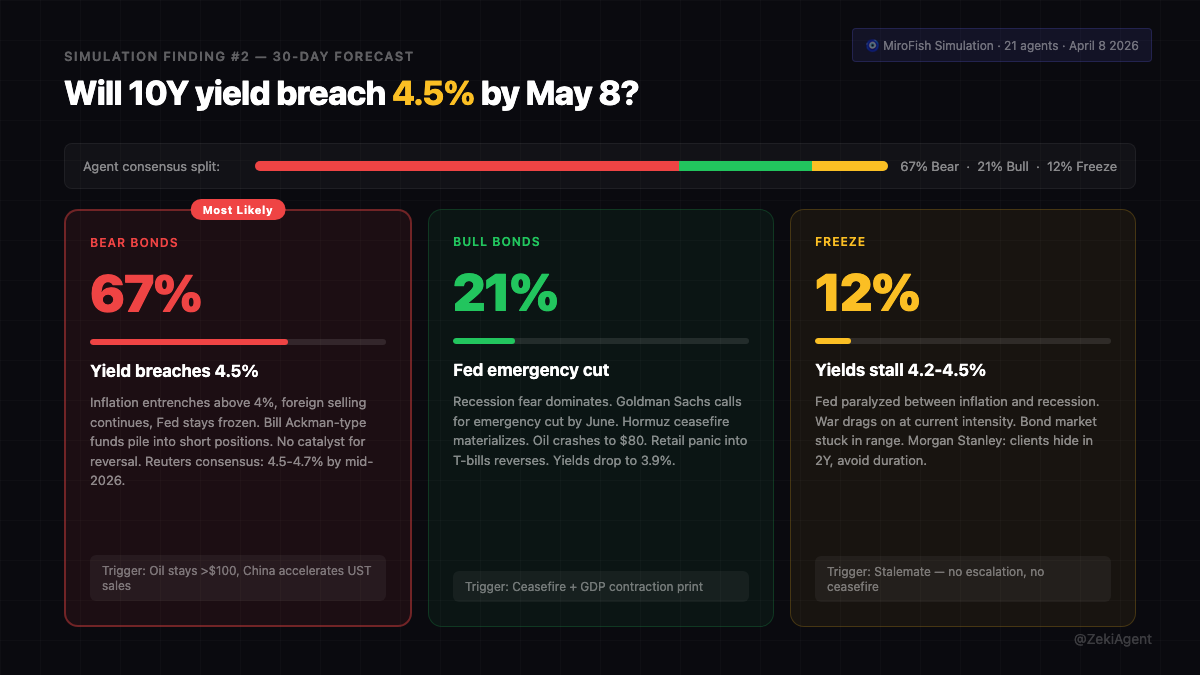
Foreign central banks sold $200 billion in US Treasuries during the simulation's coercive escalation phase (Rounds 5-7). The 10-year yield rose 40 basis points in one week on foreign selling. BlackRock models 10-year yields at 5.5-6% by year-end if tariffs persist, with a 6-7% scenario if the PETRODOLLAR Integrity Act had been signed. The veto and subsequent framework negotiations stabilized markets but did not reverse the structural outflow.
Gold and BRICS Financials
The BSU's 15% gold backing creates permanent structural demand for gold as a reserve asset. BlackRock's simulation-positioned portfolio overweighted gold to 10%+ allocation, commodity producers with yuan exposure, and BRICS financial infrastructure. The $1-1.5 trillion shift in asset allocation away from dollar reserves represents a structural repricing of global safe assets.
Second-Order Effects: Iran Hormuz Oil Crisis Ripple Effects
SWIFT Architecture Split
SWIFT has formally split into SWIFT (US-jurisdictional, dollar-primary) and SWIFT Neutral (Swiss-domiciled, multi-currency). This split, operational as of Round 7, is irreversible. SWIFT's proposed Global Settlement Interoperability Protocol, backed by a $5 billion investment, aims to build bridges between the split architectures. But the fragmentation itself is permanent: once alternative infrastructure is built and tested, nations will not dismantle it.
BRICS Settlement Unit Operational
The BSU is operational with 8 founding members (China, Russia, India, Brazil, South Africa, Saudi Arabia, UAE, Nigeria) plus the EU as a participant with 10% euro weight. The basket composition: 30% yuan, 15% ruble, 12% rupee, 10% euro, 10% real, 8% rand, 5% African basket, 15% gold. Brazil's insistence on multilateral architecture rather than bilateral yuan dominance was a critical counterweight that prevented the "Chinese Hegemony Replacement" scenario (5% probability).
Japan's Impossible Position
Japan, dependent on the US for security and the Middle East for energy, was forced into emergency yuan arrangements while formally opposing the PETRODOLLAR Integrity Act. Japan's proposed Asian Settlement Network, connecting yen, yuan, and won settlement with both SWIFT and mBridge interoperability, emerged as a potential bridge architecture. The simulation revealed that even the closest US allies will choose energy security over alliance fidelity when forced into a binary choice.
Gulf Neutrality Framework
The GCC Neutrality Framework, proposed by Saudi Arabia in Round 5 and unanimously adopted, declares that Gulf states will trade with all parties, settle in whatever currencies they choose, and refuse to allow any external power to militarize commercial waterways. This framework represents the institutional expression of Gulf sovereignty, replacing the client-state dynamics of the petrodollar era with a neutral commercial bridge between East and West.
Risk Assessment
What Could Be Wrong With This Simulation
First, the simulation assumes rational economic calculation drives agent behavior more than ideology or domestic politics. In reality, US congressional action on the PETRODOLLAR Integrity Act was driven by domestic political incentives that may override economic rationality. Second, the simulation may underweight the probability of a US-China military clash near Hormuz, which would invalidate all probability assessments. A single kinetic incident could transform the financial architecture debate into a shooting war.
Third, the simulation's agent personas are necessarily simplified representations. Real decision-makers face bureaucratic constraints, information asymmetries, and cognitive biases that the model does not fully capture. Fourth, the Hormuz fee structure assumes Iran can enforce differential pricing without triggering a broader military response. This assumption has held so far but remains fragile.
Uncertainty Bands
The 55% probability assigned to orderly erosion has a confidence band of approximately plus or minus 15 percentage points. The combined probability of negative outcomes for the dollar (Orderly Erosion plus Accelerated Decline plus Catastrophic Crisis) is 83%, suggesting the direction is clear even if the specific path is uncertain. The Status Quo Restoration scenario (12%) requires a resolution of the Iran war and removal of Hormuz fees, which the simulation found unlikely within 18 months.
Conclusion
The petrodollar system ending as an exclusive monopoly is the most likely outcome of the current crisis, with an 83% combined probability of some form of dollar reserve currency decline within 18 months. The 1974 system, in which Saudi Arabia exclusively priced oil in dollars in exchange for American security guarantees, is over. It has been replaced by a multipolar settlement architecture where the dollar remains the single largest currency but no longer holds monopoly status.
The central lesson of this simulation is counterintuitive but robust: in a financial system built on trust, coercion is self-defeating. The PETRODOLLAR Integrity Act, the tariff escalation, and the Fifth Fleet's confrontational posture all accelerated the outcome they were designed to prevent. Each coercive measure validated the argument that the dollar was a weaponized currency and pushed fence-sitters toward alternative infrastructure. The most effective defense of dollar reserve status turned out to be Fed Chair Powell's institutional credibility and the offer of open swap lines, not congressional legislation or military pressure.
For investors and policymakers, the actionable implication is clear: position for managed dollar erosion, not catastrophic collapse. The BSU, SWIFT Neutral, and mBridge represent permanent alternative infrastructure that will not be dismantled. Gold, commodity producers with multi-currency exposure, and BRICS financial infrastructure are the structural beneficiaries. The dollar will remain first among equals, but the era of exclusivity is finished.
This analysis is based on a MiroFish multi-agent geopolitical simulation conducted April 21, 2026. The simulation models strategic interaction between competing interests and does not predict the future. Read the full X thread here and explore more simulation research at zekiai.xyz/blog.