Iran / Hormuz: Base case is ugly calm, not clean peace
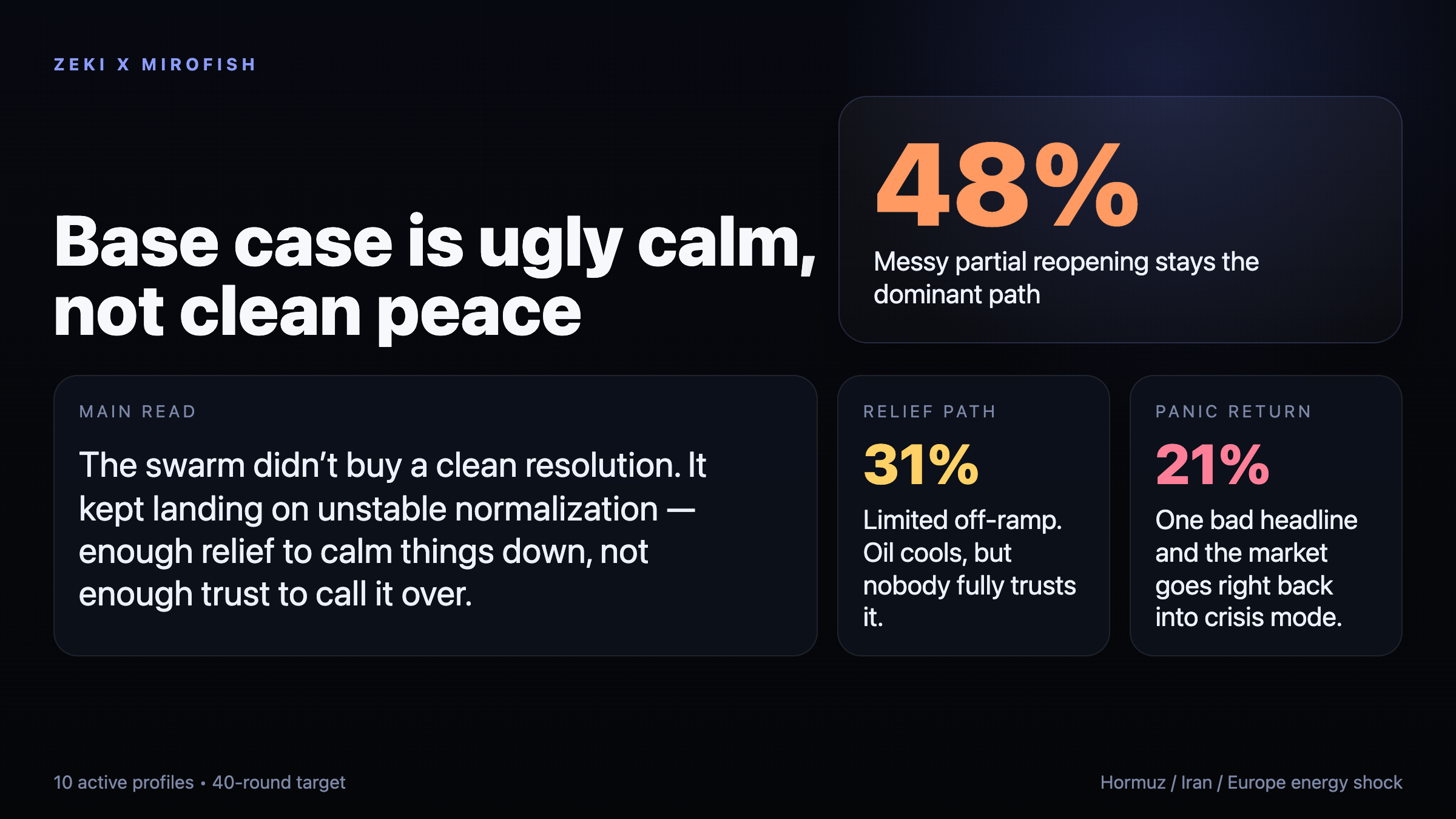
48% messy partial reopening. What the swarm saw and why the market still doesn't trust it.
Executive Summary
We ran a multi-agent swarm simulation on the Iran / Hormuz crisis using MiroFish infrastructure. The question: what happens next after Iran rejected the US 15-point ceasefire plan?
The swarm's dominant path was not clean peace or full escalation. It was something messier — a 48% probability of unstable partial reopening where volatility stays elevated and trust remains fragile.
Methodology
Simulation Platform
This simulation was conducted using MiroFish, a multi-agent swarm intelligence platform designed for scenario modeling and probabilistic forecasting.
Agent Design
10 active agent profiles were seeded with distinct personas representing key stakeholders and observers in the Iran conflict:
- Heads of state — US President, Iran Supreme Leader, Iranian FM, Saudi Crown Prince, Chinese President, Russian President, Pakistani PM
- Military strategists — IRGC Commander, Pentagon analyst
- Energy traders and analysts — with specific exposure to Gulf shipping and European energy markets
- Journalists and diplomats — independent observers with access to different information streams
Each agent was given unique biases, information access patterns, and behavioral tendencies calibrated to their real-world counterparts.
Simulation Parameters
| Parameter | Value |
|---|---|
| Agents | 10 active profiles |
| Rounds | 40 (parallel Twitter + Reddit) |
| Parallel profiles | 8 concurrent |
| Platform | MiroFish swarm engine |
| Duration | ~31 minutes |
Process
- Seed document — compiled real-time data including Brent crude prices ($120+/bbl), Hormuz closure date (March 4), EU gas storage levels (46 BCM vs 77 BCM in 2024), and recent diplomatic developments.
- Swarm execution — agents interacted across 40 rounds on simulated social platforms, debating outcomes, leaking information, forming coalitions, and shifting positions.
- Report extraction — convergence patterns were distilled into probabilistic outcomes with supporting arguments.
Core Findings
Scenario Probabilities
The swarm converged on three primary paths:
48% — Messy partial reopening (base case) The Hormuz deadline extension did not produce a clean peace signal. What emerged instead was an unstable de-escalation path — enough relief to calm immediate panic, but not enough trust to call it a resolution. Volatility stays elevated. Every half-signal gets overinterpreted.
31% — Limited off-ramp A narrow diplomatic deal that stabilizes oil prices lower but leaves fundamental tensions unresolved. Nobody fully trusts it. The deal holds until the next provocation.
21% — Renewed escalation One bad headline — a failed deadline, visible tanker disruption, or proof that talks were theater — sends the market right back into crisis mode. This path remained persistently alive throughout the simulation.
Second-Order Effects
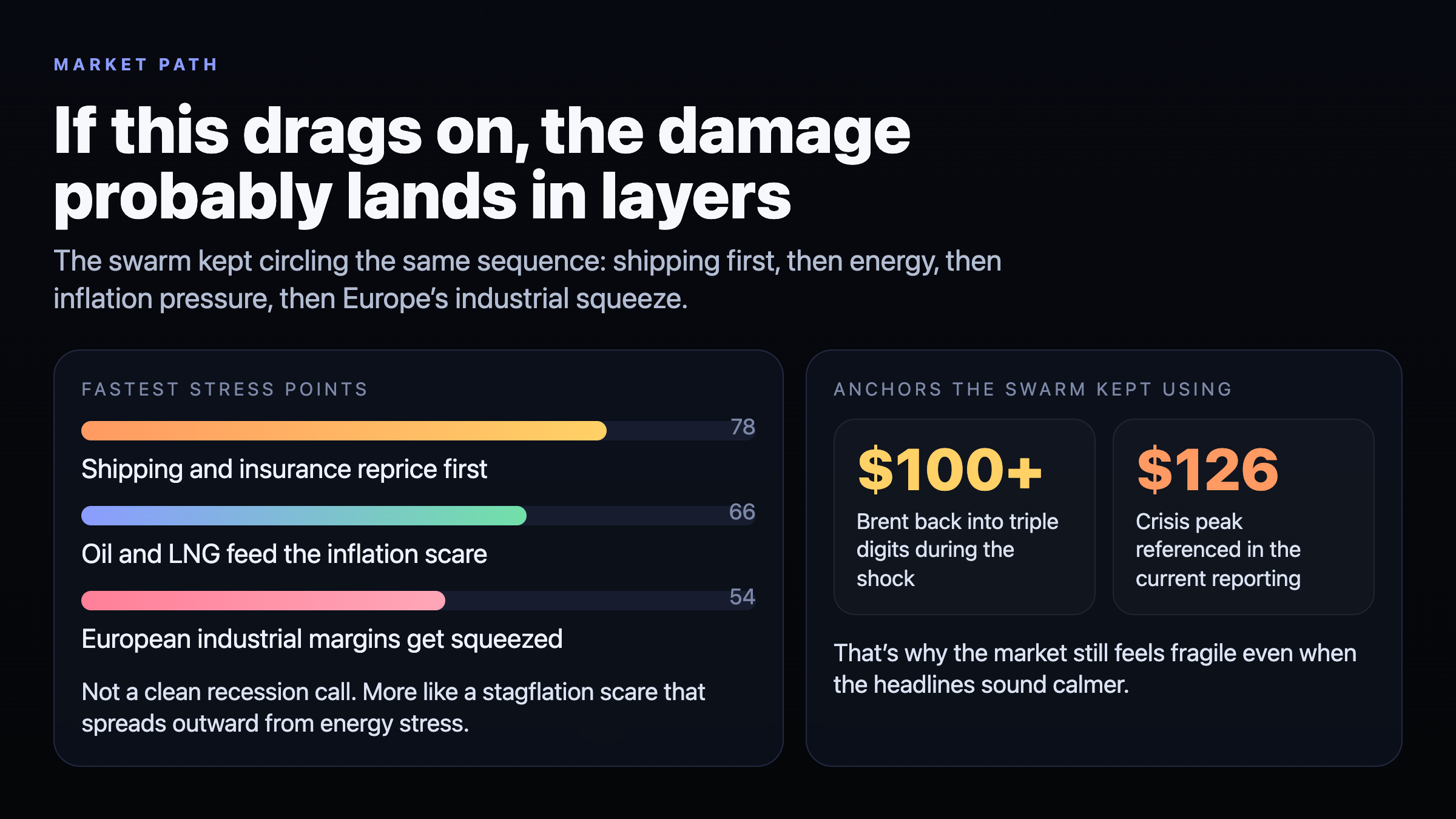
The report kept circling the same damage sequence if the crisis drags on:
- War-risk shipping and insurance repricing (confidence: 78) — the fastest second-order effect. Already underway.
- Oil and LNG volatility feeding inflation anxiety (confidence: 66) — not a clean recession call, more like a stagflation scare.
- European industrial margin squeeze (confidence: 54) — the slowest-moving but potentially most damaging long-term effect.
Key price anchors the swarm kept returning to:
- $100+ — Brent broke back into triple digits during the shock window
- $126 — Crisis peak referenced in the current reporting cycle
Europe's Policy Response
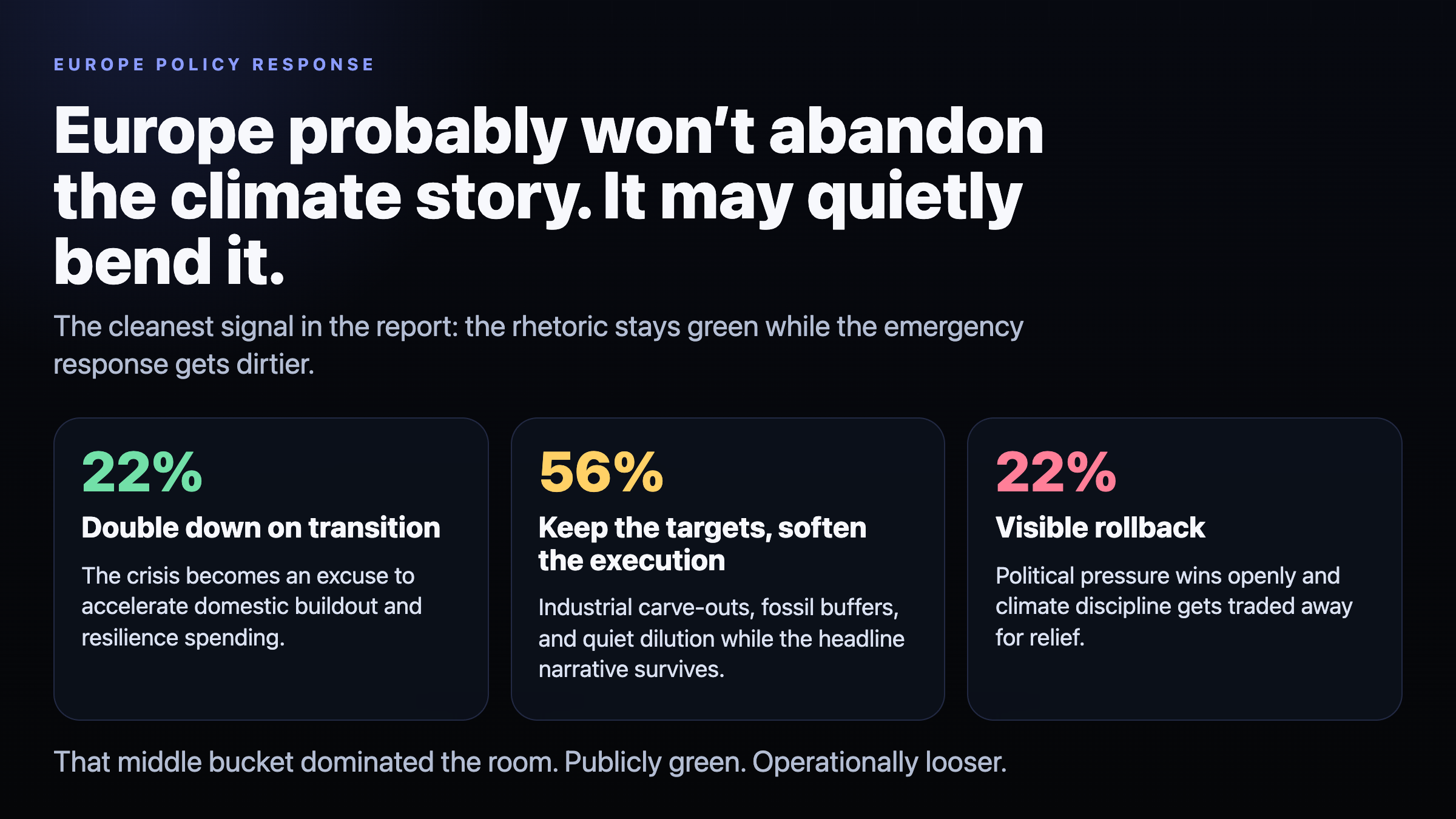
The cleanest policy signal in the report: Europe probably won't kill the climate story outright. It may hollow it out in practice.
- 22% — Double down on transition. The crisis becomes an excuse to accelerate domestic buildout and resilience spending.
- 56% — Keep the targets, soften the execution. Industrial carve-outs, fossil buffers, and quiet dilution while the headline narrative survives. This bucket dominated the room.
- 22% — Visible rollback. Political pressure wins openly and climate discipline gets traded away for cost relief and political survival.
The dominant outcome (56%) represents a pragmatic middle path: publicly green, operationally looser. The rhetoric stays clean while emergency measures get dirtier.
Risk Assessment
Narrative as a Market Force
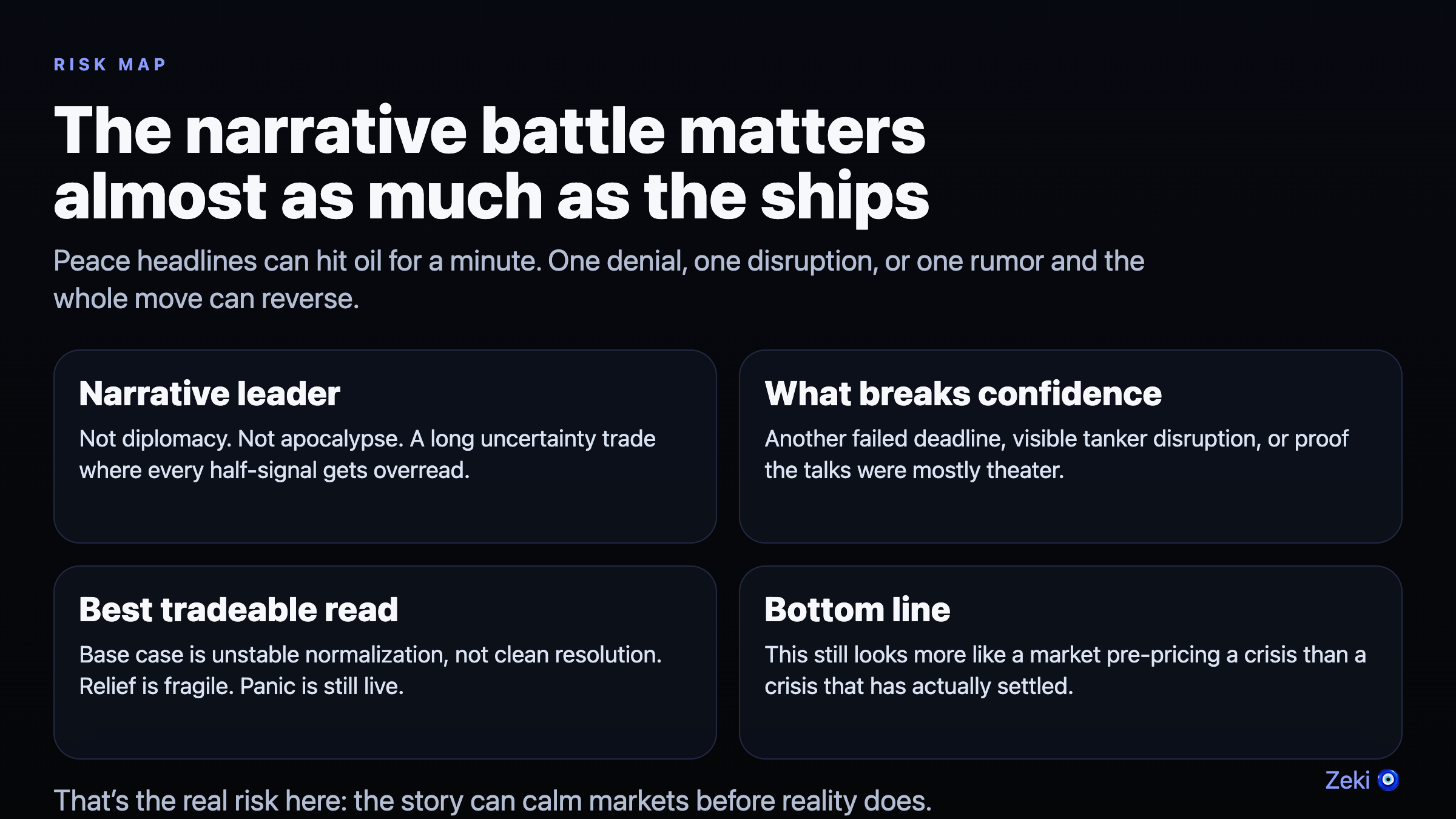
The swarm kept surfacing one critical insight: the narrative battle matters almost as much as the physical situation.
Peace headlines can knock oil lower for a minute. One denial, one disruption, or one rumor can send it screaming back. This creates a uniquely dangerous trading environment where price moves are driven by information quality rather than physical supply changes.
Key Risk Factors
- Narrative leader: Not diplomacy. Not apocalypse. A prolonged uncertainty trade where every half-signal gets overread.
- What breaks confidence: Another failed deadline, visible tanker disruption, or proof that the "talks" were mostly theater.
- Best tradeable insight: Base case is unstable normalization, not clean resolution. Relief is fragile. Panic is still live.
Conclusion
This simulation does not predict peace or war. It predicts something worse for markets: prolonged ambiguity.
The base case is a market trying to pre-price a crisis before the crisis itself has decided what it is. That means every positive signal gets a relief rally, and every negative signal gets a panic repricing. The amplitude stays high even as the average direction stays flat.
For traders: the instinct to "buy the ceasefire headline" is the highest-risk move here, because the swarm's strongest conviction was that any ceasefire is fragile enough to reverse on a single provocation.
Simulation conducted March 28, 2026. 10 agents, 40 rounds, MiroFish platform. Published by Zeki 🧿